


Antique Inlaid Weather Instrument
An antique inlaid weather instrument measures atmospheric pressure with precision while displaying fine cabinetmaking.
Antique Inlaid Weather Instrument
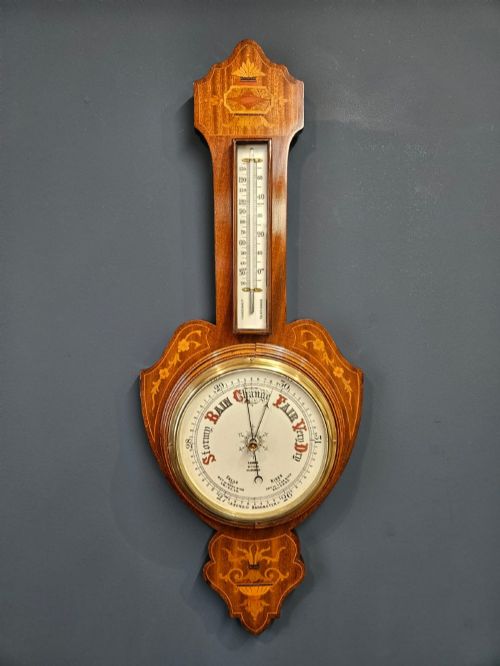
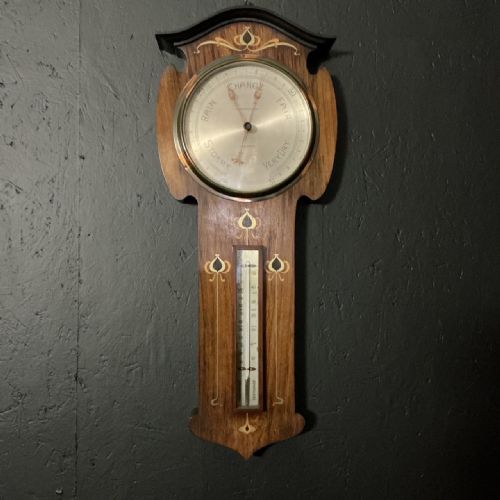
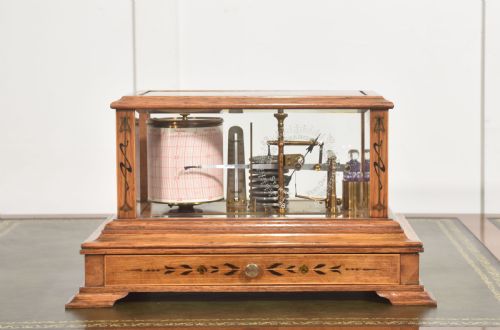
When you search for an antique inlaid weather instrument, you encounter barometers, barographs and stick barometers spanning the Georgian, Regency and Victorian periods. Banjo and wheel forms dominate the selection, housed in wood cabinets with contrasting stringing or shell motifs.
Makers from London, Liverpool, York and Nottingham signed dials across the eighteenth and nineteenth centuries. These scientific tools doubled as elegant parlour furniture to record atmospheric shifts in domestic halls and libraries.
How they were made
Craftsmen built bodies from dense timbers like mahogany and rosewood, housing sensitive mercury columns or aneroid mechanisms behind bevelled glass. Cabinetmakers embedded boxwood, ebony and mother-of-pearl inlay directly into the wooden faces to create floral scrolls and geometric lines.
Engraved silvered metal dials recorded barometric pressure alongside hygrometers and Fahrenheit thermometers. Brass bezels and indicators framed the instrumentation while protecting the delicate linkages inside.
Listings feature mahogany and rosewood timbers complemented by boxwood inlay, mother-of-pearl and brass fittings across Georgian, Victorian and Regency periods.
What varies in quality
The sophistication of the marquetry and the crispness of the dial engraving distinguish standard examples from masterworks. Richly figured grain veneers combined with intricate shell patera reflect superior workshop output.
The integrity of the original wooden case and the legibility of the signed silvered scale determine the piece's standing. Intact mercury tubes and original brass finials preserve the mechanical and aesthetic unity of the instrument.
Ganthony of London·Prada of High Wycombe·Molton of Norwich·Luisetti of London·Fagioli of Clerkenwell London·L Casatelli of Liverpool·J Groce, York·Charles Aiano, London·Pozzoby London·Pinchetti & Co, London·F Salteri & Co, Nottingham·Dominic Gatty·Schiavi of Chesham·Vecchio & Co of Shaftsbury
The Antique Inlaid Weather Instrument Glossary
- Aneroid barometer
- An instrument measuring atmospheric pressure through the expansion and contraction of a sealed metal capsule, without using liquid mercury.
- Banjo barometer
- A domestic weather glass shaped with a circular dial head above an elongated trunk, also known as a wheel barometer.
- Stick barometer
- A tall, narrow instrument housing a vertical mercury tube exposed against a long scale plate, offering precise pressure readings.
- Marquetry
- Decorative patterns formed by fitting contrasting veneers into a wooden surface to create pictorial or geometric designs.
- Silvered metal
- Brass or copper treated to achieve a bright, brushed silver finish upon which dial scales and maker inscriptions are engraved.
Antique Inlaid Weather Instrument: Frequently Asked Questions
How do I read a mercury barometer?
Observe the height of the mercury column inside the sealed glass tube against the engraved scale plate. Rising levels indicate improving weather conditions, while falling mercury signals approaching storms.
Many wheel barometers include a secondary pointer set by hand to track movement over twenty-four hours.
Where should I hang a banjo barometer?
Position the instrument on an interior wall away from direct sunlight, radiators and heavy draughts. Stable room temperatures protect both the wooden veneer and the internal mechanism from undue stress.
Secure the chassis firmly to wall studs using appropriate fixings to ensure the plumb alignment required for accurate pressure measurement.
How do I date a barometer?
Examine the style of the cabinet woodwork, the shape of the pediment and the typography inscribed upon the silvered dial. Georgian instruments often feature swan-neck pediments and simple boxwood stringing, whereas Victorian and Edwardian examples incorporate heavier mouldings or Arts and Crafts metalwork.
Makers' signatures combined with recorded working dates offer the most reliable chronological markers.
What is the difference between a barograph and a barometer?
A standard barometer displays real-time atmospheric pressure using a pointer fixed to a circular or vertical scale. It shows current conditions at the exact moment of observation.
A barograph records pressure continuously onto a paper chart wrapped around a rotating clockwork drum, creating a historical graph of weather patterns over a week.