



Antique Hock Glasses
Antique hock glasses are tall, coloured or clear drinking vessels for white wine, offering collectors rich hues and decorative craftsmanship from the nineteenth and twentieth centuries.
Antique Hock Glasses
When you search for antique hock glasses, you enter a domain of tall stemmed vessels designed specifically for hock, the traditional British term for German Rhine wine. The pieces appearing here span from the mid nineteenth century through the Victorian and Edwardian eras into the Art Deco and Art Nouveau periods of the twentieth century.
The green glass tradition dominates the selection, appearing in deep shades such as Bristol green alongside paler tones and overlay crystal forms. Alongside single items, you will frequently find matched pairs and larger sets numbering up to eight pieces, often accompanied by related glassware like decanters.
Originating from British, French, and Bohemian workshops, these vessels display distinct regional characteristics in their silhouette and ornament. Makers such as Baccarat, St Louis Massenet, Theresienthal, and Josephinenhutte represent the higher end of manufacture found within this category.
How they were made
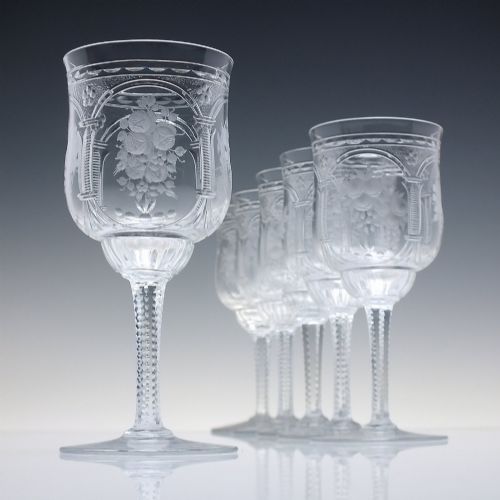
The primary material across these listings is lead glass or crystal, manipulated while molten to form the characteristic tall stem and generous bowl. Craftsmen utilised colour overlay techniques, fusing layers of coloured glass over clear crystal to allow intricate wheel cutting down to the base layer.
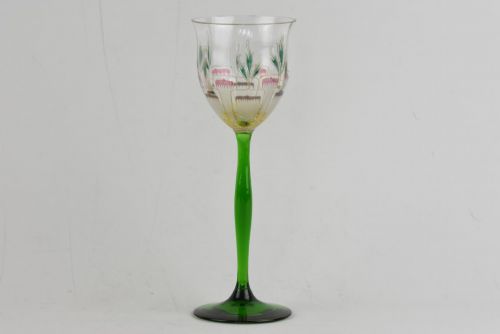
Decoration relied heavily on enamel work and gold leaf application, frequently depicting floral or foliate motifs fired onto the glass surface. Engraving also played a prominent role, with artisans cutting detailed patterns directly into the amber or clear crystal bowls of Bohemian roemers and wine glasses.
Materials documented across the inventory include standard glass, lead crystal, cut crystal, overlay glass, enamel, and gold leaf.
What varies in quality
The distinction between ordinary production and superior work rests on the crispness of the wheel cutting and the precision of the enamel and gold leaf detailing. Hand-painted floral designs on pieces from factories like Theresienthal demonstrate varying degrees of artist skill, where finer brushwork and richer enamelling elevate the piece.
The depth and uniformity of the coloured overlay also dictate the standing of a vessel, alongside the resonance and clarity of the lead crystal itself. Matched sets maintaining consistent colour saturation and identical stem dimensions across multiple pieces command greater appreciation than assembled groups.
Baccarat·Theresienthal·St Louis Massenet·Josephinenhutte
The Antique Hock Glasses Glossary
- Hock glass
- A tall stemmed wine glass traditionally used for German Rhine wines. These vessels often feature coloured bowls to showcase white wine.
- Roemer
- A traditional Germanic drinking vessel with a wide bowl resting on a large, studded stem known as a prunt stem. They appear frequently in green and amber glass from Bohemian makers.
- Overlay glass
- A glass-making technique involving two or more distinct layers of glass fused together, usually a coloured layer over clear crystal. This allows craftsmen to cut away the outer layer to reveal contrasting colours beneath.
- Prunt
- A small applied blob of glass used on the stem of a roemer to provide a secure grip. They reflect light and add tactile texture to the vessel.
- Enamel decoration
- Opaque glass paints fired onto the surface of a vessel to create colourful patterns. This technique was widely utilised by continental European glasshouses.
Antique Hock Glasses: Frequently Asked Questions
What are antique hock glasses used for?
These vessels were designed specifically for serving hock, a historical British term for sweet or dry German white wines from the Rhine region. The tall stem kept the drinker's hand away from the bowl, maintaining the cooler temperature required for the wine.
Today, collectors utilise them for formal dining or display them in cabinets to appreciate their colour and decorative glasswork.
Why are so many antique hock glasses green?
Green glass tradition stems from early European production methods where impurities in the sand and ingredients naturally created a green tint. Makers in regions like Bristol and Bohemia embraced this hue, developing specific shades that became traditional for hock wine service.
Over time, glasshouses refined the colour into intentional tones such as deep forest green and pale absinthe hues.
How do I identify Bohemian hock glasses?
Bohemian pieces often manifest as heavy roemers or cut crystal vessels featuring amber or green hues. They frequently display detailed wheel engraving or elaborate floral enamel work characteristic of late nineteenth and early twentieth-century Central European manufacture.
Checking the weight, cut precision, and typical decorative motifs helps distinguish them from British or French equivalents.
Can I use antique hock glasses for dining?
Many collectors use their vintage stemware for special occasions, provided they wash them carefully by hand. Lead crystal and enamelled surfaces require gentle handling to preserve the gold leaf and delicate glass walls.
Sudden temperature changes should be avoided to prevent thermal shock to the old glass.