


Antique Herati Rug
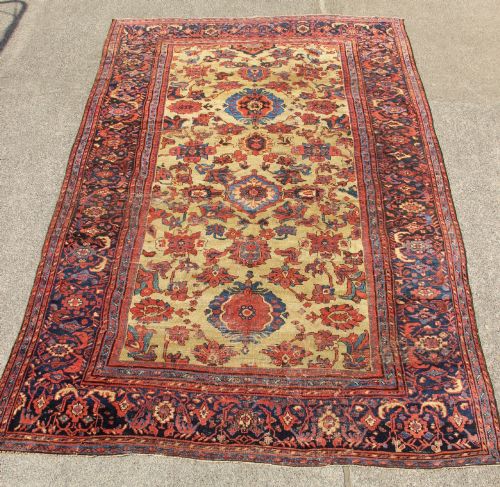
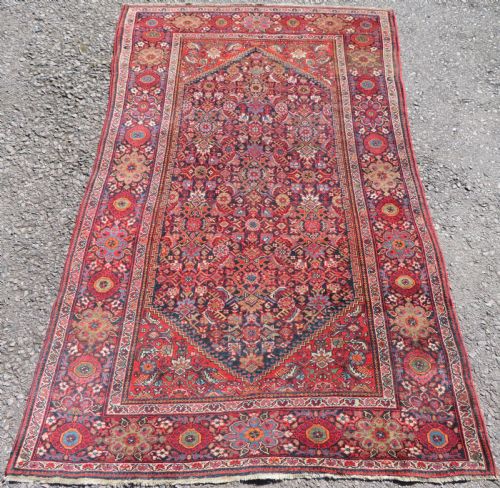
An antique herati rug brings the rhythmic, fish-and-blossom lattice of traditional Persian weaving directly onto your floor.
Antique Herati Rug
An antique herati rug is defined by the repetitive, diamond-shaped lattice motif enclosing a floral head flanked by two curved leaves, often called the fish pattern. These textiles emerge from nineteenth and early twentieth-century Persian weaving traditions, spanning village workshops and tribal groups.
The pieces available on this page encompass various formats, from intimate scatter rugs and runners to large gallery carpets and room-sized floor coverings. Village and tribal areas such as Feraghan, Malayer, Senneh, Bidjar, and Qashqai form the primary geographical origins represented in the collection.
Makers ranged from nomadic weavers working on portable looms to settled village cooperatives producing durable carpets for domestic use and export. Dating spans the nineteenth century through the early decades of the twentieth century, capturing a period of vibrant natural and early synthetic dye use.
How they were made
The construction of these floor coverings relies primarily on wool piles knotted onto cotton or wool foundations. Weavers utilised hand-spun sheep's wool, which absorbs natural dyes unevenly to create subtle tonal variations known as abrage.
Knot density and structural tightness vary according to regional technique, with village carpets like those from Bidjar employing heavy, rigid packing for durability. Finer town pieces, such as Senneh and Feraghan examples, feature delicate, precise knotting that allows for intricate rendering of the herati motif.
Listings feature village and tribal carpets from nineteenth-century Persia, executed primarily in wool and cotton with the characteristic herati lattice.
What varies in quality
Quality in these textiles rests upon the handle, the handling of the wool, and the clarity of the drawing. Superior examples exhibit soft, lustrous wool that retains its pile evenly across the field, paired with crisp delineation of the geometric lattice.
Dye saturation and palette harmony distinguish finer weaving from standard production. Pieces possessing luminous, saturated hues and well-balanced proportions command greater appreciation among collectors than those with dull or muddy coloration.
The Antique Herati Rug Glossary
- Herati pattern
- A repeating ornamental design composed of a central rosette enclosed by a diamond lattice and flanked by curved leaves. It is sometimes referred to by weavers as the fish motif.
- Kelleh
- A long, narrow format of Persian carpet traditionally designed to fit the narrow space along the side or foot of a larger room.
- Abrash
- Variations in colour shading across the field of a rug caused by changes in dye batches or distinct lots of hand-spun wool.
- Pushti
- A small-format tribal mat or scatter rug, often used as a cushion or small floor covering.
- Kilim
- A flat-woven carpet produced without a pile, relying on interlocking warp and weft threads to create geometric patterns.
Antique Herati Rug: Frequently Asked Questions
How do I care for an antique rug?
Vacuum gently without using a beater bar to protect the old wool foundation and delicate knotting. Keep the textile out of direct, intense sunlight to prevent the natural dyes from fading over time.
Professional cleaning should be undertaken sparingly by specialists experienced in handling antique Persian textiles. Avoid harsh chemical spot treatments that can strip the natural oils from the wool.
Where were these rugs made?
These textiles originate predominantly from various regions across Persia, including village workshops in Malayer and Feraghan. Tribal groups such as the Qashqai and Kurdish weavers in Bidjar also produced distinct versions of the design.
Different towns and tribes contributed unique structural traits, such as the heavy packing of Kurdish carpets or the fine, lightweight weave of Senneh pieces.
What is the herati motif?
The motif consists of a stylized floral rosette framed by a lozenge lattice, accompanied by two curved lancet leaves that resemble fish. This enduring pattern represents garden imagery translated into geometric shorthand by Persian weavers.
It appears across numerous regional styles, sometimes covering the entire field in an all-over repeat or anchored within a central medallion.
How old are these carpets?
The pieces listed generally date from the nineteenth century up to the early decades of the twentieth century. Dating is determined by structural characteristics, wool quality, and the chemistry of the dyes used in the pile.
Nineteenth-century examples frequently display greater depth of colour and softer wool texture resulting from traditional natural dyeing methods.