



Antique Gold Scales
These antique gold scales are precision instruments of brass and steel designed for weighing precious metal, offering both practical utility and historical charm.
Antique Gold Scales
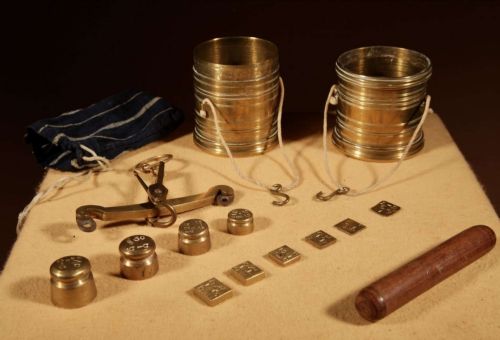
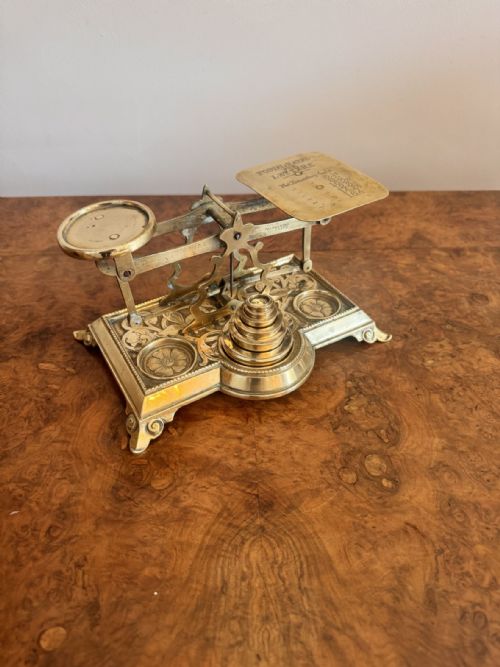
When you search for antique gold scales, you encounter precision measuring devices spanning the Georgian, Victorian, and Edwardian periods. These pieces include folding pocket balances and countertop beam scales intended for weighing sovereigns, bullion, and precious metal dust.
The selection on this page captures utilitarian workshop tools alongside refined domestic instruments. Most examples utilise brass beams and pans, often accompanied by their original sets of graduated weights in fitted wooden boxes.
Originating from makers across Britain and Europe, these survival pieces reflect the rigorous commerce of past centuries. They demonstrate the mechanical ingenuity required before the advent of digital measurement.
Judging quality in measuring instruments
Quality rests upon the precision of the mechanics and the integrity of the original components. A superior balance maintains absolute equilibrium, possessing sensitive knife-edge pivots that respond to the smallest fraction of weight without friction or drag.
Completeness dictates value among surviving examples. The presence of a matching set of fractional weights, housed within an undamaged maker-stamped box, elevates an instrument from a simple decorative object to a significant historical survival.
Some folding gold balances were small enough to fit inside a waistcoat pocket, ready for instant transactions in a bustling market square.
Stephen Houghton And Son·Bartlett And Sons·C Stevens
The Antique Gold Scales Glossary
- Balance scale
- A traditional weighing instrument operating on the principle of equal arms, suspending two pans from a central fulcrum. This configuration allows the user to compare an unknown mass against known standard weights.
- Beam
- The horizontal lever of a scale that pivots on a central fulcrum to determine equilibrium. Its balance and straightness dictate the accuracy of the entire instrument.
- Pivots
- The hardened steel edges or points upon which the beam oscillates. Maintaining minimal friction at these points is essential for high-precision weighing.
- Troy ounce
- A traditional unit of mass used for precious metals, inherited from the system of troy weights. Sets of these specific weights frequently accompany period bullion scales.
- Fulcrum
- The central supporting point about which the balance beam turns. Fine instruments utilise agate or hardened steel bearings at this junction to prevent wear.
Antique Gold Scales: Frequently Asked Questions
How do I use antique gold scales?
Most antique balances operate by placing the gold on one pan and adding verified standard weights to the opposite side until the pointer rests at dead centre. Care must be taken to handle the instrument on a level surface away from drafts.
Because these devices rely on sensitive knife-edge pivots, they should be lowered gently onto their rests when not in active use to prevent unnecessary wear on the steel bearings.
Are these scales still accurate today?
While many surviving beam scales retain a high degree of mechanical precision, they are primarily collected as historical artefacts rather than certified commercial instruments. Over the decades, microscopic wear on the pivots or loss of original mass in the weights can introduce minor discrepancies.
Collectors test them using modern reference masses purely out of curiosity, valuing the instrument more for its craftsmanship and surviving documentation than for daily metallurgical work.
How should I clean brass scales?
Dust accumulation and minor tarnish are best managed with a soft, dry microfibre cloth to preserve the historic patina developed over generations. Avoid aggressive metal polishes that can strip away original surface characteristics and erase faint maker stamps.
Wooden storage cases benefit from occasional applications of neutral microcrystalline wax to nourish the grain without leaving a sticky residue that attracts further particulate matter.
How do I date a set of scales?
Dating relies heavily upon the stylistic details of the supporting pillar, the typography engraved on the maker's label, and the shape of the accompanying weight box. Georgian and Regency examples often feature neoclassical columns, whereas late Victorian versions display heavier, industrial framing.
Patent dates stamped directly onto the brass beam or inside the lid provide a reliable terminus post quem, confirming the earliest possible year the instrument could have left the workshop.