
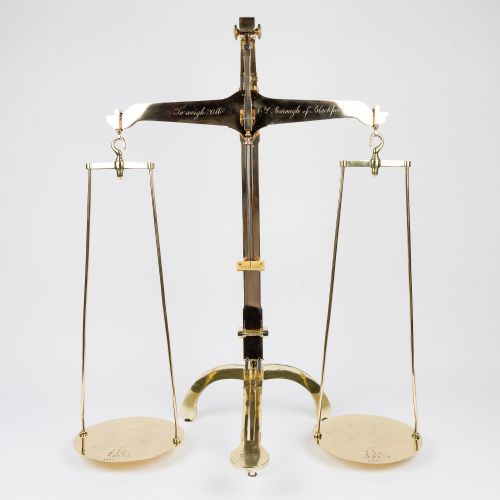
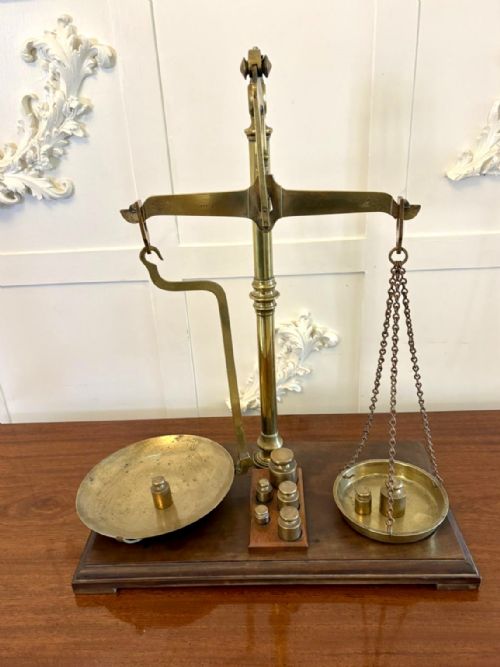
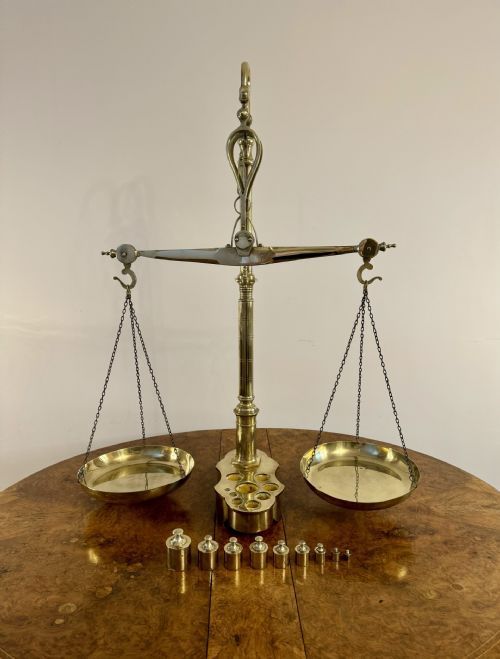


Victorian Brass Beam Balance
These Victorian brass beam balance scales bring functional nineteenth-century engineering into the modern home.
Victorian Brass Beam Balance
A victorian brass beam balance brings precision weighing instruments into domestic or commercial interiors. Buyers searching for these items encounter various forms, including apothecary sets, letter scales, and large verification balances.
Most examples on this page date from the Victorian period through to the early twentieth century, spanning decades of functional design. Forms range from compact desktop postal scales to substantial floor or counter models housed in wooden bases.
The materials reflect practical utility, combining gleaming metal components with sturdy timber mountings. Many pieces retain their original weights, completing the apparatus as it was used in shops, surgeries, and offices.
Materials and construction
These instruments utilise polished brass for the central beam, pans, and indicator components, providing both corrosion resistance and a bright appearance. The metal is cast and turned to achieve balanced proportions necessary for accurate measurement.
Listings feature brass, mahogany, oak, iron, and steel across pieces spanning the Victorian era into the twentieth century.
Assessing quality and finish
Superior examples demonstrate meticulous calibration and smooth mechanical movement across the central fulcrum. The crispness of maker engravings and the integrity of the fitted wooden cabinetry distinguish high-grade scientific instruments from standard utility pieces.
The presence of matching original brass weights elevates an instrument's completeness and historical interest. Finishes that retain their original warm patina without excessive modern intervention indicate careful preservation over generations.
Day and Millward·Parnall and Sons of Bristol·De Grave Short and Company·Bartlett and Sons
The Victorian Brass Beam Balance Glossary
- Beam
- The horizontal bar of a balance scale that pivots on a central fulcrum to weigh objects placed in suspended pans. Its precise balance determines the accuracy of the reading.
- Fulcrum
- The pivot point situated at the centre of the beam upon which the entire weighing mechanism balances. It requires minimal friction to allow free movement.
- Verification balance
- A heavy-duty scale utilised by inspectors to check weights and measures for accuracy within municipal boroughs. These pieces often feature official stamps or inscriptions.
- Apothecary balance
- A sensitive instrument designed for weighing medicinal ingredients in small quantities. They frequently sit within fitted mahogany boxes with glass panels.
Victorian Brass Beam Balance: Frequently Asked Questions
What were these scales used for?
These instruments served various precision weighing tasks in Victorian commerce, medicine, and administration. They measured everything from medicinal doses in apothecary shops to letters in postal rooms and official standards for city boroughs.
Their accurate mechanisms made them essential tools before the advent of digital weighing technology. Today, they function primarily as decorative display pieces that honour historical trade and science.
How do I date a brass beam balance?
Dating relies on stylistic clues in the wooden base, the shape of the brass components, and any stamped maker marks or verification inscriptions. Victorian examples often feature rich mahogany woodwork and engraved maker details characteristic of nineteenth-century workshop production.
Later pieces extending into the Edwardian era and the twentieth century may show subtle shifts in fastener types and lettering styles. Comparing the piece with documented manufacturer dates provides the most reliable timeline.
How do I clean antique brass?
Antique brass requires gentle dusting with a soft cloth to preserve the historical patina accumulated over decades. Aggressive chemical polishing strips away the aged surface character that collectors value.
If cleaning is necessary, a mild soapy solution dried immediately prevents moisture damage to both the metal and the surrounding timber base.
Where should I display a beam balance?
These scales suit placement on sturdy wooden desks, bookshelves, or dedicated display tables where their balanced proportions can be appreciated. Because many models feature delicate pans and suspended beams, a stable surface away from heavy household traffic is ideal.
Keeping the instrument out of direct sunlight protects the polished wood finishes and prevents uneven tarnishing of the brass components.