
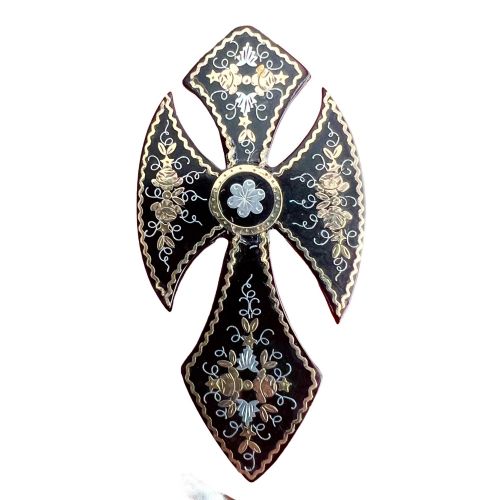


Antique Gold Crucifix
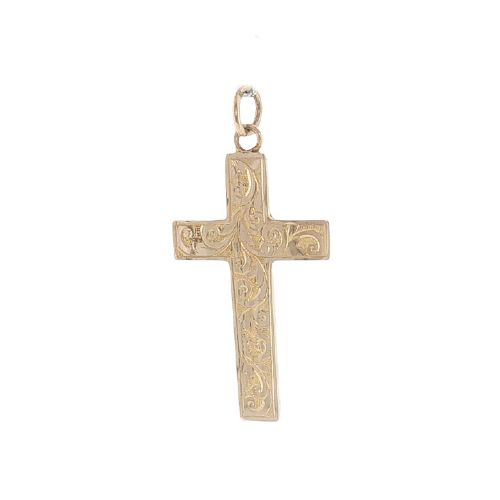
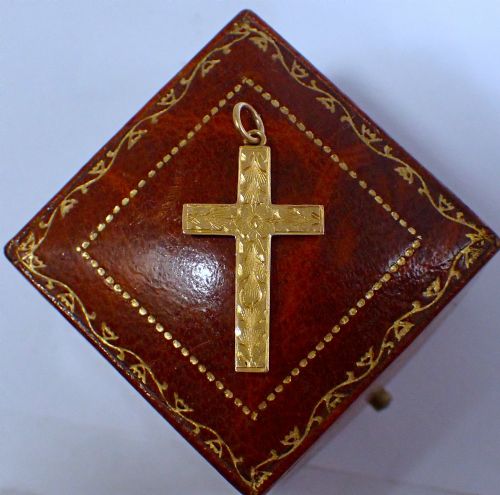
An antique gold crucifix carries centuries of devotion, appearing here in Victorian and Edwardian gold alongside Georgian coral and seed pearl iterations.
Antique Gold Crucifix
Beyond standard gold iterations, designs incorporate silver, brass, and pious Spanish devotional pieces alongside convertibles that function as both brooches and pendants. Forms range from large pique work to slender yellow gold framing, encompassing gemstones such as turquoise, seed pearls, diamonds, sapphires, and coral.
How they were made
Maker workshops utilised solid yellow gold, silver, and brass as structural bases, frequently mounting precious stones directly onto the metal surface using flush or claw settings. Engraving tools carved linear geometric patterns into the gold, while specialised techniques secured delicate seed pearls, turquoise cabochons, and table-cut diamonds.
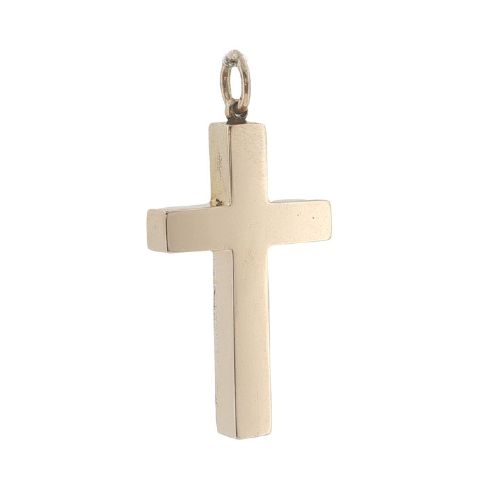
Construction methods involved soldering pendant loops, hinge pins, and safety catches to the reverse of the cross, allowing versatile wear as either a necklace attachment or a breast ornament.
Current listings demonstrate a prevalence of nine-carat and fifteen-carat yellow gold, complemented by silver, brass, seed pearl, turquoise, and diamond materials.
What varies in quality
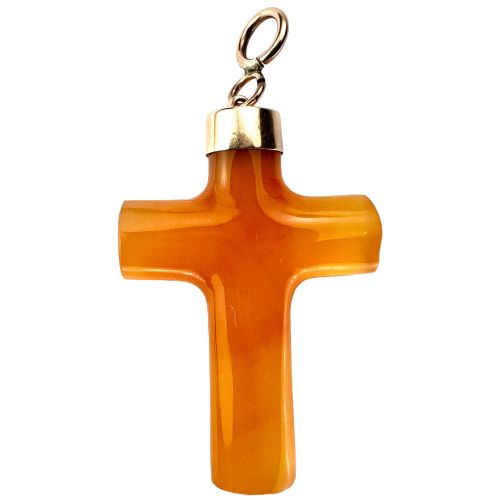
Quality separates through the purity of the metal alloy, ranging from nine-carat up to twenty-four-carat yellow gold, and the presence of documented hallmarks identifying specific assay offices like Birmingham. Superior examples demonstrate exceptional hand-carving in materials such as agate, onyx, or chalcedony, paired with securely flush-set gemstones.
Omar Ramsden & Alwyn Carr
The Antique Gold Crucifix Glossary
- Pique
- A method of embedding contrasting materials, such as gold and silver, into a dark organic base like tortoise-shell or horn. It creates geometric or floral patterns across the surface of the cross.
- Cabochon
- A gemstone shaped and polished with a smooth, convex domed surface rather than faceted edges. Turquoise and garnets are frequently cut this way in nineteenth-century devotional jewellery.
- Seed pearl
- A very small, naturally formed saltwater pearl used in dense pavé settings or floral clusters. They decorate the central intersections of many Victorian mourning and devotional crosses.
- Assay office
- An official organisation that tests the purity of precious metals and stamps them with designated hallmarks. Birmingham marks frequently appear on early twentieth-century gold pieces.
- Devotional piece
- An object created specifically for religious observance or prayer rather than purely decorative adornment. Spanish examples often reflect regional Catholic traditions from the nineteenth century.
Antique Gold Crucifix: Frequently Asked Questions
How do I wear a crucifix pendant?
These pieces generally feature integrated top loops or rings designed to accommodate a fine chain or ribbon for suspension around the neck.
Several variants also incorporate pin stems on the reverse, allowing them to function interchangeably as dress brooches.
What gold purity should I expect?
Listings feature items struck in nine-carat, fifteen-carat, and eighteen-carat yellow gold, alongside high-purity twenty-four-carat variants and silver-fronted designs.
British pieces often bear hallmarks denoting the specific carat weight and town of assay.
How do I date an antique crucifix?
Dating relies upon official assay stamps, maker marks, and stylistic indicators associated with the Georgian, Victorian, and Edwardian periods.
Specific material combinations, such as seed pearls paired with black onyx or turquoise, also point toward distinct late nineteenth-century aesthetics.
Were these always worn as jewellery?
While many examples were produced as personal ornaments for daily wear, others originated as private devotional objects or larger Spanish religious items.
Their conversion into wearable pendants and brooches often occurred decades after initial manufacture.