

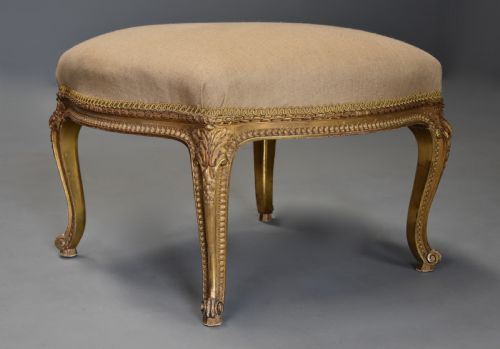


Antique Giltwood Ottoman
An antique giltwood ottoman brings layered French and Italian revival luxury to a room, offering both practical seating and sculptural presence.
Antique Giltwood Ottoman
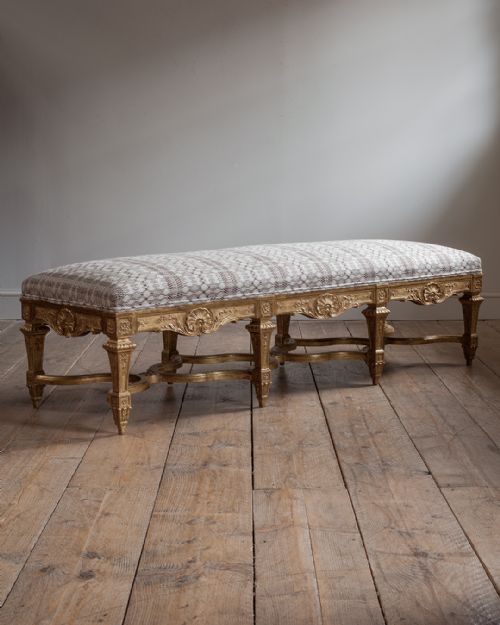
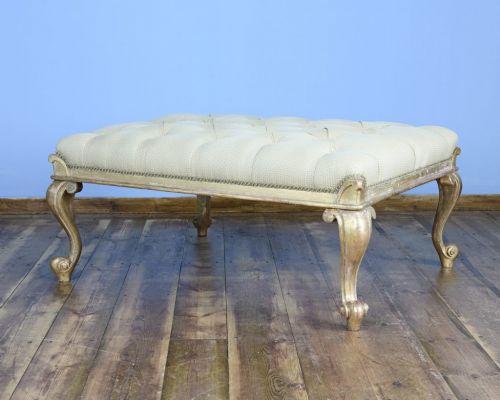
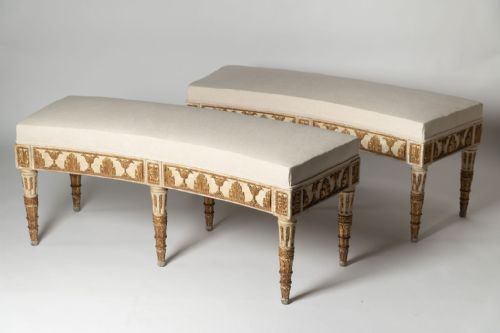
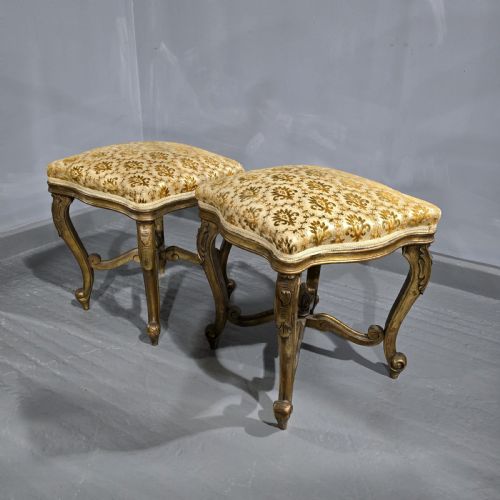
When you search for an antique giltwood ottoman, you are looking at carved wooden seating frames finished in gold leaf or gesso, upholstered in textiles such as velvet, linen, or red silk. The pieces appearing here span forms from small footstools and window seats to grand scale centre stools, X-frame curules, and multi-piece duchesse brisee sets.
The selections you meet most often date from the nineteenth century, including Georgian and Victorian eras, alongside revivals of Louis XIV, Louis XV, and Louis XVI styles. French Neoclassical, Italian Neoclassical, and Baroque influences dominate the aesthetic, presenting carved timber frames built as benches, stools, and footstools.
These items function as versatile interior accents, moving easily between dressing rooms, drawing rooms, and studies. They appear as singular statements, matched pairs, or components of larger seating arrangements alongside armchairs.
How they were made
Makers shaped these frames from timber, applying gesso to smooth the surface before laying down gold leaf or gilding. Carvers worked wood by hand to produce the scrollwork, fluting, and organic motifs seen on French and Italian revival pieces.
Upholstery completed the construction, securing textiles like velvet, linen, and silk over padding. Techniques ranged from deep buttoning on red silk to plain linen covers on X-frame curule bases and parcel gilt footstools.
Listings feature eighteenth and nineteenth-century periods, spanning Georgian, Victorian, and revival eras.
What varies in quality
The depth and crispness of the wood carving separate standard production from finer workshop output. Sharp relief work on acanthus leaves, cabriole legs, and moulded frames shows the hand of a skilled artisan.
The integrity of the original gilt surface and gesso foundation dictates the visual weight of the piece. Traces of original parcel gilding and the weight of the timber frame indicate the standard of construction.
LOIDRAULT FRERES PARIS·Miles & Edwards·A.M.E. Fournier
The Antique Giltwood Ottoman Glossary
- Giltwood
- Timber coated with gold leaf or a gold-coloured metallic finish. This surface treatment defines the bright, reflective appearance characteristic of these decorative seats.
- Gesso
- A plaster-like mixture applied to wood frames to create a smooth surface for gilding. It holds fine detail for carved ornamentation.
- Parcel gilt
- Woodwork where only specific carved details are highlighted in gold leaf while the rest of the surface remains exposed or painted. This technique creates contrast on nineteenth-century frames.
- Duchesse brisee
- A multi-part chaise longue or daybed split into a chair and one or more footstools. These composite pieces allow the user to extend their legs or separate the sections for seating.
Antique Giltwood Ottoman: Frequently Asked Questions
How do I use an antique giltwood ottoman?
These pieces serve as footstools before armchairs, standalone window seats, or centre stools in drawing rooms.
Their decorative gilt frames allow them to function as sculptural accents while providing functional low seating.
What is the difference between a stool and an ottoman?
Stools in this collection generally feature rigid wooden frames with fixed upholstered tops, ranging from curule X-frames to four-legged carved benches.
Ottoman forms often incorporate larger proportions or multi-part configurations designed for resting the feet or lounging.
How do I identify French revival styles?
Louis XIV, XV, and XVI revival pieces display distinct decorative vocabularies, from heavy Baroque curves to restrained Neoclassical fluting and giltwood frames.
Look at the carved details on the wooden legs and rails to match the specific French period influence.
What fabrics are used on these pieces?
Upholstery materials recorded on these frames include velvet, linen, silk, and general textile coverings.
Many pieces retain deep buttoning or period fabric choices that complement the gilded wood surrounds.