

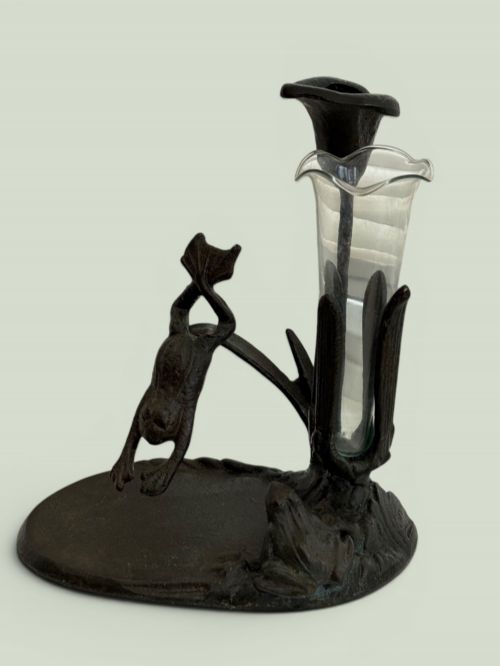


Antique Frog Ornament
These antique frog ornament pieces bring character and distinct sculptural form to a room.
Antique Frog Ornament
An antique frog ornament encompasses small desk items, sculptural figures, and vessel mounts shaped as amphibians. When you browse this selection, you encounter items designed for decorative display, paperweights, or functional items like flower holders.
The objects stem from various periods, notably the nineteenth century, the Edwardian era, and the early decades of the twentieth century. Common physical manifestations range from naturalistic bronze studies to stylized Art Nouveau and Art Deco interpretations.
Makers and workshops from Europe and East Asia produced these pieces in materials suited to both miniature carving and larger metal casting. You find everything from carved boxwood netsuke to heavy patinated bronze statues.
Materials and construction methods
Makers utilised metal casting methods such as the lost-wax technique to shape bronze into detailed animalier sculptures and vases. Artisans then applied surface finishes, including cold-painted pigments and chemical patinas, to create colour and depth.
Carvers worked with dense organic materials like boxwood to produce miniature netsuke and paperweights with intricate surface textures. Porcelain and enamel glazes also appear, shaped into functional posy holders and decorative vessels.
Antique Frog Ornament Retail Price Guide 2026
Typical asking prices for frog ornament among the pieces listed under this phrase on Sellingantiques today, from the lower quarter to the upper quarter. They describe what is for sale here now, not the wider market.
Distinctions in quality
Quality rests upon the precision of the carving or the crispness of the metal casting, where finer details in the skin texture and anatomy separate superior work from simpler productions. The subtlety of the applied patina or cold-painted colours significantly influences the visual appeal of metal pieces.
Heavier materials like solid bronze or substantial boxwood demonstrate greater material substance, while works attributed to known artists or specific Parisian and Asian workshops command higher regard among collectors.
Krister KPM Waldenburg·Jean Dunand·C Neuhaus
The Antique Frog Ornament Glossary
- Animalier
- A nineteenth-century artistic movement focused on the realistic portrayal of animals. Sculptors in this tradition captured creatures in natural poses with careful anatomical attention.
- Cold painted
- A method where enamel paint is applied to unheated bronze metal. This technique was widely utilised by Austrian workshops to add vibrant colour to small figures.
- Netsuke
- A small carved toggle traditionally fastened to the end of a cord on a kimono sash. Japanese carvers shaped boxwood and other materials into miniature animal forms.
- Patina
- A surface sheen or colour change developed on bronze through age or chemical treatment. Artists often enhanced this finish deliberately during the manufacturing process.
- Posy Holder
- A small vessel designed to support short-stemmed flowers and floral arrangements. These items often incorporate figurative mounts or sculptural elements into the rim.
Antique Frog Ornament: Frequently Asked Questions
What materials are used?
The pieces utilise bronze, boxwood, porcelain, glass, and marble. Metal works often feature patinated surfaces or cold-painted enamel details.
Organic pieces rely on close wood carving to achieve realistic textures and forms.
How were they used?
Many served as decorative desk accessories, paperweights, or small statues for interior display. Others doubled as functional vessels like flower holders and posy vases.
Miniature wood carvings functioned as traditional toggles or handheld ornaments.
Which periods do they date from?
The selection spans the nineteenth century through the early twentieth century. Examples include Victorian, Edwardian, Art Nouveau, and Art Deco eras.
Asian pieces also reflect traditional Meiji and Qing dynasty production.
How do styles differ?
European pieces range from naturalistic French animalier bronzes to stylized Art Nouveau and geometric Art Deco designs. Austrian items frequently showcase bright cold-painted finishes.
Japanese and Chinese works emphasise traditional carving techniques and symbolic money toad motifs.