



Antique Footed Centre Bowl
These antique footed centre bowls bring weight and presence to a table, offering deep vessels of cut glass, brass and pottery raised on pedestals and feet.
Antique Footed Centre Bowl
When you search for an antique footed centre bowl, you encounter a diverse gathering of raised vessels designed to hold fruit, flowers or simply to anchor a formal table setting. The examples appearing on this page span the Georgian era through to the 1930s, embracing periods such as the Victorian age, the Aesthetic Movement and the French Empire style.
The forms vary widely in function and profile, ranging from heavy lead crystal comports and tazzas to earthenware jardinieres, pottery bowls and brass planters mounted with alabaster and pietra dura. Makers represented include Ridgway and Mason's alongside continental porcelain styles like Sevres, while Waterford and heavy hobnail cut glass dominate the glasswork.
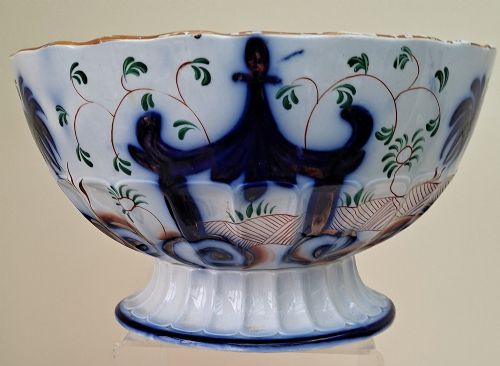
You are most likely to meet footed bowls from the nineteenth century, often decorated with cobalt glazes, gaudy Welsh patterns or repoussé work featuring animal heads. These pieces served both decorative and practical roles in period interiors, functioning as centrepieces that drew the eye toward the middle of a dining table or sideboard.
How they were made
Makers shaped these bowls from heavy lead crystal, earthenware, ironstone and brass, employing techniques such as wheel-cutting, etching, moulding and repoussé work. Glass vessels like the Waterford and hobnail pattern bowls relied on hot-forming followed by cold-working with cutting wheels to achieve deep facets and patterns.
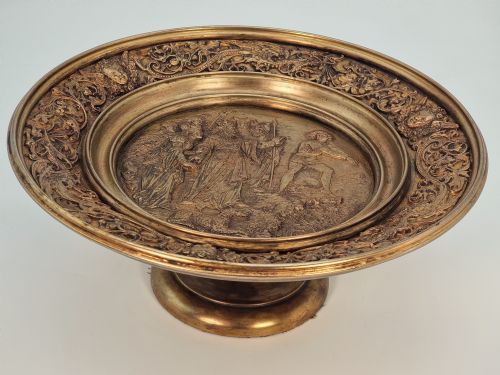
Metal and ceramic pieces integrated contrasting materials, such as brass frames mounted with alabaster and pietra dura stone plaques, or ironstone bodies transfer-printed in blue and white. Earthenware examples utilised cobalt glazes and enamel painting, while repoussé brass planters required hammering sheet metal from the reverse side to raise ornamental animal heads and relief designs.
Antique Footed Centre Bowl Retail Price Guide 2026
Typical asking prices for footed centre bowl among the pieces listed under this phrase on Sellingantiques today, from the lower quarter to the upper quarter. They describe what is for sale here now, not the wider market.
Some nineteenth-century brass planters feature fierce animal heads keeping watch over the ferns.
What varies in quality
Quality in these centre bowls rests upon the crispness of the cutting in glass, the clarity of the transfer print in ceramics, and the definition of the hand-chased or repoussé detail in metalwork. Superior glass vessels display sharp facets and a high lead content that refracts light cleanly, whereas lesser examples show softness in the moulded edges and bubbles trapped within the metal.
In composite pieces involving brass and stone, quality emerges in the precision of the mounting and the quality of the pietra dura inlay rather than the mere presence of decorative elements. Ceramic comports and bowls separate themselves by the vibrancy of the cobalt glazes and enamels, and whether the ironstone or earthenware body remains free from firing distortions.
Ridgway·Waterford
The Antique Footed Centre Bowl Glossary
- Comport
- A shallow bowl raised on a stem and foot, traditionally used for serving fruit or sweetmeats at the end of a meal.
- Tazza
- A shallow saucer-like dish mounted on a pedestal, frequently used interchangeably with a comport in nineteenth-century dining.
- Repoussé
- A metalworking technique where the artisan hammers the design from the reverse side to form raised relief patterns on the front.
- Pietra Dura
- An inlay technique using cut and fitted polished coloured stones to create pictorial designs on stone plaques.
- Jardiniere
- An ornamental pot or stand, typically ceramic or metal, designed to hold growing plants or floral arrangements.
Antique Footed Centre Bowl: Frequently Asked Questions
What is a footed centre bowl used for?
These elevated vessels traditionally occupied the middle of a dining table to hold displays of fruit, flowers or sweetmeats during formal meals.
Over time, their role shifted toward pure decorative display, serving as architectural accents on sideboards, mantelpieces and entrance tables.
How do I identify a Victorian comport?
Victorian comports often feature heavy moulded or cut glass, or transfer-printed pottery patterns like the gaudy Welsh style seen in nineteenth-century examples.
They frequently display eclectic design influences, ranging from Gothic revival motifs to Aesthetic Movement gilding.
What is the difference between a comport and a tazza?
A comport typically possesses a deeper bowl suitable for fruit, while a tazza presents a shallower, flatter dish designed more for display.
Both share the characteristic pedestal foot that lifts the vessel above the surface of the table.
How do I care for an antique brass planter?
Brass planters and repoussé bowls benefit from dusting with a soft, dry cloth to prevent the accumulation of grime in the recessed details.
Avoid harsh chemical metal polishes that strip away the natural historic patina accumulated over the nineteenth century.