


Antique Foliage Landscape Hanging
These antique foliage landscape hanging pieces bring historic verdure tapestries into modern interiors, offering rich forest scenes woven centuries ago.
Antique Foliage Landscape Hanging
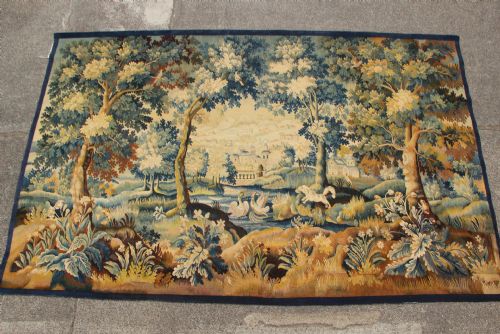
When you search for an antique foliage landscape hanging, you encounter large woven wall tapestries depicting lush woodland and garden scenes. These pieces originate from European centres such as Aubusson and Flanders during the seventeenth and eighteenth centuries.
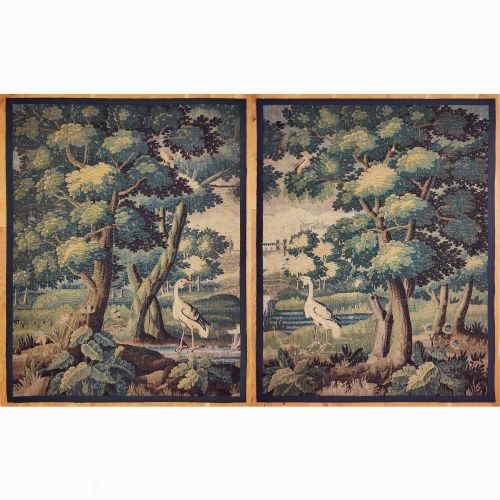
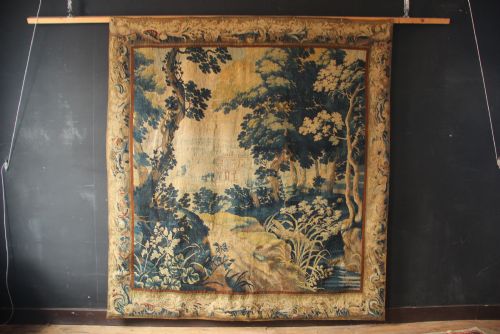
The versions you meet most frequently on this page are Flemish and Aubusson verdure panels, measuring in various dimensions from narrow friezes to large wall coverings. They feature dense foliage, trees, and often distant architectural elements or birds.
These textiles served historically to insulate stone walls and decorate grand rooms with simulated natural scenery. Today, collectors use them to introduce texture, history, and muted earthy tones into domestic spaces.
How they were made
These textiles are constructed using a combination of wool, silk, and linen yarns woven on low-warp or high-warp looms. Weavers utilised dyed wool for the heavy structural foliage and darker background shades, reserving finer silk for highlights.
The designs were worked from painted full-scale models known as cartoons, translated by skilled hands into complex pictorial weaves. Linen often forms the warp threads that provide the underlying grid and tension for the textile.
Listings feature wool, silk, and linen materials across pieces dated from the seventeenth century up to eighteen ninety.
What varies in quality
The distinction between standard and superior examples lies in the complexity of the botanical detail and the variety of the dye palette. Finer panels display nuanced gradations in the green and brown tones that create a distinct sense of depth within the forest canopy.
The material composition also shifts quality, as pieces incorporating higher proportions of silk retain a luminous quality in the highlights. The precision of the weave and the survival of the original borders further determine the standing of each textile.
The Antique Foliage Landscape Hanging Glossary
- Verdure tapestry
- A textile depicting a landscape dominated by trees, plants, foliage, and sometimes animals. These pieces rely on greens and earthy tones to create an immersive woodland scene.
- Aubusson
- A town in central France famous for its tapestry production. Pieces originating here often display lighter, more balanced floral and landscape compositions than their Flemish counterparts.
- Flemish Baroque
- A prominent artistic style originating in Flanders during the seventeenth century. Tapestries from this tradition emphasise dynamic movement, rich textures, and dramatic natural forms.
- Warp
- The strong vertical threads stretched lengthwise on a loom before weaving begins. These foundational threads are usually made of linen and remain entirely concealed by the coloured weft.
- Weft
- The horizontal threads passed back and forth through the warp to create the visible design. In these textiles, wool and silk weft yarns build up the detailed landscape imagery.
Antique Foliage Landscape Hanging: Frequently Asked Questions
How do I hang a heavy tapestry?
Large textile panels require even weight distribution across the top edge to prevent distortion or tearing along the weave. Conservation specialists typically sew a sturdy linen sleeve to the reverse and slide a flat wooden batten through it for wall mounting.
Alternatively, a row of concealed velcro or small loops can distribute the tension. Avoid hanging these textiles directly from nails or hooks that concentrate stress on a single point of the fabric.
What is a verdure tapestry?
A verdure tapestry is a specific type of wall hanging that focuses primarily on plants, trees, and landscape scenery rather than human figures or historical events. These scenes often feature stylized woodlands, distant castles, and occasional birds nestled among the leaves.
They gained immense popularity across Europe for bringing the outdoors inside large stone chambers. The palette relies heavily on greens, blues, and browns that have often mellowed gracefully over the centuries.
How do I tell Flemish from Aubusson work?
Flemish tapestries from the seventeenth century often display denser, darker canopies with heavier architectural or animal elements. The overall atmosphere tends to feel dramatic and deeply shadowed.
Aubusson panels generally present a lighter, more open composition with distinct French stylistic influences. The foliage in Aubusson works frequently incorporates softer pastel tones and more delicate floral details.