






Large Aubusson Wall Hanging
A large aubusson wall hanging brings centuries of French textile artistry into a room, offering grand pastoral scenes and verdure landscapes woven for stately interiors.
Large Aubusson Wall Hanging
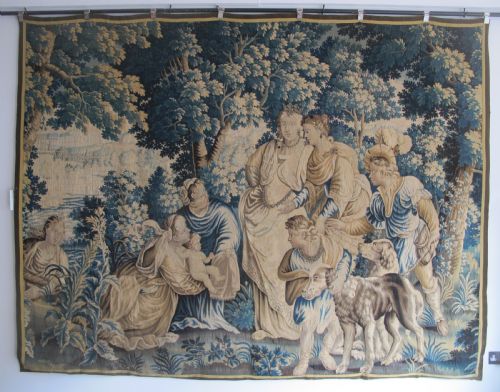
A large aubusson wall hanging represents a tradition of French weaving originating from the town of Aubusson, capturing subjects from verdure landscapes to pastoral and biblical scenes. Buyers encounter pieces spanning several centuries, from the late seventeenth century through the nineteenth century and into the early twentieth century.
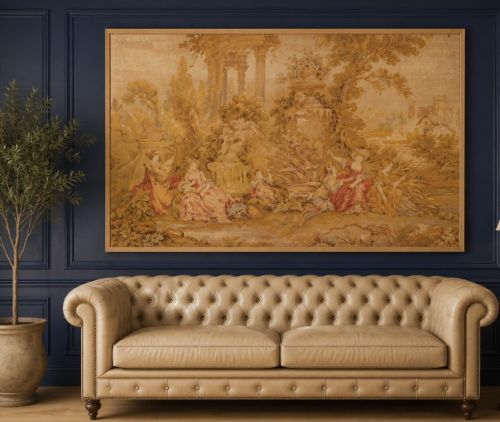
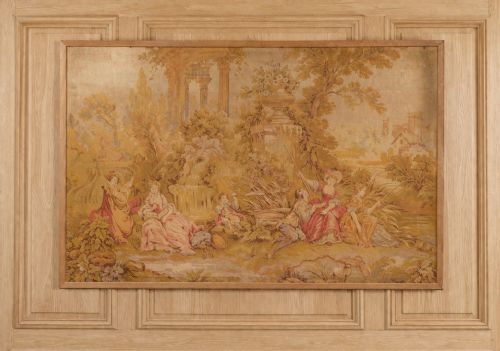
The forms vary between unframed wall tapestries intended for hanging and framed tapestry panels set within timber or walnut frames. Many examples display the characteristic French Rococo, Baroque, or pastoral aesthetic associated with historic chateaux.
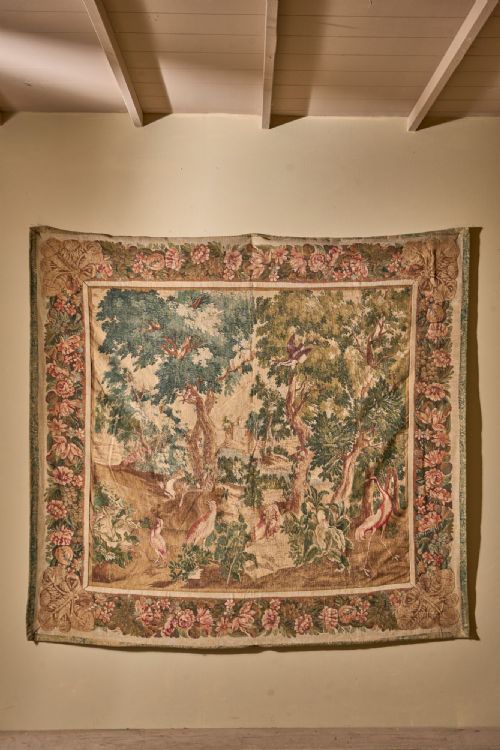
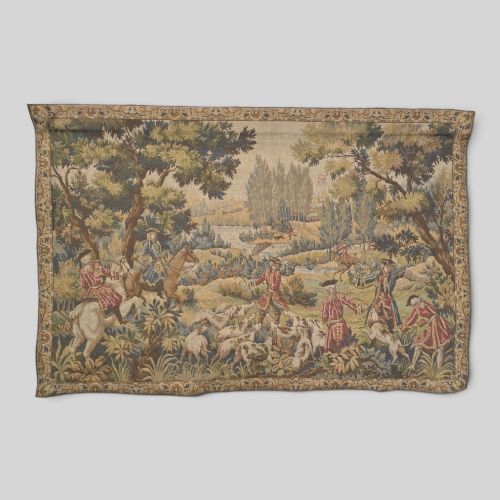
While some pieces carry the direct Aubusson attribution, others reflect the broader nineteenth century French style or regional French weaving traditions. The selection ranges from expansive verdure compositions featuring foliage and birds to figurative panels with pastoral figures.
Materials and construction methods
These textiles rely primarily on wool and silk yarns, often supported by linen or cotton warps to provide structural integrity for large wall hangings. Artisans wove the imagery by hand on high warp or low warp looms, building up the pictorial composition through meticulous colour blending.
Some antique examples are mounted within a timber frame or walnut frame, protecting the edges and allowing the textile to be hung securely on a wall. Brass hardware or backing materials appear in certain mountings to aid suspension.
Spot the hidden waterfowl lurking behind the verdure foliage before deciding if your dining room needs a flock of seventeenth century ducks.
Assessing quality in antique tapestries
Quality rests in the fineness of the weave and the complexity of the pictorial depth, where superior pieces achieve subtle tonal gradations in wool and silk. The density of the yarn count determines how sharply the foliage, figures, and architectural details are rendered.
Age and historical period influence the character of a piece, with seventeenth century and eighteenth century examples prized for their distinct palette and narrative scope. The preservation of the original fibres and the integrity of any framing timber also contribute to the standing of an individual work.
The Large Aubusson Wall Hanging Glossary
- Aubusson
- A town in central France famous for its historic tapestry and carpet weaving workshops. Pieces originating here are noted for their specific pastoral and verdure designs.
- Verdure tapestry
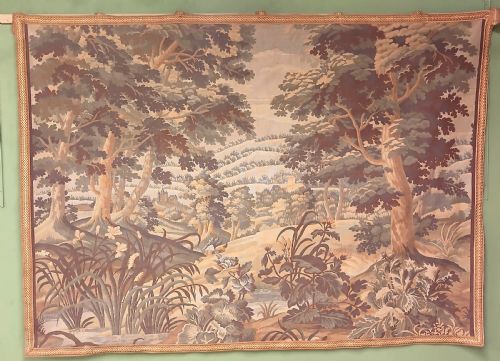
- A type of wall hanging featuring a predominant landscape theme with trees, foliage, plants, and often birds or animals. These scenes create a lush, botanical atmosphere on interior walls.
- Warp
- The vertical threads held in tension on a loom through which the coloured horizontal weft threads are woven. This foundation provides the structural strength of the textile.
- Weft
- The horizontal threads passed through the warp to create the visible pattern and imagery. In these textiles, wool and silk weft yarns form the pictorial surface.
Large Aubusson Wall Hanging: Frequently Asked Questions
How do I hang a large tapestry safely?
Most large wall hangings require a weight-distributing support system, such as a hidden timber batten or a specialised sleeve stitched to the reverse. This prevents the fabric from stretching under its own weight over time.
Framed panels can be hung using traditional heavy-duty mirror and picture hanging hardware secured directly into wall studs.
What is a verdure tapestry?
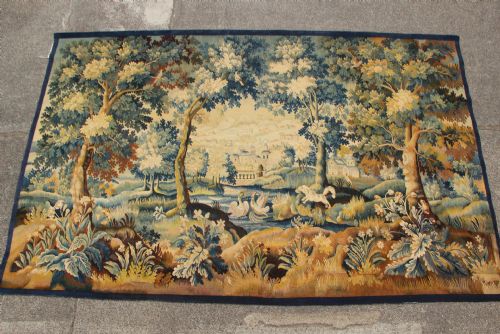
A verdure tapestry depicts a stylised woodland scene dominated by trees, leaves, plants, and frequently birds or distant chateaux. These landscape compositions were designed to bring the outside garden into grand interior rooms.
They often use deep greens, blues, and browns that have mellowed gracefully over the centuries.
How do I tell an 18th century tapestry apart from a 19th century one?
Seventeenth and eighteenth century pieces generally exhibit a softer, more harmonious palette born from natural dyes, alongside finely rendered pastoral or biblical narratives. Nineteenth century revivals often display brighter synthetic dye tones and heavier, denser weave structures.
Examining the selvedge, back fibres, and stylistic conventions helps clarify the period of production.