

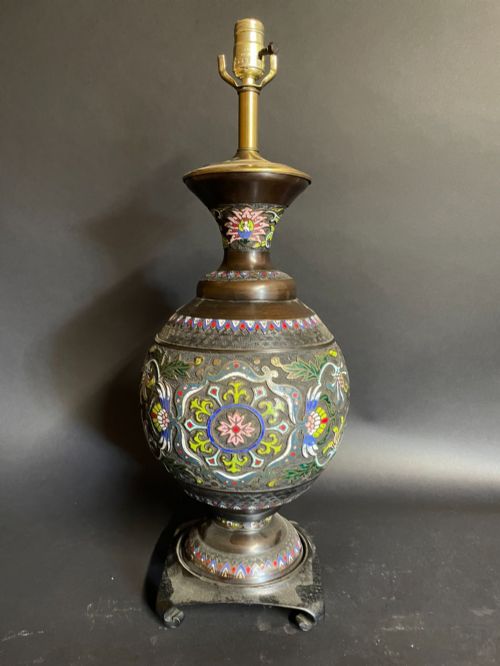


Antique Floral Enamel Lamps
Antique floral enamel lamps combine rich coloured motifs with sturdy metal bases, offering both functional illumination and distinct decorative charm for the home.
Antique Floral Enamel Lamps
When you search for antique floral enamel lamps, you encounter a mix of domestic lighting and converted vessels from the nineteenth and early twentieth centuries. The selection spans table lamps, oil lamps, and light shades created across various international centres of design.
You are most likely to meet Chinese cloisonné vases and nineteenth-century bronze or brass pieces adapted into lamps. These items bring together traditional metalwork techniques and floral enamel decoration in forms suited to period and eclectic interiors alike.
The styles range from Victorian and Art Nouveau to Art Deco and Chinese export aesthetics. This variety means that each lamp presents a distinct profile, whether through the fluid lines of a frosted glass shade or the intricate wirework of a cloisonné body.
How they were made
Makers utilised brass, bronze, copper, and wrought iron to form the robust skeletons and bases of these lamps. These metals provided structural integrity for pieces that often supported heavy glass or ceramic components.
Enamel and cloisonné techniques applied colourful floral designs directly onto the metal surfaces, while glass was moulded, frosted, or painted for shades and oil reservoirs. Artisans combined these materials with fabric elements to complete the lighting assemblies.
Several vases found their true calling after a quiet retirement, traded in by former owners for a second life as electrified companions.
What varies in quality
The finesse of the metalwork and the precision of the enamel separation lines distinguish finer examples from simpler production. Careful execution in the floral motifs and the integration of mountings indicate higher standards of craftsmanship.
The harmony between the original vessel or shade and its subsequent conversion into a lamp affects the overall cohesion of the piece. Balanced proportions and sympathetic adaptations preserve the integrity of the primary object.
The Antique Floral Enamel Lamps Glossary
- Cloisonné enamel
- A metalwork technique where fine wires form compartments on a surface, which are then filled with coloured enamel paste and fired. This method creates distinct, cell-like floral patterns.
- Art Nouveau
- A stylistic movement characterised by organic, flowing lines and plant-inspired motifs. Pieces from this period often employ frosted glass and naturalistic metal forms.
- Art Deco
- A design style defined by geometric shapes, stylised patterns, and modern industrial materials. Lamps from this era favour structured silhouettes alongside enamelled glass.
- Oil lamp
- A lighting device that burns liquid fuel via a wick, commonly converted into an electric lamp in later periods. They frequently feature decorative glass reservoirs and metal burners.
Antique Floral Enamel Lamps: Frequently Asked Questions
What periods do these lamps come from?
The pieces span the nineteenth century and the early decades of the twentieth century, including items made around eighteen-eighty and nineteen-twenty. They reflect manufacturing styles from the Victorian era through to the Art Deco period.
Production origins include both European workshops and Chinese export or Qing Dynasty traditions. This range allows collectors to select pieces aligned with specific historical design movements.
How were these lamps originally used?
Many items began as decorative vases or functional oil lamps before being wired for electricity in later years. They provided interior lighting for parlours and living spaces while serving as ornamental centrepieces.
Converted oil lamps and vases retained their decorative presence while adapting to modern domestic needs. Their dual function as art objects and light sources made them popular in period homes.
How do I live with an antique enamel lamp?
These lamps suit placement on side tables, desks, or mantelpieces where their floral enamel details can be appreciated up close. Pairing them with compatible bulbs preserves the tone of frosted or coloured glass shades.
Routine care involves dusting the metal and enamel gently with a dry cloth. Avoiding harsh cleaning agents ensures the protective glaze and metallic finishes remain undamaged over time.
How do I tell styles apart?
Victorian and nineteenth-century pieces often display traditional floral motifs on bronze, brass, or crystal glass. Art Nouveau examples introduce asymmetrical, plant-like curves and frosted glass elements.
Art Deco items present cleaner, more geometric lines using wrought iron and enamelled glass. Chinese cloisonné pieces are identified by their characteristic wire-inlaid floral patterns across bronze or copper bases.