
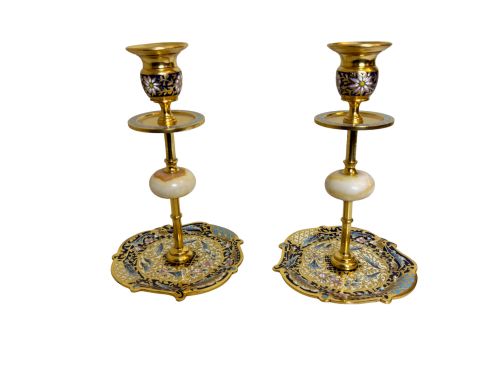
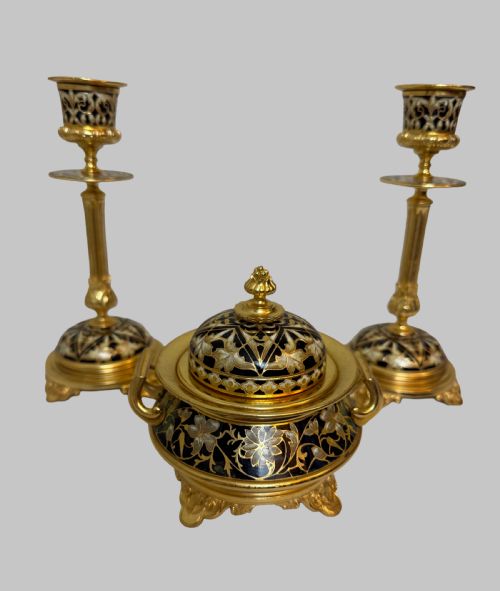
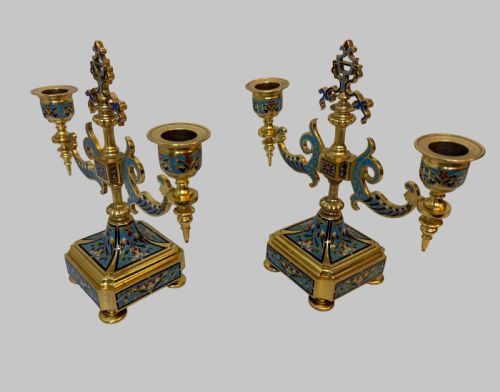


Antique Enamel Candle Holder
An antique enamel candle holder brings rich colour and metalwork together, offering a striking display piece for a mantel or table.
Antique Enamel Candle Holder
When you search for an antique enamel candle holder, you encounter a range of forms including individual candlesticks, twin-light candelabra, chamber sticks, and mantle lustres. The pieces on this page span the Georgian, Victorian, and Edwardian eras, reaching from the mid-nineteenth century to around nineteen hundred.
French workshops dominate the selection with champleve and cloisonne enamel mounted in gilt bronze, ormolu, or bronzed spelter. You also meet English Arts and Crafts designs in pewter alongside Bohemian and Victorian ruby glass lustre ornaments.
Styles range widely across the items listed, taking in French Second Empire, Napoleon III, Moorish Revival, Arabic, and Georgian Rococo influences. Sets often include matching desk accessories like inkwells alongside the primary candleholders.
How they were made
Makers fused vitreous enamel into recessed metal cells using champleve techniques or held the design within thin metal wire outlines in cloisonne work. Gilt bronze, brass, ormolu, and Tudric pewter formed the structural bodies that support these decorative enamel panels.
Stoneware, porcelain, and glass served as alternative foundations, seen in ruby glass and Bohemian overlay glass lustres decorated with enamel details. Artisans added finishing touches through gold leaf, micro mosaic inlays, and carved onyx bases.
Current listings feature nineteenth-century French champleve, Arts and Crafts Tudric pewter, and Georgian porcelain examples.
What varies in quality
The crispness of the chased metal mounts and the complexity of the enamel colour palette separate standard production from superior examples. Pieces bearing specific attributed designs, such as Archibald Knox work for Liberty and Co, demonstrate higher artistic ambition.
The integration of secondary materials like onyx plinths, gilt bronze, and matched sets of candelabra elevate certain items above single standard brass holders.
Archibald Knox for Liberty and Co·Georgian Derby Porcelain
The Antique Enamel Candle Holder Glossary
- Champleve enamel
- An enamelling technique where troughs or cells are hollowed out of a metal surface and filled with vitreous enamel paste before firing. This method creates bold patterns bounded by visible lines of the base metal.
- Cloisonne enamel
- A technique where fine metal wires are soldered to a metal base to create individual compartments, which are then filled with enamel. The resulting surface shows intricate, delicate compartmentalised designs.
- Mantle lustre
- A decorative ornamental vase or candlestick hung with cut glass prisms designed to catch the light. These pieces were popular on Victorian mantelpieces alongside standard candle holders.
- Ormolu
- A metallic alloy used to simulate gold, applied as a surface finish to bronze mounts. It provides a bright, durable decorative trim on nineteenth-century French lighting.
- Chamber stick
- A low candlestick fitted with a handle and a shallow drip pan, originally used for lighting a person's way to bed. Many surviving examples incorporate enamel and micro mosaic decoration from the Grand Tour period.
Antique Enamel Candle Holder: Frequently Asked Questions
How do I date an enamel candle holder?
Dating relies on stylistic clues, manufacturing materials, and mounting techniques typical of periods like the Victorian era or the Arts and Crafts movement. Nineteenth-century French pieces often utilise champleve enamel on gilt bronze, whereas later British examples feature distinctive pewter alloys.
Examining the underside, screw types, and construction methods helps distinguish mid-nineteenth-century work from later reproductions or twentieth-century adaptations. Hallmarks and registry marks, where present, provide precise production years.
Were these holders used for daily lighting?
Many ornate pairs of champleve candelabra and glass lustres served primarily as decorative garnitures for formal reception rooms rather than working sources of light. Chamber sticks, by contrast, were practical items carried by hand through dark hallways at night.
Grand Tour souvenirs and porcelain pieces often occupied drawing-room mantelpieces where their rich colours complemented other decorative arts of the period.
How do I care for antique enamel and bronze?
Enamel surfaces require gentle dusting with a soft, dry cloth to prevent abrasion of the vitreous glass paste. Moisture and chemical cleaners must be kept away from both the enamel and the underlying metal mounts.
Gilt bronze and brass should not be aggressively polished, as this removes the aged patina and any remaining fire gilding or gold leaf highlights accumulated over the decades.
What is the difference between champleve and cloisonne?
Champleve involves carving or etching sunken channels directly into a thick metal plate to hold the coloured enamel. The raised metal walls remaining between the channels form the outline of the design.
Cloisonne builds the design upwards by soldering thin metal wires onto a smooth metal base to create the enclosed cells. This produces a finer, more linear pattern across the decorated surface.