


Antique Embroidered Alphabet
These antique embroidered alphabet pieces are historic needlework samplers charting literacy and needle skill across centuries.
Antique Embroidered Alphabet
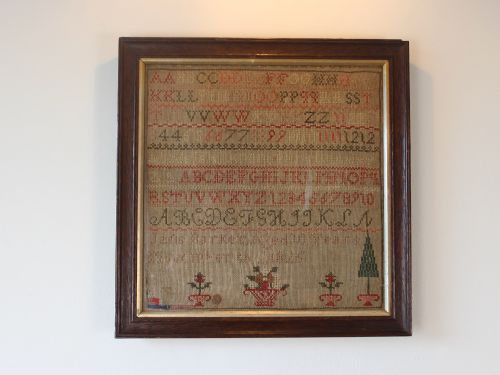
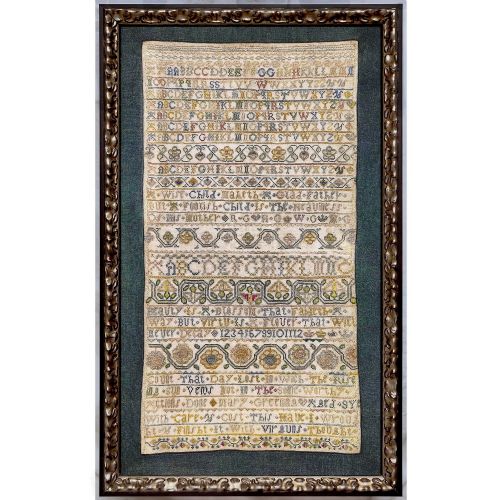
An antique embroidered alphabet represents a foundational textile exercise worked primarily by young girls learning stitchery and lettering. These historic pieces span the 18th, 19th and Victorian periods, taking the form of framed needlework samplers and wall art.
Most examples encountered on this page originate from the Georgian and Victorian eras, often bearing the maker's name, age and date of completion. Alongside rows of capital and lowercase letters, makers frequently added numbers, verses, motifs and religious texts like the commandments.
How they were made
These needlework pieces were constructed using fine linen foundations stitched with silk thread, wool or standard thread. Makers employed various embroidery stitches to form the precise lettering and decorative borders seen across the panels.
Surviving examples are frequently housed behind glass within period wood frames to protect the delicate textiles from environmental damage.
Young maker Louiss Elkins proudly stitched her age as 12 yeas, leaving behind a charming spelling mistake that endures after two centuries.
What varies in quality
The distinction between ordinary and superior needlework lies in the regularity of the stitch tension and the complexity of the compositional layout. Finer samplers demonstrate remarkable dexterity in letter formation and incorporate sophisticated pictorial motifs alongside the standard alphabet.
Historical significance also alters the standing of a piece, particularly when a sampler retains documented maker details, school origins or precise dates that securely anchor its place in domestic social history.
The Antique Embroidered Alphabet Glossary
- Sampler
- A piece of needlework produced as a demonstration or test of skill in various stitches. These textiles frequently served as reference pieces for young stitchers.
- Band sampler
- An early format of needlework featuring horizontal rows of distinct pattern bands. They were popular in the seventeenth and eighteenth centuries before pictorial layouts became standard.
- Needlepoint
- A type of canvas work embroidery where yarn or thread is stitched through a stiff open-weave mesh. This technique provides structural rigidity well suited for framed wall art.
Antique Embroidered Alphabet: Frequently Asked Questions
How old are most alphabet samplers?
Most surviving examples date from the nineteenth century, though earlier pieces from the seventeenth and eighteenth centuries occasionally appear.
Maker details and dates inscribed directly onto the linen often provide a clear timeline of creation.
Why did children stitch alphabets?
Stitching alphabets served as a dual exercise in mastering literacy and developing needlework competence. Young girls demonstrated their diligence and proficiency by rendering letters and numbers accurately.
These completed panels functioned as household decorations and testaments to a child's education.
How should I hang my sampler?
Textiles require protection from direct sunlight to prevent the silk and wool threads from fading. Displaying them behind UV-filtering glass helps preserve the original colours.
Keep them away from damp environments to protect the fragile linen and wooden frames.
Can I identify the maker?
Many pieces include stitched names, ages, and dates directly into the composition. Some samplers even record specific institutions like the Oswestry National School.
Genealogical research can occasionally reveal further context about the young makers.