
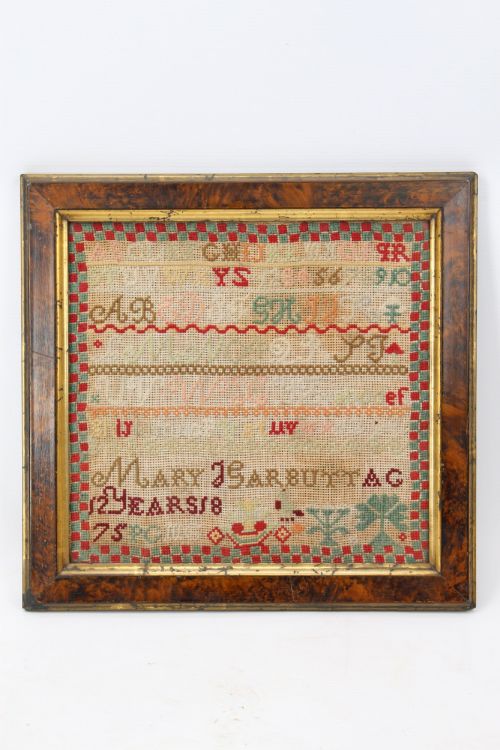
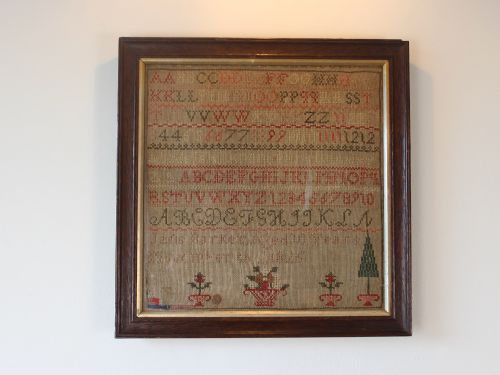


Alphabet Cross Stitch Sampler
An alphabet cross stitch sampler is a needlework piece recording letters and verses, offering a tangible link to domestic schoolroom education.
Alphabet Cross Stitch Sampler
An alphabet cross stitch sampler takes the form of a textile panel worked in needlework, often executed by young girls learning stitches and literacy in the nineteenth century or the Georgian era. These pieces frequently record the maker's name, age, and a specific date, alongside alphabets, numerals, and moral verses.
The versions met on this page span from the Georgian period through to the late nineteenth century, including Victorian examples. Many are presented as framed textile wall art, preserved behind glass within wood frames.
Makers often included familial details or institutional names, such as school names or specific locations, grounding the textile art in a precise historical context. Simpler miniature formats appear alongside larger framed panels featuring the Lord's Prayer or the Commandments.
What Varies in Quality
The refinement of the needlework and the regularity of the stitching define the standard of the piece. Samplers demonstrating careful execution of complex alphabets and pictorial borders sit above simpler exercises.
The preservation of the linen ground and the vibrancy of the silk or wool threads affect the visual impact of the textile. Framing and the survival of legible maker details or dates add archival interest.
Listings include materials such as linen, wool, and silk thread, alongside wood and glass frames.
The Alphabet Cross Stitch Sampler Glossary
- Cross stitch
- A form of embroidery built from diagonal stitches that cross to form an "X" shape. This technique creates the geometric lettering seen across these samplers.
- Sampler
- A panel demonstrating a collection of stitches, alphabets, and motifs created by a needleworker. Historically used to practice and showcase sewing proficiency.
- Linen
- A textile made from the fibres of the flax plant, providing the woven foundation ground for the embroidery. Its even grid structure aids the counting required for cross stitch.
- Tapestry
- A category of heavy hand-woven or embroidered textile art. In this context, it refers to densely worked needlework panels.
Alphabet Cross Stitch Sampler: Frequently Asked Questions
What is an alphabet sampler?
An alphabet sampler is a piece of needlework displaying rows of letters and numerals, used historically to demonstrate literacy and sewing proficiency.
Young makers stitched these panels in schoolrooms or at home to practice lettering before moving on to complex pictorial designs.
How old are these samplers?
The pieces on this page date primarily from the Georgian and Victorian eras, spanning the nineteenth century.
Dates are often stitched directly into the textile alongside the maker's name and age, providing a clear record of origin.
What materials were used?
The foundation is typically a woven linen ground stretched to receive the embroidery.
Needleworkers used thread, wool, and silk thread to stitch the alphabets and motifs, often framing the finished panels behind glass in wood frames.
How should I display a sampler?
Samplers are best displayed away from direct sunlight to protect the fragile silk and wool threads from fading.
Most examples are framed behind glass as textile wall art, which helps shield the linen ground from dust and atmospheric damage.