
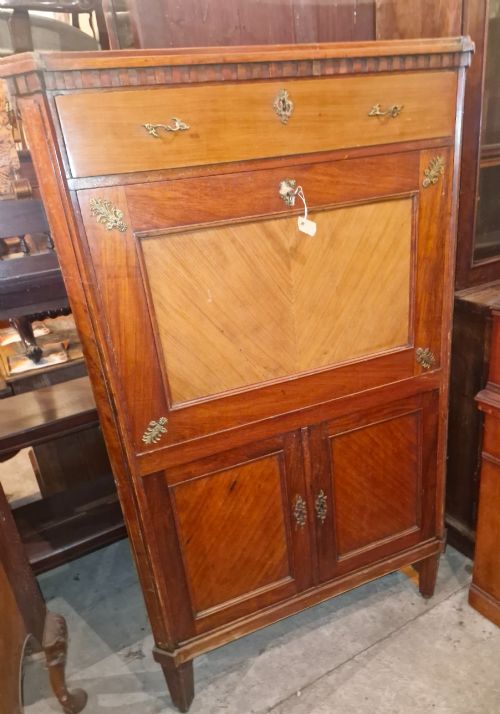


Antique Drop Down Desk
These antique drop down desk pieces offer clever writing surfaces that conceal fitted interiors, blending practical storage with period craftsmanship.

Antique Drop Down Desk
An antique drop down desk provides a folding or falling flap that drops into a horizontal position for writing, revealing small internal drawers and pigeonholes behind it. The pieces on this page span from the 17th century to the early 20th century, encompassing diverse regional styles and cabinet forms.
Materials and construction
Cabinet makers utilised dense hardwoods like mahogany and walnut, frequently applying flame mahogany veneer to large flat surfaces to create striking grain patterns. Brass handles, escutcheons, and hinges provide functional hardware that accents the polished wood exterior.
Interior compartments relied on precise joinery to house secret drawers and small pigeonholes behind the main drop front. Pine frequently served as a secondary timber for internal framing and drawer linings.
Several desks manage to hide secret compartments behind their pigeonholes, proving that 18th-century writers loved a hidden stash as much as anyone.
Judging quality
Superior examples display careful matching of wood veneers across the fall front and drawer fronts, ensuring the grain flows naturally across the piece. The complexity and cleverness of the internal secret compartments also distinguish finer cabinet work from simpler vernacular items.
The integration of brass fittings and the crispness of carved details, such as those found on French Empire or Louis XVI variants, separate standard workshop output from exceptional furniture.
The Antique Drop Down Desk Glossary
- Escritoire
- A writing cabinet featuring a vertical drop front that conceals a fitted interior. This term frequently appears on continental European pieces.
- Secretaire
- A piece of furniture containing a writing drawer or drop down writing compartment disguised as a standard drawer or cabinet door. It originates from the French term for a writing secretary.
- Pembroke table
- A small table with hinged drop flaps on either side, occasionally associated with writing use depending on its internal configuration. These tables offer versatile surface space.
- Flame mahogany veneer
- A thin slice of mahogany timber cut from the fork of the tree where branches meet the trunk, creating a distinct flickering flame pattern. Cabinet makers used it to decorate prominent exterior panels.
- Pigeonhole
- A small, open compartment within a desk interior designed for sorting letters and papers. They sit behind the main drop down flap.
Antique Drop Down Desk: Frequently Asked Questions
What is an antique drop down desk?
An antique drop down desk is a piece of furniture featuring a hinged writing flap that lowers to create a horizontal surface. Behind this flap lie various small drawers and compartments for correspondence.
These desks evolved through several centuries, appearing as freestanding escritoires, bureau bookcases, and cocktail cabinets with concealed writing drawers.
How do I identify the period?
Period identification relies on observing timber choices, hardware styles, and structural forms. Eighteenth-century pieces often use solid mahogany with subtle inlay, while Victorian examples frequently employ heavier rosewood or walnut veneers.
Secondary timbers like pine and the complexity of internal secret drawers also help narrow down the date of manufacture.
How were these desks used?
These items served primarily for correspondence, household accounting, and the storage of writing implements. The drop down flap provided a stable, private surface for writing letters before the widespread use of freestanding writing tables.
Internal pigeonholes and secret compartments kept sensitive documents secure and organised away from main living areas.
How do I care for the wood?
Maintenance involves keeping wooden surfaces away from direct heat sources and strong sunlight to prevent veneer splitting and fading. Regular dusting with a soft, dry cloth preserves the polished finish.
Occasional application of appropriate wax polish nourishes hardwoods like mahogany, walnut, and oak without building up heavy residues.