




Antique Desert Landscape
These antique desert landscape works capture vast arid vistas and timeless horizons that draw collectors of orientalist and nineteenth-century art.
Antique Desert Landscape
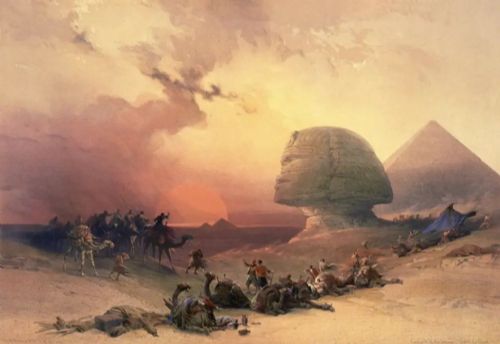
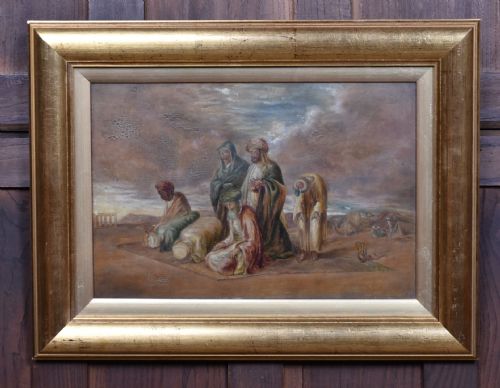
When you search for an antique desert landscape, you encounter nineteenth-century and early twentieth-century depictions of Middle Eastern scenes, river tributaries, and ancient pyramids. These pieces range from intimate watercolours to large oil paintings on canvas depicting Bedouin tribesmen, camels, and vast wilderness expanses.
The selections available here lean heavily into Victorian orientalism, featuring specific regional views from Egypt, Jerusalem, and the Suez Canal. You will frequently find watercolours on paper or board alongside oils, capturing the intense light and atmospheric conditions of foreign terrains.
Materials and techniques
Artists working on these scenes utilised traditional pigments such as watercolour, gouache, and oil paints applied to prepared canvas, paper, or wooden board. Many works combine watercolour and gouache to achieve dense opacity alongside luminous washes of desert skies.
Framing often involves period wood structures that protect delicate works on paper behind glass, preserving the fugitive pigments from light damage. Canvas works are stretched over wooden frames, occasionally retaining their original artist signatures and inscriptions.
The archive contains works spanning orientalist styles, British twentieth-century views, and modern Iraqi art traditions.
Judging quality in desert scenes
Quality rests upon the handling of light and atmospheric perspective, distinguishing atmospheric depth from flat, formulaic illustration. Superior examples demonstrate confident brushwork in capturing figures, camels, and architectural monuments without stiffness.
The preservation of the medium significantly impacts desirability, particularly with watercolours and gouache where fading alters the intended tonal balance. Original framing and clear provenance to recognised artists also elevate the standing of a piece within this genre.
David Roberts·Edwin Lord Weeks·William James Muller·Otto Pilny·Hugo Vogel·Abdul Kadir Al Rassam·Earl Haig·Frank Holme
The Antique Desert Landscape Glossary
- Orientalism
- The imitation or depiction of aspects of Eastern cultures by writers, designers, and artists from the West. This style dominated much nineteenth-century European art depicting North Africa and the Middle East.
- Gouche
- An opaque water-based paint consisting of watercolour mixed with a high proportion of a white inert pigment. It provides flat areas of rich colour and dense highlights in works on paper.
- Bedouin
- Nomadic Arab peoples inhabiting the desert regions of the Middle East and North Africa. They frequently appear as subjects in nineteenth-century paintings of wilderness and desert travel.
- Simoon
- A strong, hot, dry dust-laden wind that blows in the Sahara and Arabian deserts. It is referenced in nineteenth-century visual narratives of desert expeditions.
Antique Desert Landscape: Frequently Asked Questions
What periods do these paintings come from?
The pieces span the nineteenth century through to the mid-twentieth century, capturing shifts in artistic perception of foreign lands.
Victorian orientalism and early twentieth-century movements account for the majority of the surviving watercolours and oil canvases.
How should I display works on paper?
Watercolours and gouache require protection from direct sunlight to prevent the fading of delicate pigments against the paper or board.
Hanging them away from strong heat sources and moisture preserves the integrity of both the paper support and the original framing.
What subjects typically appear in these scenes?
Common subjects include desert caravans, river tributaries, ancient monuments such as pyramids, and Bedouin tribesmen with camels.
Artists frequently documented specific geographical locations, including the Suez Canal, Jerusalem, and the wilderness of Gizeh.
How do oils and watercolours differ here?
Oil paintings on canvas offer robust texture and deep pigment saturation, often executed on a larger scale for dramatic visual impact.
Watercolours and gouache provide delicate atmospheric effects on paper or board, requiring glass framing for long-term preservation.