




Antique Church Print
These antique church print pieces capture centuries of ecclesiastical architecture and devotion, offering a tangible link to historic houses of worship through detailed engravings, lithographs, and drawings.
Antique Church Print
An antique church print encompasses framed architectural drawings, lithographs, engravings, and original pen and ink works depicting cathedrals, colleges, and rural parishes. Buyers examining this phrase will encounter works spanning the eighteenth century through to the Edwardian period and the nineteen-twenties.
Works attributed to notable figures or followers of established artists sit alongside anonymous topographical views, capturing both grand ecclesiastical facades and intimate churchyard scenes. Collectors select these items for their historical documentation of British and European sacred buildings.
Assessing quality and execution
The distinction between standard topographical records and superior examples rests in the precision of the draughtsmanship and the clarity of the architectural detail. Works featuring named hands or documented topographical subjects demonstrate greater accomplishment in perspective and line.
Framing and mounting choices contribute significantly to the visual weight of each piece, with period wooden and gilded frames enhancing the paper works. Condition of the paper support, stability of the ink or pigment, and original signatures or dates elevate the standing of individual items.
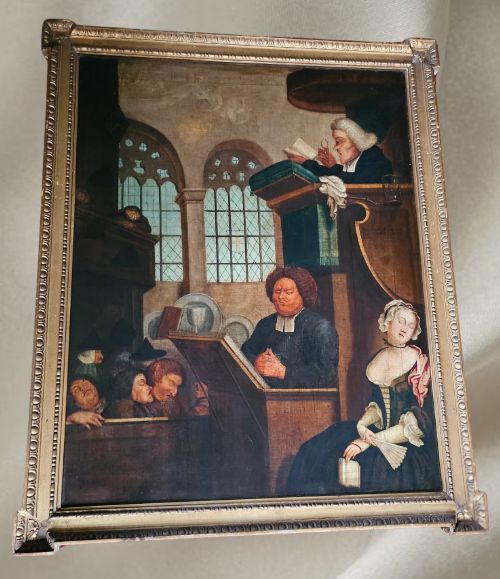
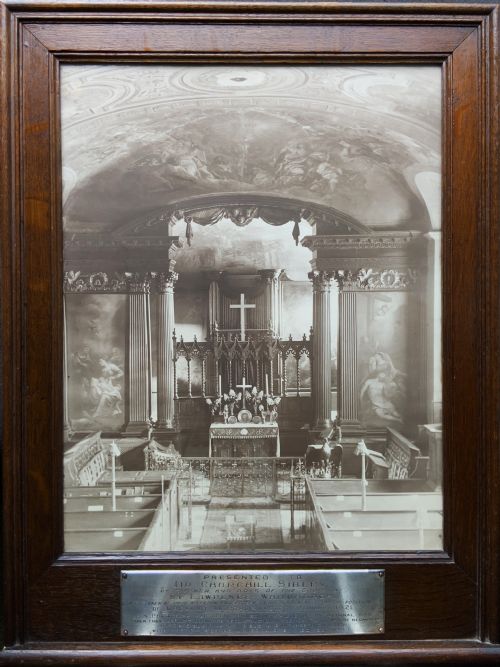
Object types span framed architectural drawings, lithographs, paintings, photographs mounted from altar wood, and blue and white ceramic serving plates.
William Hogarth·Sir William Nicholson·William Marlow·Joseph Hansom·J Beckett
The Antique Church Print Glossary
- Engraving
- A printmaking process where an artist cuts an image into a metal plate using a burin. The resulting lines hold the ink for transfer onto paper under pressure.
- Lithography
- A planographic printing method based on the chemical repulsion of oil and water. Artists draw directly onto a limestone slab or metal plate to produce multiple impressions.
- Gothic Revival
- An architectural and artistic style beginning in the mid-eighteenth century and flourishing in the nineteenth century. It imitates medieval Gothic forms, pointed arches, and ecclesiastical motifs.
- Architectural drawing
- A technical or artistic drawing of a building or structure. These works provide precise visual documentation of cathedrals, churches, and collegiate foundations.
Antique Church Print: Frequently Asked Questions
What periods do these church prints cover?
The available items span from the eighteenth century through the Victorian era and the Edwardian period, extending into the nineteen-twenties. This temporal range encompasses Georgian engineering, Gothic Revival movements, and early twentieth-century ecclesiastical documentation.
Buyers will find that earlier works often focus on precise architectural elevation, while later Victorian and Edwardian examples lean towards atmospheric interior perspectives and historical drawings.
How were these architectural drawings used?
Original drawings and engravings served as studies for builders, records for historians, and decorative art for domestic interiors. Many depict specific cathedrals and parish churches with working surveyors or masons in the foreground.
Over time, these pieces transitioned from functional architectural records into collectible wall art valued for their topographical and historical importance.
How should I care for antique paper art?
Paper works require protection from direct sunlight to prevent fading of inks, watercolours, and sepia photographs. Maintaining stable indoor humidity levels prevents warping of the paper support and damage to wooden or gilded frames.
Glazing should remain intact to shield the delicate medium from airborne pollutants and dust accumulation over decades of display.
How do I distinguish between an engraving and a lithograph?
Engravings exhibit crisp, indented lines where the metal plate pressed into the damp paper during printing. Lithographs display a smoother surface texture without plate marks, relying on chemical ink adhesion to create softer tonal gradations.
Examining the printed surface under a magnifying glass reveals the characteristic sharp incisions of the burin versus the more planar quality of lithographic stone work.