


Antique Chessmen Set
An antique chessmen set brings tactile history to the board, offering turned boxwood and carved bone pieces shaped in classic Victorian and Edwardian patterns.
Antique Chessmen Set
When you search for an antique chessmen set, you encounter complete groupings intended for strategy and display, ranging from miniature travelling boards to substantial library sets. The pieces listed on this page predominantly date from the nineteenth century into the Edwardian era, spanning the Victorian and late Victorian periods.
Most examples follow established regional and competitive patterns rather than arbitrary designs. You will frequently meet Staunton pattern sets alongside specialised regional forms like Whittington, St George, Calvert, and Whitty styles.
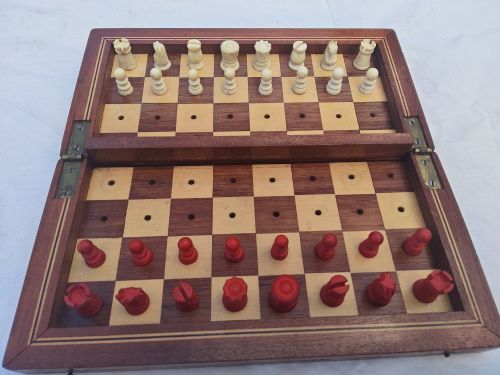
The objects take the form of individual chess sets, often accompanied by folding chess boards or housed within dedicated games boxes. These sets combine functional utility with the distinct aesthetic of nineteenth-century domestic leisure.
Materials and construction
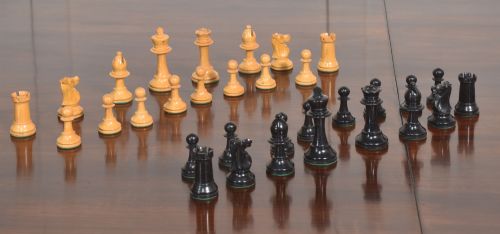
Makers fashioned these pieces primarily from dense turning woods such as boxwood, paired with contrasting dark materials like ebony, ebonised wood, mahogany, and occasionally rosewood. Some sets utilise carved bone for both white and red-stained sides, reflecting traditional material choices for intricate turning.
Many nineteenth-century sets incorporate lead weighting within the base of each piece to improve stability during play, often finished with felt pads underneath. Surface treatments rely on natural polish or ebonising processes to achieve deep contrast between opposing sides.
Some nineteenth-century travelling sets include tiny pegs on the base of each piece to anchor them securely into drilled board squares during bumpy carriage rides.
Distinctions in quality
Quality reveals itself in the precision of the turning and carving, particularly in the delicate openwork of knight's heads and the uniform height of pawns. Finer sets display crisp detail across crown markers on rooks and queens, whereas simpler versions show broader tool marks.
The choice of materials and the presence of makers' marks or specific pattern attributions elevate certain sets. Weighted bases, original fitted boxes, and documented workshop origins distinguish standard production sets from superior examples.
Jaques·British Chess Company·F. H. Ayres·Calvert
The Antique Chessmen Set Glossary
- Staunton pattern
- The standard competitive chess piece design introduced in the mid-nineteenth century, characterised by architectural king and queen forms and distinct coronets on rooks. This style remains the benchmark for tournament play.
- Boxwood
- A dense, pale wood traditionally utilised for the lighter side of chess sets due to its smooth grain and durability under detailed turning. It takes fine detail exceptionally well.
- Ebonised wood
- Timber treated with a dark finish to imitate ebony, providing the dark pieces in many nineteenth-century sets at a more accessible production cost. The finish maintains a uniform dark surface.
- St George pattern
- An earlier nineteenth-century English chess piece design featuring simpler, shorter forms without the elaborate crown details later popularised by the Staunton standard. It represents a transitional phase in board game equipment.
- Calvert pattern
- A distinct nineteenth-century style of carved bone chessmen known for specific geometric finials and cylindrical proportions. These sets possess a unique tactile quality distinct from wooden pieces.
Antique Chessmen Set: Frequently Asked Questions
What is a Staunton chess set?
A Staunton set is the standard design of chess pieces featuring clear, recognisable symbols for each piece type. It became the tournament norm in the nineteenth century.
This pattern ensures players can easily distinguish kings, queens, rooks, and pawns during fast-paced play.
How do I date an old chess set?
Dating relies on stylistic clues, materials, and any accompanying boxes or stamps. Nineteenth-century sets often show specific turning characteristics and proportions.
Changes in crown designs and the presence of lead weighting help narrow the period of manufacture.
Were all antique sets made of wood?
While boxwood and ebony dominate, many sets utilised carved bone or ivory. These alternative materials offered smooth surfaces and intricate detail.
Bone sets often came in natural and stained red or black finishes to separate the opposing sides.
What is a travelling chess set?
Travelling sets were designed for portability, often featuring folding boards or pegged pieces that secured into the board. This prevented pieces from shifting during transit.
Miniature versions allowed players to continue games while on coaches, trains, or ships.
How should I store an antique set?
Store wooden and bone sets away from direct sunlight and extreme humidity fluctuations. Using a lined box or dedicated games box prevents surface friction between pieces.
Keeping the set in a stable environment protects the original polish and delicate carved details.