


Antique Chamber Clock
An antique chamber clock is a brass timekeeper built for domestic walls, offering the heavy mechanical presence of the seventeenth and eighteenth centuries.
Antique Chamber Clock
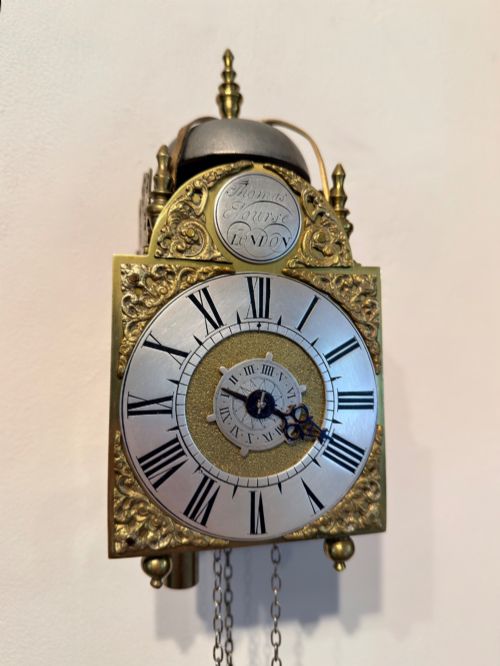
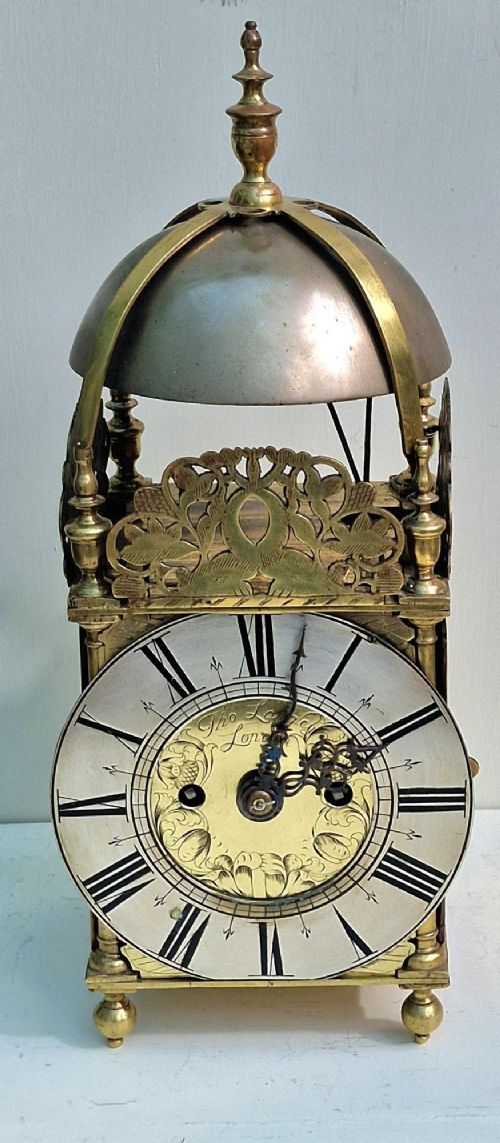
When you search for an antique chamber clock, you encounter domestic weight-driven timepieces made predominantly in brass and iron during the seventeenth and eighteenth centuries. These objects include lantern clocks and wall clocks designed for early homes.
The most common form on this page is the English lantern clock, often featuring brass frames and verge escapements from periods spanning the seventeenth century through to the Georgian era. Makers signed these pieces with regional pride, from London workshops to provincial towns in Lancashire and Wiltshire.
How they were made
Makers constructed these clocks using brass frames, steel wheels, and iron components, casting the brass plates and dials before hand-engraving the metal surfaces. Many examples utilise a verge escapement mechanism to regulate the time, paired with alarms or quarter-striking trains.
Dials display engraved chapter rings with Roman numerals, flanked by pierced brass frets at the summit. Smiths combined lead, copper, and silvered metal to complete the works and faces.
Antique Chamber Clock Retail Price Guide 2026
Typical asking prices for chamber clock among the pieces listed under this phrase on Sellingantiques today, from the lower quarter to the upper quarter. They describe what is for sale here now, not the wider market.
Makers working in London, Salisbury, Preston, and West Yorkshire signed these domestic brass timepieces.
What varies in quality
The distinction between standard and exceptional pieces rests on the survival of original components, such as the escapement, movement, and engraved brass work. Clocks retaining their early balance wheels or verge mechanisms carry greater mechanical integrity.
Engraving depth on the dial and the crispness of the cast brass frets separate provincial work from fine London production. The presence of a signed maker's inscription on the dial adds substance to the piece.
Thomas Langley·John Spershott·Windmills and Bennet·Samuel Tinham·Peter Closon·John Waller·James Ogden Senior·William Barrow·William Clement
The Antique Chamber Clock Glossary
- Verge escapement
- An early mechanical regulator using a crown wheel and pallet pivots to control the descent of the weights. This mechanism governs the beat of many seventeenth-century timepieces.
- Lantern clock
- A domestic brass wall clock featuring an enclosed weight-driven movement beneath a bell. The name derives from its brass frame shape resembling a church lantern.
- Fret
- A pierced brass decorative panel placed above the dial of a lantern clock. These openwork ornaments often depict heraldic motifs or floral designs.
- Chapter ring
- The circular metal band attached to the dial bearing the numerals for hours and minutes. Early examples use single hands pointing to quarter-hour markers.
Antique Chamber Clock: Frequently Asked Questions
How do I hang a chamber clock?
These pieces hang from a sturdy wall bracket or hook and spike driven into a solid wall. The heavy brass case and descending weights require secure placement to support the mechanical load.
Ensure the wall can bear the downward pull of the iron weights and that the clock hangs completely plumb to allow the pendulum or balance to swing evenly.
What is a lantern clock?
A lantern clock is a traditional brass wall-hanging timekeeper developed in the seventeenth century. They feature a square brass frame with a bell mounted on top.
These clocks operate on weights suspended by cords or chains, driving a verge escapement mechanism that regulates the striking and timekeeping.
How do I tell seventeenth century clocks apart from later ones?
Early seventeenth-century examples typically feature single hands and simpler posted brass frames with verge escapements. Maker signatures appear engraved directly onto the brass dial plate.
Later eighteenth-century pieces often incorporate twin fusee movements or quarter-striking trains, reflecting advances in clockmaking technology and changing domestic requirements.
Did these clocks run on weights or springs?
Most traditional chamber clocks rely on suspended lead or iron weights to drive the gear train. The pull of gravity turns the wheels and powers the strike train.
Later nineteenth-century interpretations or specific variations introduce fusee movements and spring-driven mechanics to regulate the rotation of the wheels.