
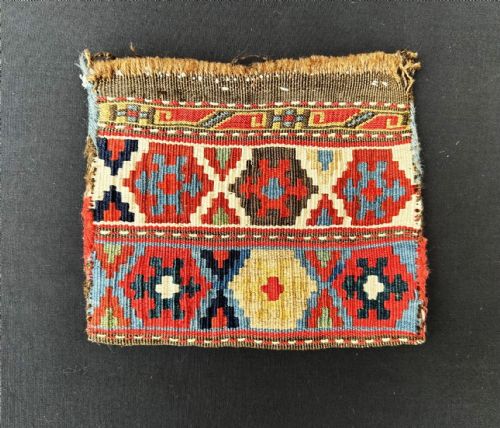


Antique Caucasian Tribal Bag
An antique caucasian tribal bag brings nomadic weaving into a modern interior through rich wool and geometric patterning.
Antique Caucasian Tribal Bag
When you search for an antique caucasian tribal bag, you encounter functional storage pieces made by nomadic and village weavers across the Caucasus and border regions. These items served practical roles for portable living, taking forms such as saddlebags, vanity bags, storage containers, and individual bag faces.
The selections span from the mid-nineteenth century into the early twentieth century, capturing distinct regional output. Shahsavan nomads and Jaf Kurdish groups dominate the available pieces, often appearing as complete pairs, single bag faces, or constructed cushions.
Moghan and Azerbaijan origins surface frequently in these textiles, alongside broader South Caucasian attributions. Buyers typically find specific utilitarian fragments that have been preserved, adapted into pillows, or kept in their original format.
What varies in quality
Quality rests upon the crispness of the drawing and the complexity of the technique employed by the weaver. Soumak work with well-defined birds, dragons, or structured geometric layouts sits at the higher end of the spectrum.
The depth and saturation of the natural dyes heavily influence the visual impact of each piece. Intact structures, complete pairs, and retaining original plain weave backs separate standard fragments from more desirable survivals.
Materials recorded across the inventory consist entirely of hand-spun wool, cotton foundations, and natural vegetable dyes.
The Antique Caucasian Tribal Bag Glossary
- Mafrash
- A large rectangular storage bag or chest panel used by nomads for bedding and household goods. These pieces are often encountered as complete four-sided containers or individual flat panels.
- Soumak
- A flatweave technique using a wrapping stitch that produces a ribbed surface texture and allows for complex graphic designs. It provides greater structural stability than standard kilim.
- Khorjin
- The traditional Persian and Caucasian term for a double saddlebag designed to be slung over an animal. Surviving examples often appear split into individual bag faces or joined as pairs.
- Kilim
- A tapestry-woven flat textile lacking a pile, produced by tightly interlocked weft threads over warp foundations. This method creates sharp geometric patterns visible from both sides.
- Bag face
- The decorative front panel of a utilitarian storage bag that remained visible while hanging in a tent or loaded on an animal. Many surviving examples have been trimmed and backed to serve as decorative cushions.
Antique Caucasian Tribal Bag: Frequently Asked Questions
What is a mafrash?
A mafrash is a large rectangular storage container utilised by nomadic groups to transport bedding and household belongings during seasonal migrations. These containers were constructed from multiple flatwoven or soumak panels stitched together.
Today, collectors encounter complete mafrash bodies or individual panels that display the intricate geometric and pictorial designs characteristic of the weaving group.
How were saddlebags used?
Saddlebags served as practical transport containers loaded onto horses, donkeys, or camels to carry personal possessions, provisions, and trade goods. The double configuration allowed balanced weight distribution across the animal's back.
As nomadic lifestyles shifted, many pairs were separated into individual bag faces or adapted into cushions and decorative domestic objects.
What is soumak technique?
Soumak is a flatweave construction method where coloured weft threads wrap around the warp threads in a continuous brocading motion. This technique produces a strong, durable fabric with a characteristic braided texture on the face.
Weavers utilised soumak to create sharp diagonal lines and complex figurative motifs like birds and dragons without cutting yarn ends.
How do I care for a textile cushion?
These antique textiles require gentle treatment to preserve the historical wool and natural dye foundations. Light vacuuming without a rotating brush helps remove surface dust without stressing the old fibres.
Keep them away from direct, prolonged sunlight to prevent the natural dyes from fading over time.