


Antique Catholic Medal
An antique catholic medal offers miniature devotional craftsmanship, worn as a pendant to hold sacred imagery close.
Antique Catholic Medal
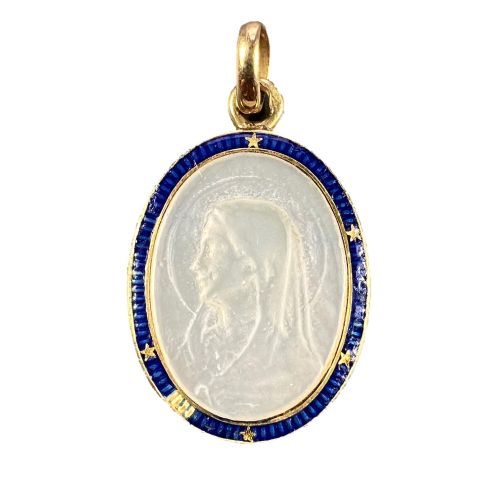
An antique catholic medal centres on devotional iconography such as the Virgin Mary, the Madonna and Child, or the Sacred Heart. These pieces function primarily as pendants, worn on necklaces or carried as charms.
The pieces on this page are predominantly French in origin, spanning the late nineteenth century through to the mid-twentieth century. Art Nouveau and ecclesiastical styles shape the forms, drawing on traditional religious themes.
Makers shaped these medals in oval and circular formats, frequently pairing devotional figures with floral motifs, chalices, or holy doves. The workmanship reflects a specific historical devotion expressed through wearable art.
Materials and Technique
Metals form the structural foundation, utilising 18ct yellow, rose, and white gold to create durable pendants and charms. Goldsmiths shaped these precious metals through casting, piercing, and engraving.
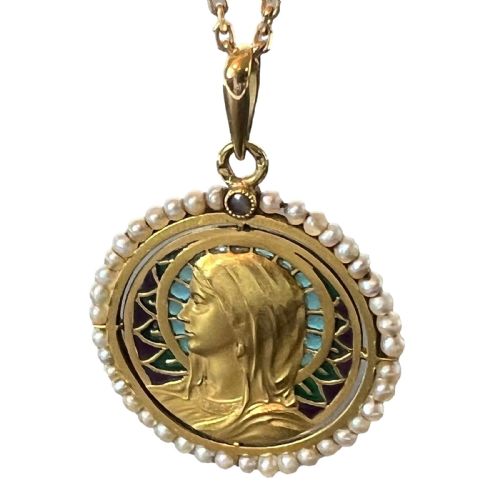
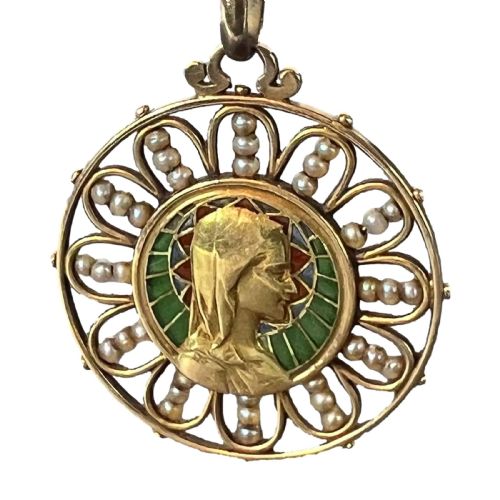
Enamel work adds colour and depth, particularly through the translucent technique of plique-a-jour, which allows light to pass through the coloured glass like stained glass. Mother of pearl panels provide an iridescent background for relief figures.
Seed pearls are incorporated as decorative borders, fixed carefully around the central devotional subject to frame the sacred imagery.
Listings span from the late nineteenth century through to the 1950s, with a strong concentration of pieces dated to the 1900 and 1910 decades.
Factors of Quality
The refinement of the metalwork and the crispness of the relief casting separate standard production from finer examples. Hand-engraved details and intricate piercing demonstrate greater labour by the artisan.
The application of plique-a-jour enamel requires high technical skill to maintain uniform suspension across open gold cells without flaws. The integration of mother of pearl and the secure setting of seed pearls indicate superior manufacturing standards.
Emile Monier·Emile Dropsy·Mazzoni·Sellier·Tairac·Guilbert·Vernon·Becker
The Antique Catholic Medal Glossary
- Plique-a-jour
- An enamelling technique where enamel is applied in cells without a backing, producing a translucent effect similar to miniature stained glass.
- Sacred Heart
- A devotional representation of the physical heart of Jesus Christ as a symbol of divine love.
- Miraculous Medal
- A particular devotional medal whose design was traditionally based on Catherine Labouré's visions of the Blessed Virgin Mary.
- Mother of pearl
- The iridescent internal layer of mollusc shells, carved and polished to serve as a luminous backing for devotional figures.
Antique Catholic Medal: Frequently Asked Questions
What metals were used?
Gold forms the primary metal for these pieces, predominantly utilising 18ct yellow, rose, and white gold variants. Some examples incorporate enamel and mother of pearl elements.
Precious metal standards remain consistent across the periods represented in the listings.
How do I wear them?
These pieces function as pendants and charms, designed to be suspended from gold chains or attached to charm bracelets. Their compact size suits daily wear.
Consider the weight and bail size when selecting a compatible chain for the pendant.
Are they French in origin?
The vast majority of these medals originate from France, showcasing distinct Art Nouveau and religious artistic movements. French hallmarks often appear on the gold components.
This regional concentration reflects the prominent centres of devotional jewellery production during the period.
How are periods dated?
Dating relies on stylistic markers such as Art Nouveau curving lines, maker attributions, and period characteristics spanning from the late Victorian era to the mid-twentieth century.
Design motifs and recorded maker signatures provide reliable chronological indicators.