


Antique Cane Armchairs Set
These antique cane armchairs set examples bring together woven cane and carved timber across periods from Regency to the twentieth century.
Antique Cane Armchairs Set
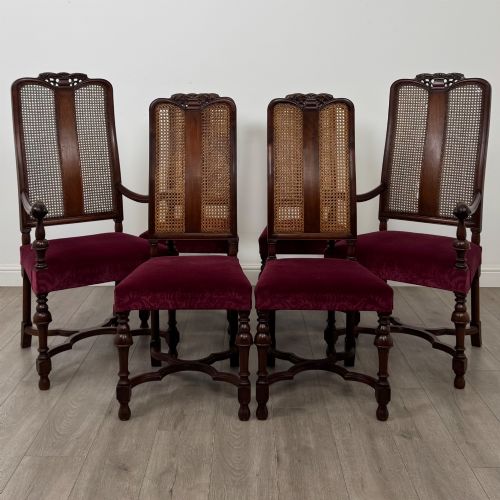
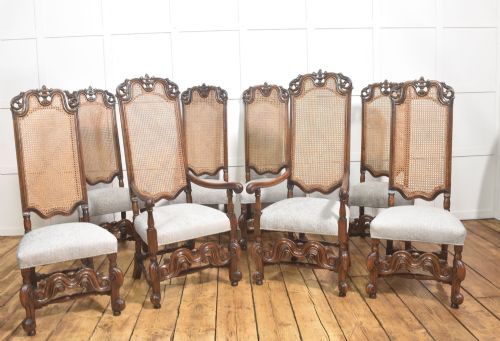
The versions most commonly met on this page range from small sets of three or four salon chairs and bergere armchairs to large dining sets of six, eight, fourteen, or more pieces. Many examples incorporate revival aesthetics, drawing directly on Jacobean, Carolean, and Anglo-Indian design traditions.
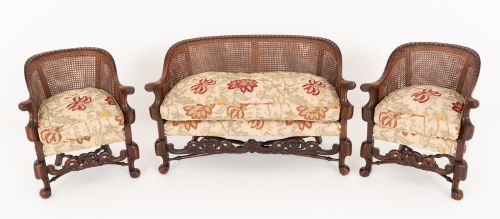
Beyond standard dining chairs, the category encompasses elaborate suites complete with matching settees and open elbow armchairs. Certain variants arrive ready for re-upholstery, while others retain their original upholstery fabrics and woven cane panels.
How they were made
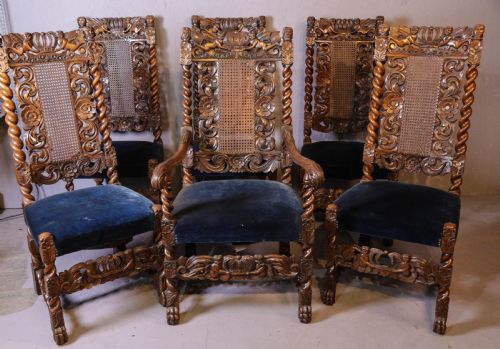
Makers utilised dense timbers such as mahogany, walnut, and ebony to construct the robust frames required for large seating suites. These wooden components received extensive hand-carving in styles reflecting Carolean, Jacobean, and Egyptian revival influences.
Panels of woven cane form the backs and seats, inserted carefully into rebated frames to provide flexible support. Where upholstery appears, fabrics and velvet are secured over traditional stuffing materials to complete the seating.
Some chairs arrive with fourteen companions, ready for very large dinner parties.
What varies in quality
The depth and crispness of the hand-carving across the wooden frame separate standard production from finer work. Deeply articulated foliage and scrollwork demand greater skill from the maker than shallow, mechanical tooling.
The tightness and regularity of the woven cane panels indicate the standard of craftsmanship. Uniform tension across the weave ensures durability and comfortable support over decades of use.
The Antique Cane Armchairs Set Glossary
- Bergere
- An enclosed upholstered armchair with a wooden frame and woven cane back and sides. This French-inspired form often appears in suites from the late nineteenth and early twentieth centuries.
- Cane
- Strips of woven rattan used to create light, flexible panels for chair backs and seats. It provides a resilient surface that responds to the sitter's weight.
- Carolean
- A seventeenth-century design style revived during the Victorian era, characterised by rich carving, scrolling foliage, and tall backs. Chairs in this manner make heavy use of walnut and oak.
- Elbow chair
- An armchair featuring open sides with armrests, typically designed to sit at the head of a dining table or within a drawing room suite. These pieces match larger sets of side chairs.
- Revival
- A design movement that reinterprets historical aesthetics from periods such as the Jacobean or Regency eras. Makers adopted these past styles to satisfy nineteenth and twentieth-century tastes.
Antique Cane Armchairs Set: Frequently Asked Questions
What periods do these chair sets come from?
The listings span the Regency era, the nineteenth century, and the early decades of the twentieth century. This includes Victorian and Edwardian examples alongside specific revival periods.
Craftsmen across these eras drew on earlier seventeenth-century motifs while utilising contemporary woodworking techniques for their frames.
How were large dining sets arranged?
Large sets of six, eight, or fourteen chairs were produced to furnish substantial dining rooms for formal entertaining. They typically combined a core group of side chairs with matching elbow armchairs for the heads of the table.
Drawing room suites often extended this matching aesthetic to include settees alongside the armchairs.
What woods appear most frequently?
Mahogany and walnut form the structural basis for the majority of the frames. Oak and ebony also appear in specific regional and revival designs.
These timbers provided the structural strength needed to support carved details and woven cane panels.
How do I care for woven cane panels?
Woven cane benefits from occasional gentle cleaning with a damp cloth to maintain its flexibility. Avoiding excessive dryness helps preserve the natural rattan material.
Protective placement away from direct heat sources ensures the woven panels remain taut and secure within the wooden frames.