
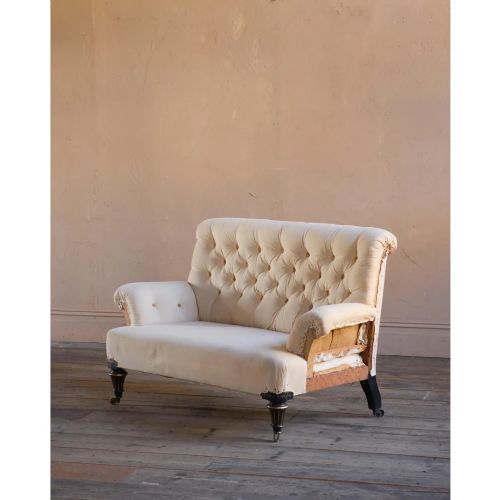
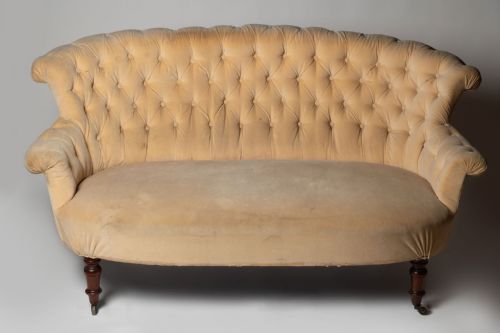


Antique Buttoned Loveseat
An antique buttoned loveseat brings intimate seating and rich upholstery to a room, offering compact comfort paired with period character.
Antique Buttoned Loveseat
An antique buttoned loveseat is a compact two-seater sofa designed for smaller spaces, encompassing forms identified as settees, couches, and canapes across the listings. These seating pieces appear frequently in Victorian, Edwardian, and Napoleon III styles, alongside Aesthetic Movement and French Provincial interpretations.
The pieces on this page span the nineteenth century, nineteen hundred, and nineteen thirty, covering walnut, mahogany, and hardwood frames. Upholstery materials include velvet, leather, calico, and brass details, reflecting diverse origins from English Victorian workshops to French makers.
Materials and construction
Frames are constructed from solid hardwoods including walnut and mahogany, often carved or ebonised to suit Victorian and Aesthetic Movement tastes. Joinery techniques support compact two-seat proportions, ranging from exposed carved walnut to frames prepared for fresh upholstery.
Buttoning forms the defining decorative upholstery technique, securing the fabric deep into the padding to create characteristic tufted patterns. Covering materials vary from hand-dyed leather and velvet to calico foundations, occasionally accented with brass fittings.
Listings feature frames in walnut, mahogany, and general hardwood, paired with velvet, leather, calico, and brass materials across nineteenth-century and early twentieth-century periods.
Judging quality in compact seating
Quality rests in the crispness of the timber carving and the structural integrity of the hardwood frame, distinguishing simple forms from elaborately styled cameo and high-back settees. The precision of the deep buttoning work dictates the refinement of the upholstery finish.
The choice of covering material, from robust hand-dyed leather to fine velvet, shifts the character of the piece while older frames retain the weight and density of solid mahogany and walnut.
A Jackson and Graham
The Antique Buttoned Loveseat Glossary
- Buttoned
- An upholstery technique where stitches pull the fabric deep into the padding in a grid pattern. This creates distinct tufts across the backrest.
- Canape
- A French term for an upholstered sofa or settee, often featuring an exposed wooden frame and carved details. These pieces typically date to French-influenced periods.
- Ebonised
- Wood stained or painted a deep black to imitate ebony. This finish appears frequently on Aesthetic Movement furniture.
- Walnut
- A dense, dark hardwood prized for furniture framing throughout the nineteenth century. Its grain takes fine carving particularly well.
Antique Buttoned Loveseat: Frequently Asked Questions
What is an antique buttoned loveseat?
An antique buttoned loveseat is a compact two-seater sofa featuring deep button-tufted upholstery. These pieces include settees, couches, and canapes dating from the nineteenth century onward.
They appear in styles ranging from Victorian and Edwardian to Napoleon III and Aesthetic Movement, utilising frames of walnut, mahogany, and hardwood.
How were these small sofas used?
These compact seating pieces served as intimate parlour seating or bedroom furniture where full-sized sofas proved too large. Their two-seat proportions provided comfortable conversation spaces.
Upholstered in velvet, leather, or calico, they combined decorative presence with functional seating in period interiors.
How do I identify a Victorian piece?
Victorian examples often feature walnut or mahogany frames with distinctive carving, high backs, or upholstered salon formats. They frequently incorporate deep buttoning and traditional joinery.
Stylistic cues also point to related nineteenth-century movements such as the Aesthetic Movement and Rococo Revival.
What woods were used for frames?
Makers utilised solid hardwoods, most notably walnut and mahogany, alongside general hardwoods and ebonised timber. These materials provided the structural strength required for carved frames and buttoned upholstery.
Brass elements occasionally appear as decorative hardware or castors supporting the frame.