
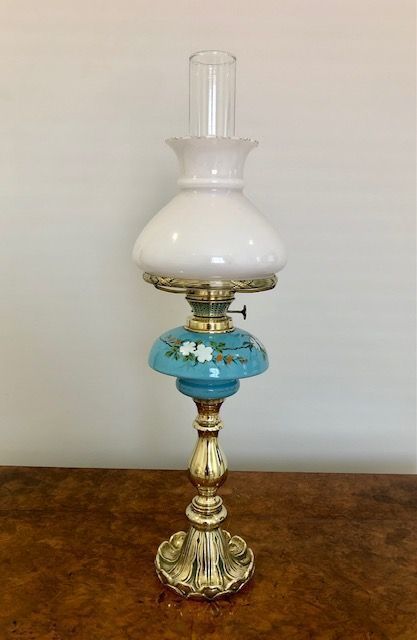


Antique Blue Oil Lamp
An antique blue oil lamp brings rich colour and steady nineteenth-century light into a room, combining brass, glass, and ceramic in one working object.
Antique Blue Oil Lamp
When you search for an antique blue oil lamp, you enter a field defined by nineteenth-century domestic lighting where rich blue glass, ceramic, and porcelain fonts sit upon brass or glass bases. These pieces range from simple finger lamps designed to be carried between rooms to grand Victorian column lamps topped with tinted or globe shades.
You are most likely to meet Victorian examples on this page, often dating from the eighteen-sixties through to nineteen-hundred. They appear in varied forms, including wall brackets, table lamps, and converted vases from French and English workshops.
The blue colour itself varies from the deep tone of Bristol glass to the softer hue of duck egg blue and French bleu celeste. Some examples feature paired fonts and shades, while others rely on the contrast of blue glass bodies mounted on black glass or heavy brass footings.
How they were made
Maker's workshops combined heavy cast brass with moulded or blown glass fonts, joining metal burners to glass reservoirs using plaster or threaded collars. Brass components were frequently embossed or polished, while glass bodies utilised mould-blowing techniques to achieve structural columns, spherical globes, and finger handles.
Ceramic and porcelain elements, such as those seen in Sevres-style vases and painted bodies, were hand-finished and glazed before metal mounts were fitted for domestic oil burning. Burner mechanisms, including those by makers like Hinks, required precise engineering to control the wick and flame safely beneath the glass shade.
Listings span the Victorian era, the Meiji period, and the Qing dynasty, utilising brass, opaline glass, cloisonne enamel, and porcelain.
What varies in quality
Quality rests in the weight of the brass casting, the clarity and depth of the blue glass, and the harmonious proportion between the font, stem, and shade. Superior examples maintain original matched shades, crisp embossing on metal components, and substantial glass without heavy clouding or poor moulding seams.
The sophistication of the burner mechanism and the presence of undamaged original collars also separate standard utility lighting from finer salon pieces. Where the materials remain integrated and honest to their period of manufacture, the object holds greater visual presence.
The Antique Blue Oil Lamp Glossary
- Font
- The oil reservoir of the lamp, typically formed from coloured glass, porcelain, or ceramic to hold the fuel beneath the burner.
- Finger lamp
- A small portable oil lamp featuring a looped handle attached directly to the body, designed to be carried by hand.
- Cloisonne enamel
- Metalwork decorated with coloured enamel compartments separated by thin strips of metal wire, seen on Japanese decorative bodies.
- Bleu celeste
- A distinct bright sky-blue glaze colour associated with French porcelain production, particularly from the Sevres tradition.
- Terrestrial globe shade
- A spherical glass shade painted or moulded to resemble a world map, popular on Victorian lighting.
Antique Blue Oil Lamp: Frequently Asked Questions
What is an antique blue oil lamp?
An antique blue oil lamp is a nineteenth-century lighting device featuring a coloured glass, ceramic, or porcelain reservoir designed to burn paraffin or lamp oil.
These pieces combine functional metal burners with decorative blue bodies, resting on bases of brass, ceramic, or black glass.
How do I date an oil lamp?
Dating relies on stylistic markers, manufacturing techniques, and burner designs patent-dated to specific decades of the nineteenth century.
Victorian and late nineteenth-century examples often display registration marks, specific brass collar stamps, or characteristic moulded glass patterns.
Were these lamps converted to electricity?
Many surviving oil lamps have been adapted for modern electrical use by running a cord through the burner or font.
Original burners and unperforated reservoirs are typically preserved on pieces that remain in their original oil-burning configuration.
How do I clean a glass oil lamp?
Cleaning requires gentle warm water and mild soap, keeping moisture away from antique brass collars and historic wicks.
Careful handling protects hand-painted details and prevents abrasive damage to delicate blue glass surfaces.