
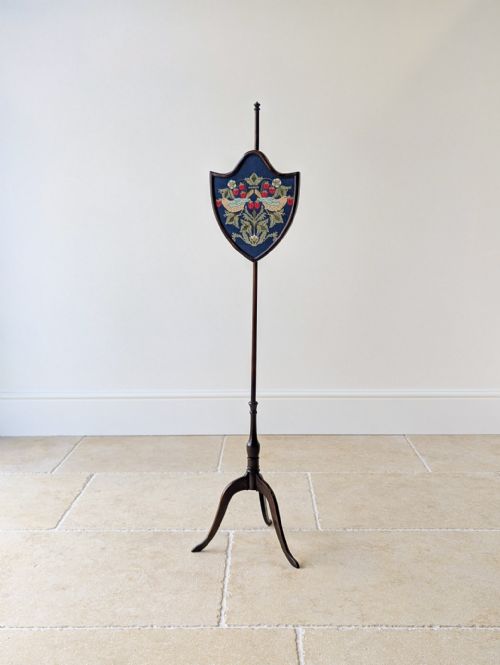


Antique Adjustable Shield Screen
An antique adjustable shield screen shields a face from the fire or focuses candle light, combining fine timber and needlework in a piece every room needs.
Antique Adjustable Shield Screen
An antique adjustable shield screen takes the form of a pole screen or fireside reflector, designed to move up and down on a vertical shaft to manage radiant heat from an open hearth. These furnishings appear primarily in Regency, Georgian, 18th Century, and Victorian periods, often taking the shape of a tripod base holding a sliding panel.
The objects on this page span several material expressions, including fire screens, fireplace screens, and scientific instruments such as a microscopy candle shade. Mahogany, rosewood, satinwood, and giltwood form the structural supports, while the shields themselves utilise glass, textile, fabric, silk, and needlepoint tapestry.
Makers and origins recorded in the listings point to English workshops from around 1800 to 1860. Buyers encounter variations featuring needlepoint tapestry panels, poker work designs, and pivoting brass fittings that govern the height of the shield.
How they were made
Cabinetmakers shaped dense timbers like mahogany and rosewood into slender turned poles and sturdy tripod legs, ensuring stability beside the hearth. Inlaid decoration and giltwood enrich the timber frames, while brass mechanisms allow the central shield to slide and lock at the desired height.
The shields themselves frequently display textile arts, using needlepoint tapestry, silk, and fabric stretched over wooden or brass frameworks. Alternatively, glass panels act as fireside reflectors, and specialised scientific instruments employ polished brass and adjustable shades.
A delicate candle shade once helped a Victorian scientist peer down a microscope without getting his nose scorched by the flame.
What varies in quality
Quality rests upon the selection of timbers and the precision of the turning on the central pole and tripod legs. Dense, finely figured rosewood or mahogany paired with crisp giltwood enrichment distinguishes the finer pieces from simpler workshops.
The execution of the panel elevates a piece, whether through intricate needlepoint tapestry, delicate poker work, or original glass and silk components. The smooth operation of the brass adjustment mechanism also marks the standard of the maker's output.
M Pillischer of London
The Antique Adjustable Shield Screen Glossary
- Pole screen
- A vertical stand with an adjustable sliding panel used to block heat from a fireplace. It sits on a tripod or pedestal base.
- Fireside reflector
- A glass or polished panel designed to bounce light into a room or away from the face. These serve a similar function to standard heat shields.
- Needlepoint tapestry
- Stitched yarn work stretched within the shield frame to provide decoration and insulation against the hearth. This medium often displays floral or figural motifs.
- Poker work
- A decorative technique using a heated metal point to burn designs into wood or leather panels. This method creates shaded brown imagery on the screen surface.
- Microscopy candle shade
- A specialised scientific instrument designed to direct or soften illumination for viewing specimens. It shares the adjustable mounting mechanics of standard screens.
Antique Adjustable Shield Screen: Frequently Asked Questions
What is an antique adjustable shield screen?
An antique adjustable shield screen is a decorative furnishing featuring a vertical pole and a sliding panel. It was placed near a fireplace to protect the face from the heat of the fire.
These pieces typically date from the Georgian and Regency eras through to the Victorian period. They combine cabinetmaking in timbers like mahogany with textile arts such as needlepoint.
How were pole screens used?
People placed these screens between themselves and an open hearth to prevent facial makeup from melting or skin from overheating. The adjustable panel slid up and down the pole to match the sitter's height.
They also functioned as decorative room accessories when the hearth was not in use. Some variations acted as reflectors for candlelight or scientific work rather than fireplace guards.
How do I date a pole screen?
Dating relies on the style of the woodwork, such as the tripod base design and timber choice. Regency and George III examples often feature fine mahogany or rosewood with delicate turning.
Victorian pieces frequently utilise satinwood or heavier proportions. Original textiles and brass adjustment hardware also provide clues to the exact period of manufacture.
What materials are used in these screens?
The frames and poles consist of hardwoods like mahogany, rosewood, satinwood, and giltwood. Tripod bases provide stability on carpeted or wooden floors.
The shields incorporate glass, silk, fabric, and needlepoint tapestry. Brass components allow the panel to move along the vertical shaft.