




Anglo Indian Pedestal Desk
An anglo indian pedestal desk brings together dense tropical timbers and intricate carving, built to serve colonial officers and scholars across the nineteenth century.

Anglo Indian Pedestal Desk
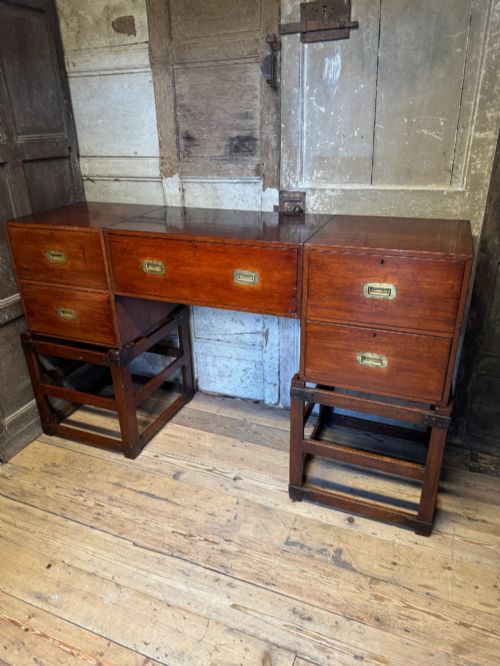
An anglo indian pedestal desk is a substantial writing furniture form produced during the colonial period, combining British cabinet proportions with native craftsmanship. These pieces typically feature pedestal banks of drawers flanking a central kneehole, often built to heavy proportions.
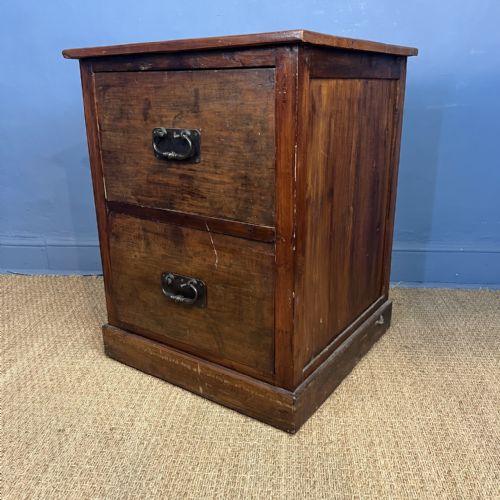
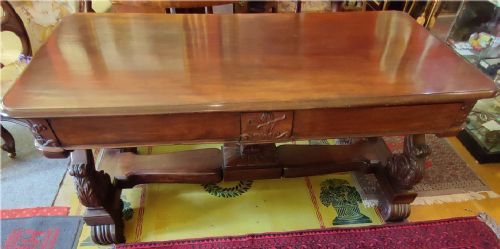
The examples found here draw on nineteenth century periods, including Victorian and Regency eras. Alongside standard pedestal desks, buyers encounter related forms such as partners desks, Davenport writing desks, and filing cabinets.
Originating in workshops across the Indian subcontinent for British administration use, these desks utilise dense imported timbers adapted to tropical conditions. Their survival reflects robust construction designed for colonial officers and merchants.
How They Were Made
Cabinetmakers constructed these desks using heavy tropical hardwoods, predominantly padauk, teak, rosewood, and mahogany. These timbers were selected for their stability and resistance to humidity.
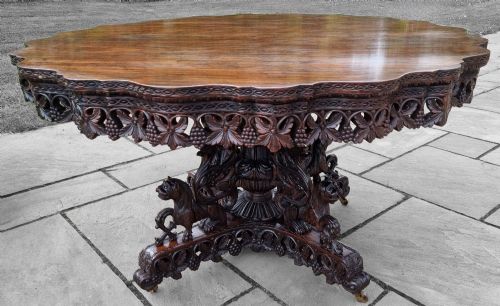
Surface decoration relies heavily on deep hand carving, often floral or foliate in motif, applied directly to the solid timber framing rather than veneered surfaces. Structural joints were reinforced with brass and iron hardware to withstand transit.
Scholar's reading stands in the collection fold flat, proving that nineteenth-century intellectuals also suffered from tight luggage restrictions.
What Varies in Quality
The standard of carving defines the upper tier of these desks, distinguishing deep, crisp relief work from shallower, repetitive execution. The choice of timber also dictates quality, with dense figured padauk and richly grained rosewood commanding greater visual depth than plainer teak.
Integrity of construction and original hardware remain central to a piece's standing, separating unaltered examples from those with later alterations or replaced components. Proportion and balance in the pedestal layout further separate master workshop output from simpler regional production.
Currie and Co Calcutta
The Anglo Indian Pedestal Desk Glossary
- Padauk
- A dense, heavy tropical hardwood native to Southeast Asia and India, known for its deep reddish-brown colour that darkens with age. It forms the primary structural and decorative material for many high-status colonial furnishings.
- Pedestal desk
- A form of writing furniture comprising two separate banks of drawers that support a wide writing top, creating a kneehole space in the centre. This configuration provides substantial storage capacity while allowing a seated user comfortable access.
- Partners desk
- A large double-sided writing table designed for two people to work opposite one another, featuring drawers and cupboards on both longitudinal faces. Such pieces were standard in administrative offices and large libraries.
- Davenport
- A compact writing desk featuring a sloping, hinged desktop above a pedestal of side-opening drawers. Originating in the Regency period, this form maximised storage within a small footprint.
- Campaign furniture
- Portable items designed to be easily dismantled and packed into trunks for military officers or officials on the move. These pieces often incorporate flush brass fittings and reinforced corners.
Anglo Indian Pedestal Desk: Frequently Asked Questions
What is an anglo indian pedestal desk?
An anglo indian pedestal desk is a nineteenth-century writing table featuring dual drawer pedestals, built in India using dense local timbers like padauk and teak. These pieces combine traditional British furniture layouts with intricate regional hand carving.
They served administrators and merchants within the colonial network, offering heavy construction and substantial storage. Their distinct appearance sets them apart from standard domestic British furniture of the same era.
How do I date an anglo indian desk?
Dating relies on examining the timber selection, construction methods, and stylistic cues present in the carving and hardware. Pieces from the Regency period or early nineteenth century often display restrained classical proportions, whereas Victorian examples tend towards heavier ornamentation.
Secondary woods used inside the drawers and the presence of brass or iron campaign-style fixings also provide clues. Comparing the carving depth and motifs against documented nineteenth-century pieces helps narrow the decade of production.
How should I care for padauk furniture?
Padauk and other tropical hardwoods require stable indoor humidity to prevent timber movement and cracking in the solid panels. Regular dusting with a soft, dry cloth maintains the surface without the need for heavy chemical polishes.
Keeping the desk away from direct heat sources and strong sunlight preserves the deep red tones of the wood. Natural wax can be applied sparingly to nourish the grain when the surface appears dry.