
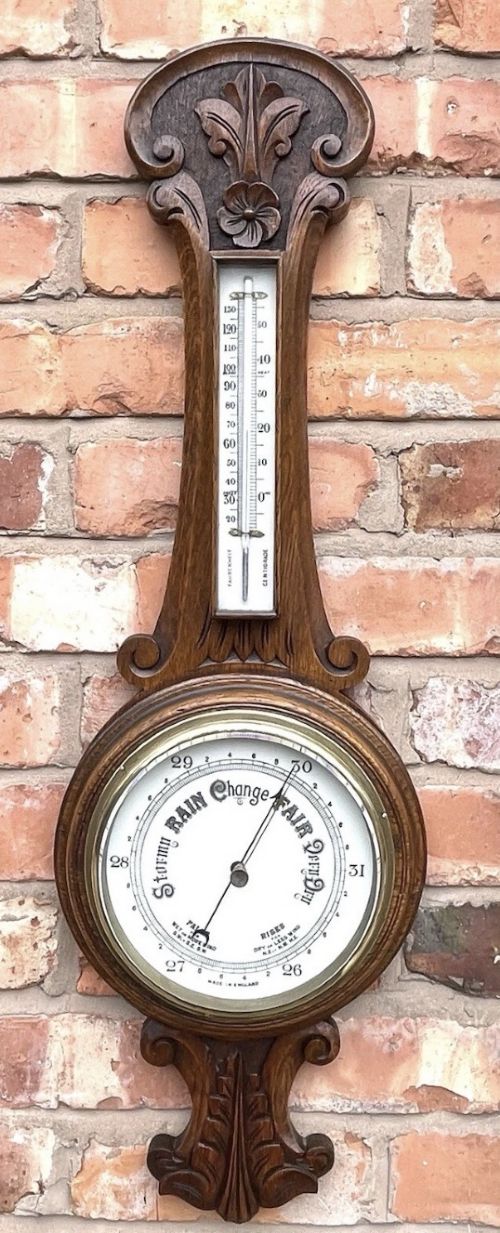


Aneroid Barometer Clock
An aneroid barometer clock is a dual-function household instrument that measures atmospheric pressure and tells the time, combining utility with Victorian and Edwardian craftsmanship.
Aneroid Barometer Clock
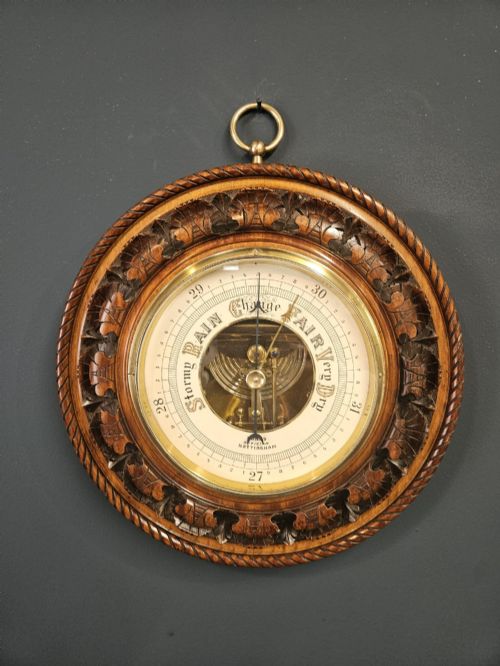
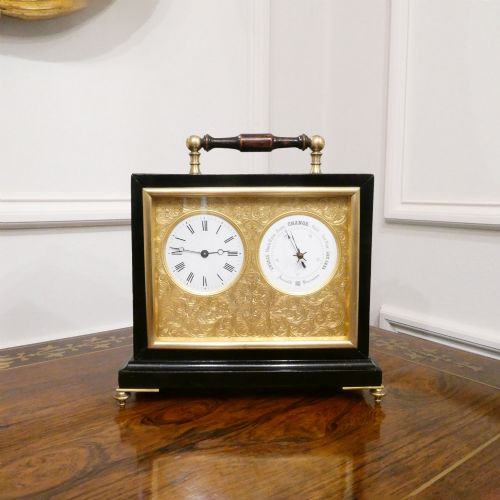
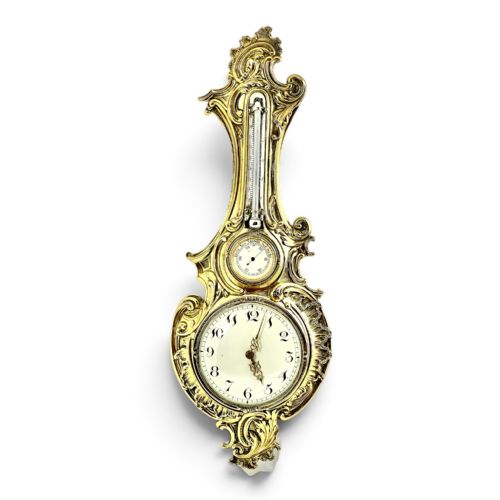
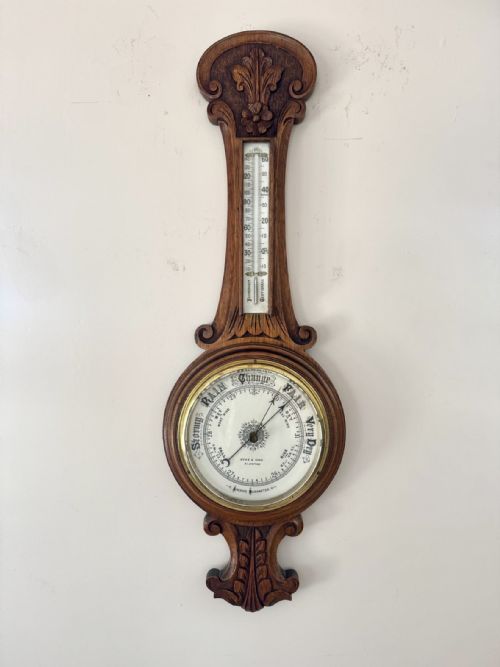
An aneroid barometer clock brings together timekeeping and weather forecasting within a single housing, appearing most frequently in this selection as wall-mounted banjo instruments or mantel-standing combinations. These pieces merge dials for barometric pressure and time, often accompanied by thermometers, to serve both domestic convenience and interior decoration.
The objects seen here span the Victorian, Edwardian, and early twentieth-century periods, showing forms from architectural oak desk clocks to wall-hung Black Forest carvings and maritime brass bulkheads. Walnut and oak form the predominant casework, while skeletonised movements and silver-gilt station instruments represent the more elaborate expressions of the type.
How they were made
Cabinetmakers utilised dense timbers such as walnut and oak, shaping them through carving and turning to house delicate mechanical movements alongside pressure-sensitive aneroid capsules. Ebonised finishes and brass fittings added structural contrast and visual weight to the timber housings.
Dials were rendered in enamel, ceramic, or silvered bronze, featuring painted or etched numerals that required precise hand-finishing to remain legible alongside the barometer and thermometer scales.
Listings feature woods like oak, walnut, and ebonised timber, alongside brass, glass, and enamel.
What varies in quality
The standard of carving and the selection of timber dictate the primary tier of quality, with deeply sculpted walnut and figured oak casework marking out the more ambitious workshops. Simpler architectural boxes represent standard domestic production.
The integration of multiple instruments - such as the inclusion of thermometers, hygrometers, or 8-day clock movements within a single carved frame - distinguishes complex compendiums from basic combination pieces.
Hyde & Sons Sleaford·Negretti & Zambra
The Aneroid Barometer Clock Glossary
- Aneroid barometer
- An instrument that measures atmospheric pressure using a flexible-walled metal capsule without liquid. Changes in pressure cause the capsule to expand or contract, moving a pointer across a calibrated dial.
- Banjo barometer
- A wall-mounted barometer housed in a vertical wooden case shaped loosely like a banjo. This form typically accommodates a thermometer above and a large circular dial below.
- Desk compendium
- A multi-instrument desk accessory grouping a clock, barometer, and thermometer into a unified architectural or figurative stand. These were popular for office and library use during the late nineteenth century.
- Skeletonised
- A design style where the dial and plates of a clock or barometer are cut away to reveal the internal mechanical workings. This exposes the brass gears and levers to view.
- Silver gilt
- Silver objects coated with a thin layer of gold to give a warm, rich metallic finish. It appears on high-status Victorian desk stations and instruments.
Aneroid Barometer Clock: Frequently Asked Questions
How do aneroid barometer clocks work?
An aneroid barometer uses a sealed, corrugated metal box that expands or contracts as air pressure shifts. This microscopic movement is transferred through levers to the dial pointer you see on the face.
The accompanying clock movement operates independently through a spring-driven or weight-driven gear train, sharing the housing purely for domestic convenience.
Where should I hang a wall barometer?
Hang your barometer on an interior wall away from direct sunlight, radiators, and heavy draughts. Rapid temperature swings affect the metal components and timber casework.
Choose a stable partition where the instrument can be easily viewed at eye level for daily weather observation.
How do I date an aneroid barometer clock?
Examine the timber, dial style, and casework architecture to determine the period. Heavy walnut carvings often point to the Victorian era, while lighter oak and cleaner lines suggest Edwardian production.
Maker signatures, registered design marks, or paper labels pasted inside the rear door also provide specific chronological clues.
Can these barometers still forecast weather?
Most antique aneroid barometers can still track pressure changes after a careful calibration against a known local reading. Adjust the pointer using the small screw on the back or front case.
Keep in mind they reflect immediate barometric trends rather than precise local forecasts.