


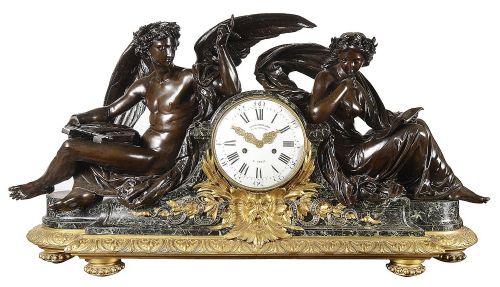


Allegorical Mantel Clock
An allegorical mantel clock turns timekeeping into storytelling, pairing mechanical precision with classical myth, philosophy or romance.
Allegorical Mantel Clock
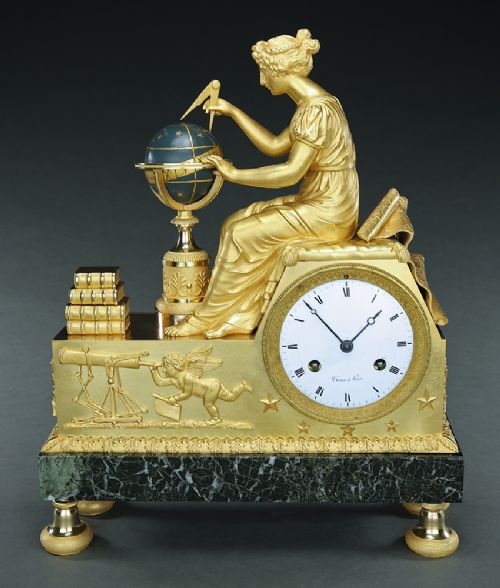
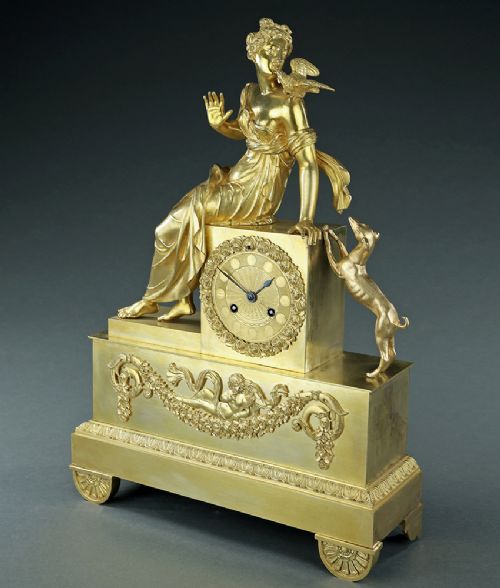
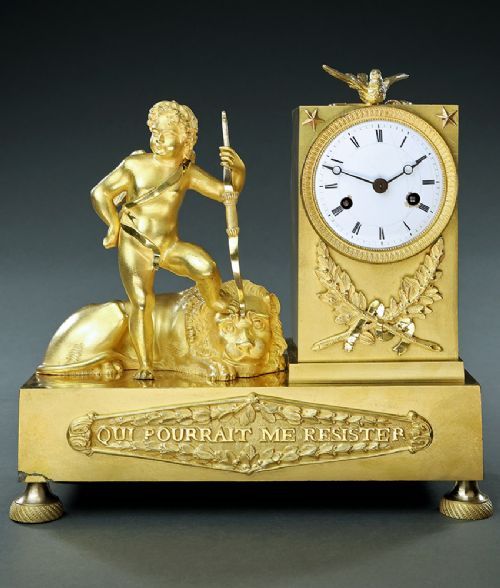
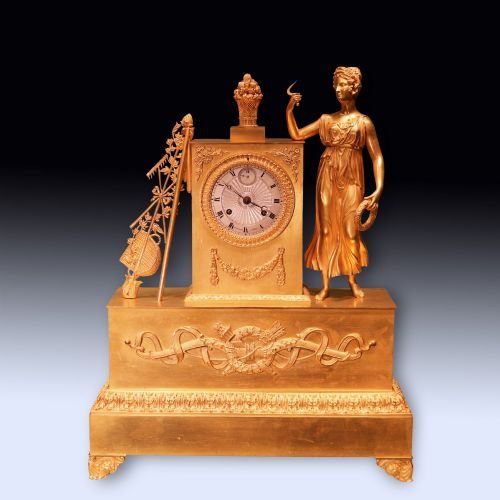
An allegorical mantel clock uses figural sculpture to represent abstract concepts such as love, astronomy, literature or fidelity. These pieces serve as both functional timepieces and sculptural focal points for a room.
You are most likely to encounter French examples from the nineteenth century, ranging from the formal symmetry of the Empire and Louis XVI styles to the flowing lines of Art Nouveau.
Forms include single mantel clocks and larger clock garnitures that incorporate matching side ornaments. The subjects draw heavily on classical mythology and nineteenth-century allegorical themes.
Materials and construction
The heavy brass and bronze sculptural elements are often finished with fire gilding or ormolu, creating a brilliant, layered metallic surface. Enamel is frequently utilised for the visible clock dial faces.
Bases combine contrasting materials like rouge marble and patinated bronze, providing stability and visual weight to the composition. Cast metal components are meticulously chased by hand to sharpen the detail of hair, drapery and floral motifs.
Chastity points firmly at a font of holy water while time quietly ticks away beneath her gaze.
Distinctions in quality
Quality rests upon the crispness of the bronze casting and the depth of the subsequent hand-chasing, which separates ordinary production from workshop masterpieces. Finer examples retain their original mercury gilding, showing a warm, deep lustre rather than a flat, modern metallic finish.
The sculptural integration matters profoundly, where figures, dials and architectural marble mounts are conceived as a single harmonious design rather than assembled from disparate parts.
Canaillor of Paris·Victor Paillard
The Allegorical Mantel Clock Glossary
- Ormolu
- Gilded bronze, typically produced using a mercury amalgamation technique during the eighteenth and nineteenth centuries. This process creates a durable and luminous gold finish.
- Garniture
- A set of matching decorative objects, commonly comprising a central clock flanked by two matching vases, candelabra or urns. These sets are designed to sit together on a mantelpiece.
- Spelter
- A zinc alloy frequently utilised as a less expensive alternative to bronze for sculptural figures, often given a bronze-coloured metallic paint finish. It is softer and lighter than true bronze.
- Chasing
- The hand-tooling of metal surfaces with punches and hammers after casting to refine details, textures and contours. Superior chasing distinguishes high-end French clockmaker production.
Allegorical Mantel Clock: Frequently Asked Questions
What is an allegorical mantel clock?
An allegorical mantel clock is a decorative timepiece featuring figural sculpture that symbolises a specific theme, such as astronomy, literature or fidelity.
These pieces combine functional clockwork movements with sculptural art, often drawing on classical mythology or philosophical concepts popular in the nineteenth century.
What is a clock garniture?
A clock garniture is a matched set consisting of a central mantel clock accompanied by two side ornaments, such as urns or candelabra.
These sets were designed to create a balanced, imposing display across a fireplace mantel or large sideboard.
How should I care for ormolu surfaces?
Ormolu surfaces require gentle dusting with a soft, dry brush to prevent the accumulation of grit in the chased recesses.
Avoid using liquid cleaners, polishes or abrasive cloths, as these can permanently strip or damage the historic gilt layer.