
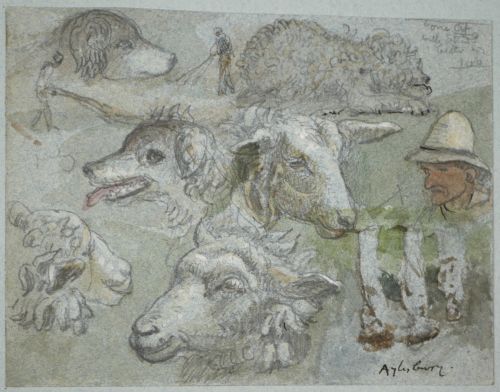


Agricultural Watercolour Painting
An agricultural watercolour painting captures the quiet rhythm of rural labour, offering a direct window into farming life through delicate pigments on paper.
Agricultural Watercolour Painting
An agricultural watercolour painting depicts traditional rural scenes such as harvesting, ploughing, and farm animals set within British landscapes. These original works span from the nineteenth century through the Edwardian period and into the mid-twentieth century.
Buyers will most frequently encounter framed works created during the 1900s and 1910s, reflecting Victorian pastoral and British Impressionist traditions. Common subjects include haymaking, cart horses, and farm hands at work.
The compositions range from detailed nineteenth-century drawings to later Modern British interpretations of rural shows and stack yards. Each piece records agricultural practises that have largely disappeared from the modern countryside.
Materials and Technique
These works are executed using watercolour paint and pigment applied to paper, often accompanied by graphite underdrawing or ink detailing. Artists layered translucent washes to build depth in fields, skies, and figures.
Framing typically involves glass protection paired with wood or burr wood frames that complement the natural tones of the landscape. The combination of paper support and traditional pigment requires careful preservation away from direct sunlight.
Several watercolours preserve the quiet dignity of working horses and heavy bulls taking a well-earned rest after a long day in the fields.
Assessing Quality
The strength of the composition and the artist's ability to render human figures and working animals animate the upper tier of these works. Finer examples capture movement and atmosphere in the field rather than relying on rigid botanical or topographical accuracy.
Condition of the paper support and the vibrancy of the watercolour pigment distinguish superior pieces from faded examples. Original framing materials, such as period wood frames, also contribute to the integrity of the piece.
James Smetham·Oswald Garside·James William Booth·Henry Bailey·John Atkinson·George Soper·Rowland Henry Hill·Joseph Kirkpatrick·Arthur Claude Strachan·Walter Duncan·George Hamilton Constantine·Sonia Lawson·George Graham·Fred Lawson·Charles James Adams·JE Hood
The Agricultural Watercolour Painting Glossary
- Watercolour paint
- A medium consisting of colour pigments suspended in a water-based solution, applied to paper to create translucent washes.
- Graphite
- A form of carbon used for preliminary sketching beneath watercolour paint to outline figures and landscape elements.
- British Impressionism
- An art movement focusing on natural light and everyday rural scenes, prominent in many early twentieth-century paintings.
- Victorian Pastoral
- A genre celebrating idealized rural life, agricultural labour, and bucolic countryside views.
Agricultural Watercolour Painting: Frequently Asked Questions
How should I hang my watercolour?
Hang your watercolour painting away from direct sunlight to prevent the pigments from fading over time.
Ensure the room maintains stable humidity levels to protect both the paper support and the wooden frame.
What subjects do these paintings feature?
The works primarily depict rural and agricultural scenes, including haymaking, ploughing teams, and farm labourers.
Cattle, horses, stack yards, and harvest landscapes also appear frequently across the collection.
How do I identify the period?
Periods are identified through stylistic traits, artist signatures, and framing materials characteristic of the nineteenth and twentieth centuries.
Edwardian and Victorian pastoral styles offer distinct visual clues regarding the date of execution.