



Agricultural Landscape Painting
An agricultural landscape painting captures the rural labour, heavy horses and harvest fields of the nineteenth and early twentieth centuries.
Agricultural Landscape Painting
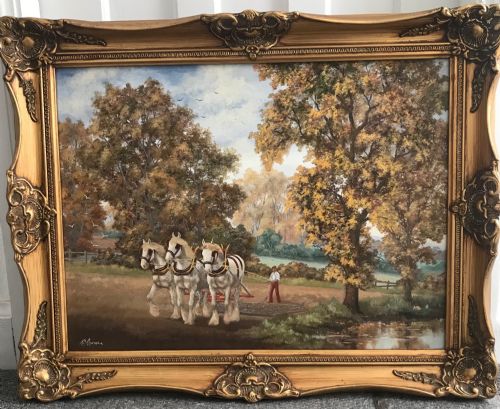
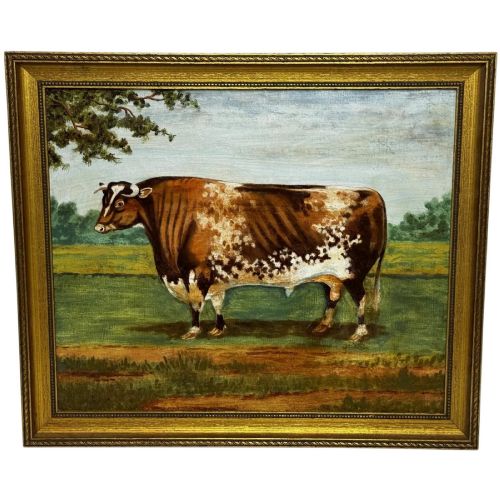
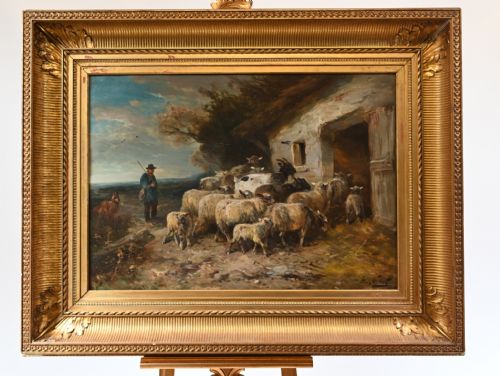
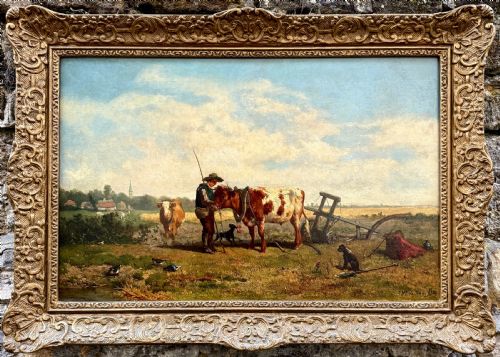
When you search for an agricultural landscape painting, you encounter works recording the rural economy, from working shire horses to harvest scenes in fields and farmyards. These pieces emerge predominantly from the Victorian era, the Edwardian period, and the opening decades of the twentieth century.
The subjects focus heavily on livestock like shorthorn bulls and sheep flocks alongside farmhands at work with carts and ploughs. You meet watercolours on paper and oil paintings on canvas, framed variously in wood or ebonised surrounds.
Materials and Techniques
Artists painted primarily in oil on canvas or applied watercolour to paper, employing traditional brushwork to render figures, animals and rural scenery. Support materials include timber stretching frames and applied gesso on timber frames.
The surfaces display the textured build-up of oil paint or the fluid washes characteristic of period watercolours. Framing often utilises timber, sometimes with ebonised finishes or burr wood grain.
The current selection spans from the Victorian era through the Edwardian period and into the nineteen-fifties.
Quality Variations
Quality rests upon the artist's command of anatomical proportion in horses and cattle, alongside the convincing depiction of light across open fields and farmyards. Stronger examples display confident brushwork and balanced composition, capturing movement in working animals rather than static poses.
Condition also dictates standing, particularly the preservation of the original paint layer or watercolour pigment free from heavy fading, alongside the integrity of the period frame.
Henry Schouten·Johannes de Haas·A M Gauci·Oswald Garside·Raimond Louis Lecourt·James William Booth·Henry Bailey·Herbert Royle·Percival Glenfern·John Atkinson·J C Grey·George Soper·Arthur Winter Shaw·Arthur Charles Dodd·Vernon Stokes·Rowland Henry Hill·Joseph Kirkpatrick·W A Clark·Joseph Paulman·J L Van Leemputten·Frederick William Jackson·John Percy Cooke·W E Millner·Arthur Claude Strachan·Ernest Higgins Rigg
The Agricultural Landscape Painting Glossary
- Canvas
- A heavy woven fabric stretched across a wooden frame to serve as a support for oil paint. It provides a textured surface that holds thick applications of pigment.
- Gesso
- A plaster mix applied to wooden frames or panels to prepare a smooth surface for gilding or painting. It creates a solid base for decorative mouldings.
- Watercolour
- A paint consisting of pigment suspended in a water-soluble binder, traditionally worked on paper. It relies on the white of the paper showing through translucent washes.
- Ebonised
- Wood finished to resemble ebony, typically through dark staining or painting. This technique creates a deep black, glossy or matte appearance popular in period frames.
- Provenance
- The documented history of ownership surrounding an artwork. It establishes authenticity and traces the journey of the piece through time.
Agricultural Landscape Painting: Frequently Asked Questions
What subjects appear in these paintings?
These works depict rural life, centring on working horses, cattle, sheep and farmworkers engaged in harvesting and ploughing.
The scenes capture the daily routines of farming across British and European landscapes during the nineteenth and early twentieth centuries.
How do I date an agricultural painting?
Dating relies on stylistic evidence, artist signatures, framing materials and inscribed dates left by the painter.
Victorian and Edwardian works often carry distinct clothing styles, agricultural equipment and tonal palettes characteristic of their decade.
Are these works originals or prints?
The listings comprise original paintings and watercolours executed by hand directly onto canvas or paper.
Every piece represents a unique artistic creation rather than a mechanical reproduction.
How should I display an oil painting?
Hang oil paintings away from direct sunlight and dramatic fluctuations in household temperature and humidity.
Ensure the wall fixings safely support the weight of the timber frame and canvas stretcher.