


Edwardian Pastoral Watercolour
An edwardian pastoral watercolour captures the quiet charm of British rural life through delicate pigment on paper.
Edwardian Pastoral Watercolour
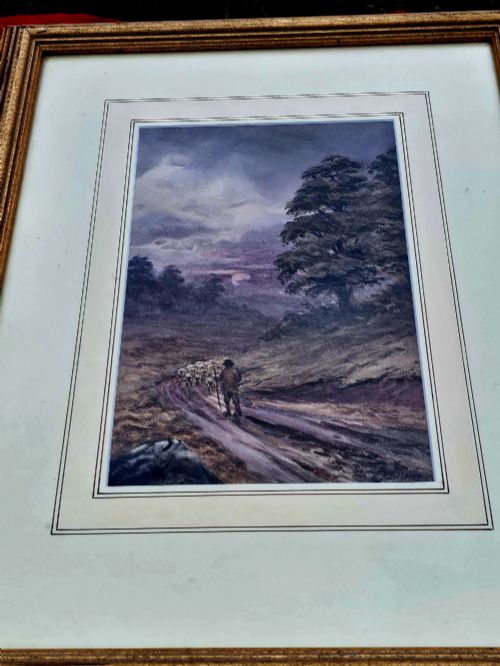
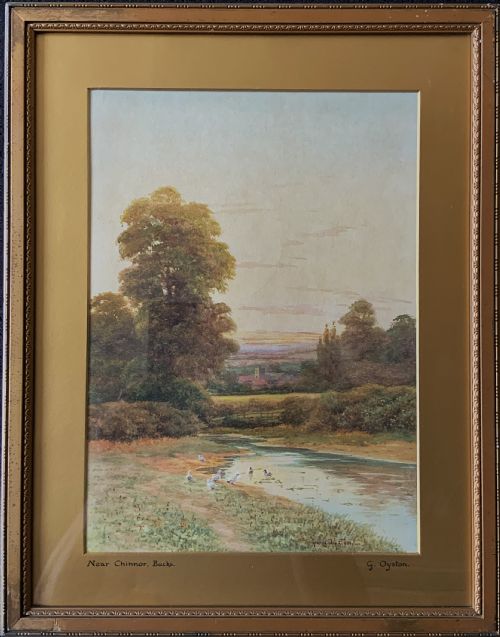
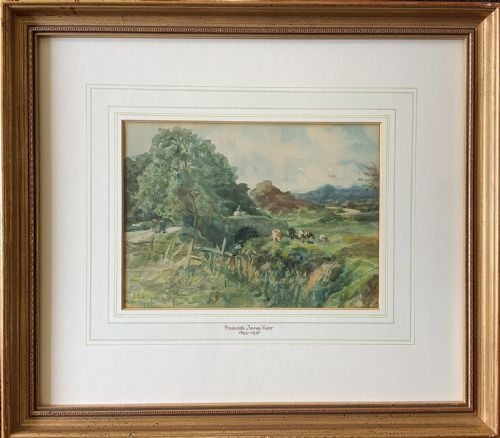
An edwardian pastoral watercolour depicts traditional rural scenes such as herding sheep, harvesting crops, and thatched cottages by streams. The versions found here span the late nineteenth century into the early decades of the twentieth century, reflecting a period of intense affection for the British countryside. These framed artworks bring the atmosphere of quiet meadows and farming life directly onto the wall.
Most pieces show influences from traditional British fine art, the Pre-Raphaelite movement, and early impressionist landscape traditions. Subjects range from solitary shepherds and drovers guiding livestock to children fishing at dusk in Thameside villages. Each painting acts as a historical window into rural pursuits before the widespread arrival of modern mechanisation.
How they were made
Artists painted primarily with watercolour pigment suspended in water, applied directly onto absorbent paper supports. Many of these works retain their original timber frames, occasionally accented with gold leaf or gilt detailing to frame the composition. Glass panels protect the delicate paper surface from moisture and environmental degradation over the decades.
The technique relies on transparent washes of colour that allow the reflective quality of the white paper to shine through the pigment. Painters built up depth by layering lighter tones before introducing darker accents to define shadows in foliage, livestock, and rustic architecture.
Several sheep clearly seized the artistic moment, patiently posing across nineteenth-century pastures for remarkably attentive painters.
What varies in quality
The skill of the draughtsman dictates the naturalism and anatomical accuracy of figures and livestock within the landscape. Master practitioners control fluid washes to create atmospheric light and weather effects, whereas lesser hands produce flat, uniform skies and stiff compositions.
Preservation of the paper and the vibrancy of the original pigments play a major role in the standing of a piece. Works exposed to excessive sunlight suffer from faded pigments, losing the subtle tonal shifts that separate a competent study from a finished exhibition painting.
George Oyston·Philip Richard Morris·Oswald Garside·Henry Charles Fox·Ernest Pile Bucknall·Alfred Grey·Harold Lawes·Harry Sylvester Stannard·Robert Hollands Walker·Basil Bradley·Thomas James Lloyd·Joseph Kirkpatrick·Henry Sykes·John R. K. Duff·Walter Duncan·Thomas Mackay·Walter Henry Sweet·Thomas Nicholson Tyndale·Frederick J. Knowles·Charles James Adams·Benjamin D. Sigmund·Thomas Pyne·Henry J. Kinnaird·David Heward·Jessie Hall
The Edwardian Pastoral Watercolour Glossary
- Watercolour pigment
- Finely ground colour particles mixed with a water-soluble binder for application on paper. This medium allows artists to achieve luminous effects through thin, translucent layers.
- Pre-Raphaelite Movement
- An artistic association focused on detailed observation, bright colours, and serious subjects inspired by nature. Painters in this orbit approached rural themes with intense botanical accuracy.
- Gilt
- A thin layer of gold applied to wood mouldings on frames. This finish adds a warm metallic border that enhances the colours within the painting.
- Provenance
- The documented history of ownership and origin for an artwork. Establishing this trail connects the piece to specific exhibitions, artists, or historical collections.
Edwardian Pastoral Watercolour: Frequently Asked Questions
What subjects appear in these watercolours?
Paintings frequently feature farm workers, shepherds with flocks, cattle watering in rivers, and rural cottages. Scenes capture everyday agricultural tasks across various British counties.
Artists focused heavily on traditional countryside routines, recording landscapes before modern industrial changes altered the rural horizon.
How should these framed watercolours be displayed?
Hang paintings away from direct sunlight to prevent the watercolour pigments from fading over time. Stable indoor humidity levels protect both the historic paper and the wooden frames.
Keep the original glass intact, as it safeguards the fragile paper surface from atmospheric pollutants and dust accumulation.
How do you date an edwardian pastoral watercolour?
Dates often rely on artist biographical records, signature styles, and framing materials typical of the period. Exhibition labels or inscriptions on the reverse of the paper provide direct chronological clues.
Stylistic shifts between Victorian academic realism and later impressionist approaches help narrow down the decade of creation.
Are these paintings original works?
Every listed piece is a hand-painted original work on paper rather than a modern print or reproduction. Individual brushstrokes and the texture of the paper remain visible under close inspection.
Artists signed many of these watercolours directly on the front or recorded titles and locations on the reverse.