
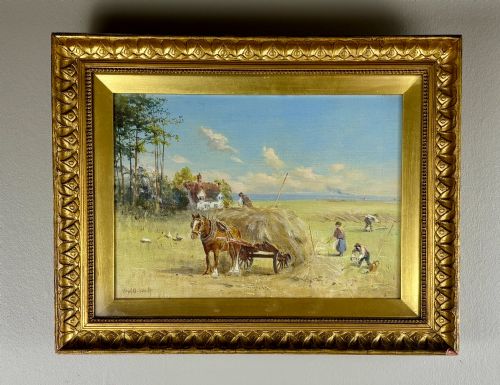


Vintage Hay Harvest Artwork
Vintage hay harvest artwork captures rural labour on canvas and paper through British Impressionism and Victorian Pastoral scenes.
Vintage Hay Harvest Artwork
Vintage hay harvest artwork brings rural farming scenes into domestic interiors through paintings and watercolours. These pieces record agricultural landscapes from the late nineteenth century up to the mid twentieth century, capturing historical farming methods before mechanisation took over.
The selections available on this page include watercolours and oil paintings created during distinct periods such as the Edwardian era and Victorian times. Buyers encounter works attributed to named artists alongside examples from the naive school, all focusing on hay carts, meadows and harvest time.
Formats vary from intimate watercolours on paper to large oil paintings framed in wood and gilt. Each piece depicts agricultural scenes ranging from the Wharfedale landscape to rural fields worked by hand and horse.
Materials and methods
Artists painted these rural scenes using oil paint or watercolour pigment applied to canvas, paper or wood panels. Oil paintings allowed for rich textures and deep tones, while watercolours offered a transparent lightness suited to pastoral skies and open fields.
Finished works found their presentation in wooden frames, sometimes incorporating gilt details to enhance the visual weight of the composition. The physical support typically matches the period of creation, with nineteenth and twentieth century pieces utilising standard artistic substrates of their day.
Assessing quality
Quality rests upon the artist's handling of light, atmosphere and perspective within the agricultural setting. Stronger works demonstrate confident brushwork and a convincing sense of space, whether executed in the style of British Impressionism or straightforward realism.
The depth of the composition and the fidelity of the rural observation separate accomplished professional works from simpler naive school pieces. Material preservation of the canvas or paper also influences the overall standard of the artwork.
James William Booth·John Atkinson·Herbert Royle·Frederick William Jackson·Walter Duncan·George Hamilton Constantine·William Kay Blacklock·Robert Thorne Waite
The Vintage Hay Harvest Artwork Glossary
- Watercolour
- A painting method where fine pigment is suspended in a water-based solution and applied to paper. This medium creates translucent washes that capture outdoor light.
- Oil paint
- A slow-drying paint made by mixing pigment particles with a drying oil, typically used on canvas or wood. It permits thick impasto application and subtle colour blending.
- Gilt
- A thin layer of gold leaf applied to wood frames or surfaces. It provides a decorative metallic border that complements traditional paintings.
- Naive art
- Artwork created by individuals without formal academic training, often characterised by a direct perspective and unpretentious use of line and colour.
- Impressionism
- An art movement focusing on accurate depiction of light and ordinary subject matter. British practitioners applied these principles to rural landscapes and agricultural toil.
Vintage Hay Harvest Artwork: Frequently Asked Questions
What periods do these artworks cover?
The pieces span from the late nineteenth century through the Edwardian period and into the nineteen-fifties. They reflect shifting artistic approaches from Victorian Pastoral traditions towards British Impressionism and naive school painting.
Each era brings distinct stylistic choices regarding palette, brushwork and the portrayal of agricultural workers and their horses.
How should I frame an unframed painting?
Selecting a frame depends on the period and medium of the artwork, with wood and gilt mouldings being traditional choices for these rural subjects. Ensure the artwork is mounted with conservation-grade materials to prevent acid damage to the paper or canvas.
Consulting a professional picture framer helps protect watercolours behind suitable glass while maintaining adequate spacing from the surface.
Where were these scenes typically painted?
Artists painted these agricultural subjects across British rural locations, capturing specific regions like Wharfedale alongside unnamed meadows and fields. The imagery documents traditional haymaking practices involving hand scythes and horse-drawn carts.
Such locations served as primary subjects for artists associated with regional realism and pastoral art movements.
How do I care for vintage watercolours?
Watercolour paintings require protection from direct sunlight to prevent the pigments and paper from fading over time. Displaying them away from moisture-prone areas preserves both the paper substrate and the integrity of the watercolour pigment.
Using UV-protective glass during framing further safeguards the piece against environmental degradation.