

3 Tier Corner Shelf
A 3 tier corner shelf transforms neglected room angles into display space with stacked open surfaces.
3 Tier Corner Shelf
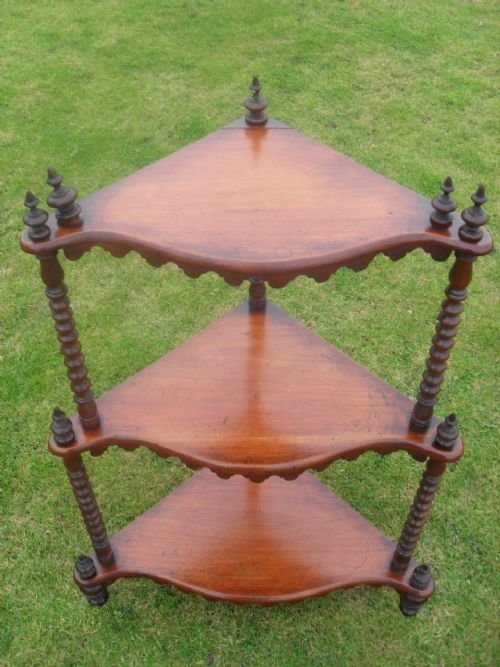
A 3 tier corner shelf takes the form of tiered shelving units, etageres, and whatnots designed to fit into room angles. These pieces provide vertical display surfaces without taking up central floor area in a room.
The pieces appearing in this category span the Georgian, Regency, and Victorian periods, alongside Edwardian examples and items from around nineteen hundred. Mahogany and burr walnut dominate the structural choices, accompanied by rosewood, brass, and ebonised wood.
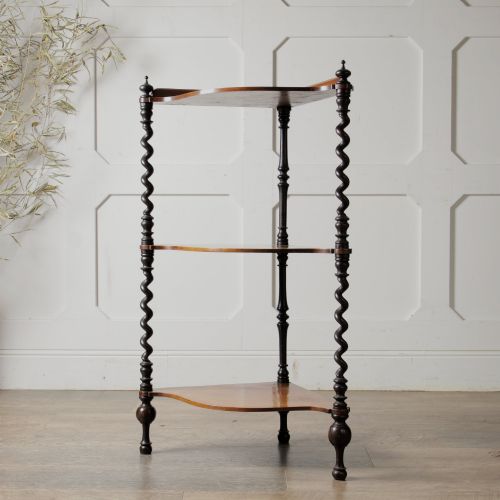
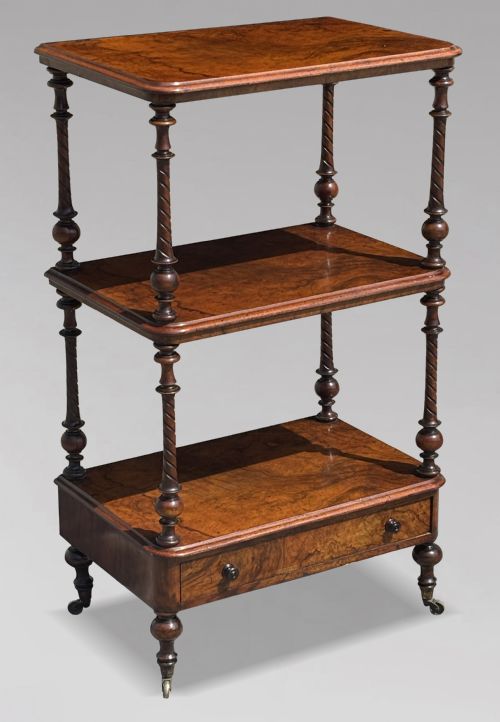
Victorian walnut and mahogany examples represent the most common finds, frequently incorporating turned supports, barley twist columns, or inlaid decoration. Corner stands and hanging variants serve similar functions for displaying small decorative objects.
Materials and construction
Cabinet makers utilised dense hardwoods such as mahogany, walnut, and rosewood, often selecting figured burr veneers for prominent display surfaces. These timbers provided the structural integrity required to support multiple stacked tiers without excessive bulk.
Joinery methods included turned uprights, brass or gilt metal mounts, and occasionally iron or bamboo frameworks for specific stylistic effects. Inlaid parquetry and contrasting ebonised details appeared on pieces influenced by the Aesthetic Movement and French Revival styles.
Listings in this category feature pieces from the Georgian, Regency, and Victorian periods, constructed in mahogany, walnut, rosewood, and wrought iron.
Distinctions in quality
Selection of timber grain dictates much of the visual distinction, particularly where figured burr walnut or rich rosewood veneers are employed on the shelves. Superior examples display careful matching of wood grains across the tiers and finely turned structural supports.
Gillows
The 3 Tier Corner Shelf Glossary
- Whatnot
- A piece of furniture consisting of a set of open shelves for displaying small objects or books. These developed during the eighteenth century and remained popular throughout the Victorian era.
- Etagere
- A piece of furniture with a set of open shelves for displaying ornaments. The term often applies interchangeably with whatnot in nineteenth-century listings.
- Burr walnut
- Wood taken from the warted growths on walnut trees, yielding highly figured grain patterns. Cabinet makers prized this material for decorative veneer panels.
- Barley twist
- A type of furniture turning resembling a twisted rope. This technique appeared frequently on upright supports during the Victorian period.
- Aesthetic Movement
- A late nineteenth-century design style emphasising visual beauty over narrative content. Pieces from this movement often feature ebonised wood and Japanese-inspired details.
3 Tier Corner Shelf: Frequently Asked Questions
What is a 3 tier corner shelf used for?
These tiered structures held books, ceramics, and decorative ornaments in domestic interiors. Their corner footprint allowed them to utilise dead space in parlours and drawing rooms.
They functioned primarily as display furniture rather than heavy storage. The open shelves kept collections visible from various angles in the room.
How do I identify a Victorian corner shelf?
Victorian examples frequently utilise dark hardwoods like walnut and mahogany, often featuring turned upright columns or barley twist supports. Inlaid decoration and burr walnut veneers appear regularly on pieces from this era.
Construction methods and secondary timbers on the underside or backboards help confirm the nineteenth-century origin. Stylistic markers include Rococo Revival curves or Aesthetic Movement ebonisation.
Are these shelves stable on the floor?
Floor-standing corner units rely on precise right-angle construction to fit snugly against wall junctions. Many period pieces include attachment points for securing the top tier to the wall for added safety.
Uneven floors can affect stability, so careful placement matters with antique furniture. Freestanding designs distribute weight across multiple legs positioned outward into the room.
What is the difference between a whatnot and a corner shelf?
A standard whatnot is designed to stand against a flat wall or freestanding in a room, often featuring rectangular or serpentine shelves. A corner shelf specifically incorporates an angled footprint to tuck into a ninety-degree room junction.
Both types share the multi-tiered open shelf format used for display. Makers applied similar decorative treatments and timber selections to both forms.