




![Pen and Ink Sketch - Female Nudes by William Edward Frost [1810-1877]](https://www.sellingantiques.co.uk/photosnew/dealer_kendallhouse/dealer_kendallhouse_full_1758970795762-8493507346.jpg)


19th Century Watercolour Drawing
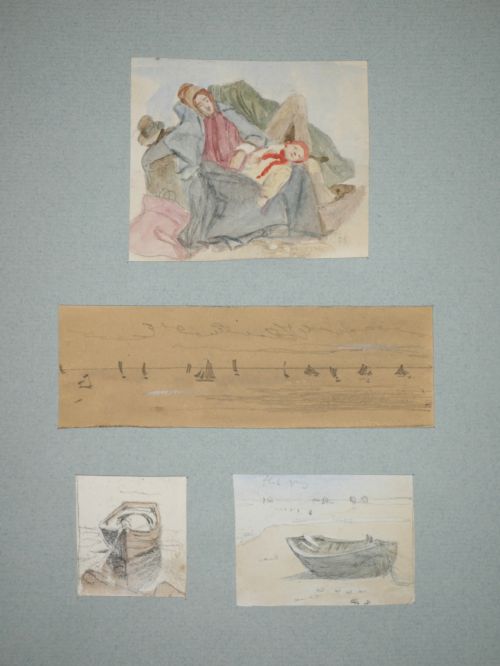
A 19th century watercolour drawing captures the immediacy of Victorian life, offering tactile works on paper that range from detailed architectural studies to maritime sketches.
19th Century Watercolour Drawing
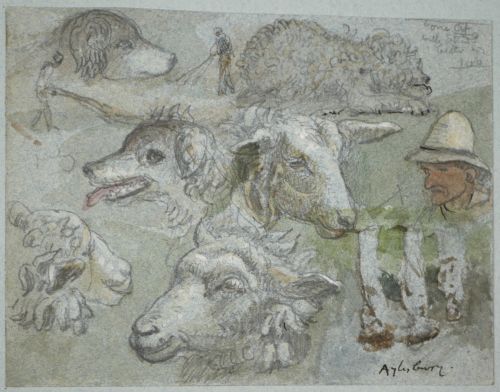
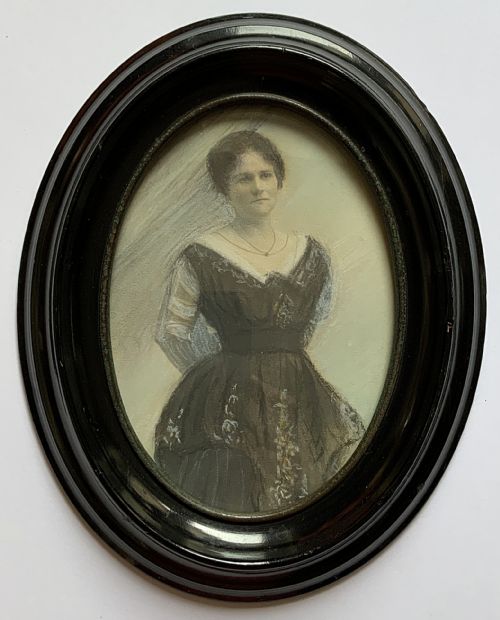
A 19th century watercolour drawing spans diverse subjects, including maritime scenes, architectural studies, genre paintings, and detailed portraiture. These works on paper capture both grand architectural vistas and quiet domestic interiors.
The selections on this page feature Victorian, Regency, and Georgian periods alongside regional movements like the Norwich School and Pre-Raphaelite sketches. Most pieces appear framed in period wood or gilt surrounds, preserving their original character.
Materials and execution
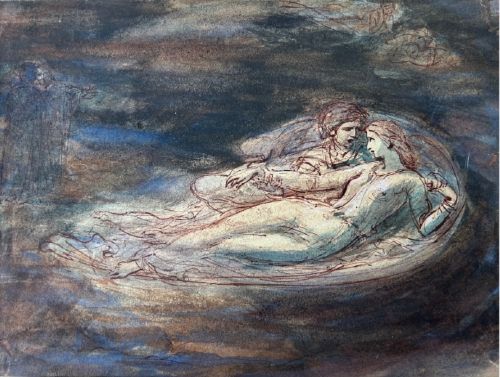
Artists relied primarily on watercolour pigment applied to paper, frequently combining graphite, ink, or pastel to define structural lines before applying washes of colour. Monochrome ink or sepia wash techniques also appear across early and mid-century studies.
Framing materials commonly include wood, gilt wood, and maple frames, often paired with protective glass to secure these delicate works on paper against environmental degradation.
Bear training captured in Dutch folk art sits alongside delicate portraits of royalty and quiet views of Kew Gardens.
Assessing the works
Quality rests upon the sureness of the initial drawing, the handling of pigment transparency, and the preservation of the paper surface over time. Strong compositions display confident brushwork and precise ink or pencil underdrawing.
The integrity of the original framing, such as maple or gilt wood surrounds, alongside documented attribution to named artists or distinct schools, elevates the historical significance of the piece.
Alfred Young Nutt·James Smetham·Albert Ludovici Jnr·William Frederick Settle·J Bizo·William Edward Frost·Samuel Owen·Robert Richard Scanlan·Charles H Poingdestre·George De Paris·Matthew Hale·Josiah Gilbert·John Baragwanath King·Margaret Thompson·Alexander Melville·Sir William Charles Ross·John Thistle·John Joseph Cotman·Thomas Lound·Charles Stanley Peach·Pugin J Hansom
The 19th Century Watercolour Drawing Glossary
- Watercolour pigment
- The primary coloured medium composed of finely ground colour particles suspended in a water-soluble binder.
- Ink and wash
- A technique combining linear ink drawing with diluted monochrome or coloured washes to create shadow and depth.
- Works on paper
- A collective classification for drawings, watercolours, prints, and pastels created on a paper support.
- Gilt wood
- Wood framing treated with gold leaf or a gold-coloured metallic finish, typical of period display.
- Norwich School
- A regional movement of landscape artists working in Norfolk during the period, known for capturing local scenery and architecture.
19th Century Watercolour Drawing: Frequently Asked Questions
How should I display a 19th century watercolour drawing?
Keep these works on paper away from direct sunlight to prevent the watercolour pigments from fading over time. Maintaining stable indoor humidity also protects both the paper support and any original wooden framing.
Utilise UV-resistant glass if you reframe the piece to provide an extra layer of conservation support. Hanging them in interior rooms with subdued lighting ensures safe, long-term enjoyment.
What subjects are common in these drawings?
The inventory records a wide range of subjects, from sweeping marine sketches of ships at sea to precise architectural studies of cathedrals and Gothic altars. Portraiture of Georgian and Victorian figures also appears frequently alongside pastoral landscapes and genre scenes.
Artists often documented their travels on the Continent during the Grand Tour or recorded everyday domestic scenes. This variety reflects both the academic training and personal travels of the period's artists.
How do I distinguish between Regency and Victorian pieces?
Regency pieces often align with the early decades of the century, displaying neoclassical influences, restrained palettes, and distinct linear precision in portraiture or architectural prints. Victorian examples tend to embrace richer narratives, varied landscape studies, and broader stylistic movements like the Pre-Raphaelite circle.
Examining the costume, framing materials, and dated signatures helps confirm the precise era of creation. Comparative study of regional schools also clarifies these chronological shifts.
Are these works always signed by the artist?
Many listings feature signed works, initialled studies, or pieces formally attributed to specific practitioners through archival records and stylistic comparison. Others represent the output of broader regional entities like the English School.
Attribution often relies on contemporary exhibition labels, inscriptions on the reverse of the paper, or distinct handling of ink and wash. Unsigned works remain valued for their technical execution and period authenticity.