





19th Century Vienna Urns
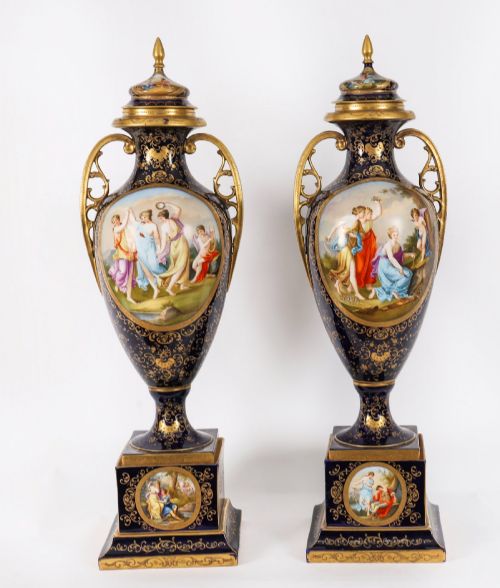
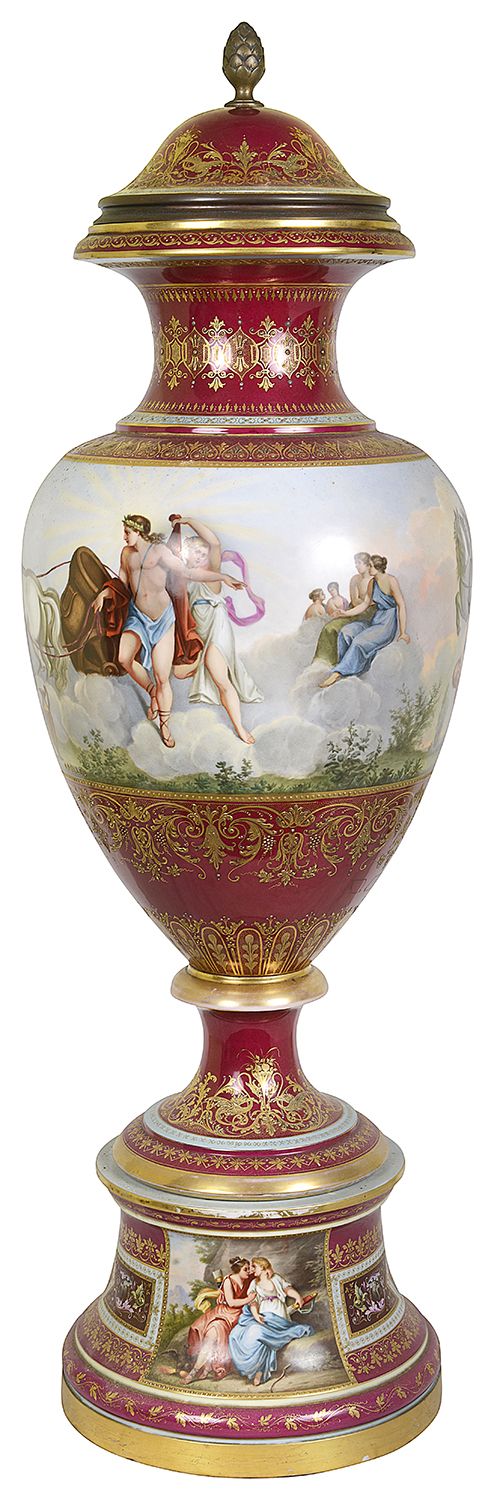
These 19th century vienna urns bring classical presence to a room, offering porcelain forms finished with gilt and hand-painted detail.
19th Century Vienna Urns
When you search for 19th century vienna urns, you encounter decorative vessels made from porcelain, spanning styles from Neoclassical and Victorian Neoclassical to Neoclassical Revival. These pieces take forms such as lidded urns, vases, and decorative ewers produced across the nineteenth century, including specific dates around eighteen seventy, eighteen eighty, eighteen ninety, and nineteen hundred.
You are most likely to meet pairs of vases or lidded urns on this page, alongside individual large vases and garnitures of three large lidded vases. These objects showcase classical forms that reflect the revivalist tastes of the period, often incorporating hand-painted decoration upon white porcelain bodies.
How they were made
These pieces are constructed from porcelain as the primary body, shaped into decorative vessels, lidded urns, and ewers. Artisans applied enamel colours to the porcelain surfaces, often creating hand-painted pictorial or ornamental scenes.
Makers embellished the porcelain bodies using gold leaf, gilt, and gilding to highlight handles, rims, and classical motifs. Wooden elements appear alongside the porcelain in certain presentations, supporting the overall structure of the decorative objects.
19th Century Vienna Urns Retail Price Guide 2026
Typical asking prices for 19th century vienna urns among the pieces listed under this phrase on Sellingantiques today, from the lower quarter to the upper quarter. They describe what is for sale here now, not the wider market.
Even when nominally designed to hold water like a jug, these ewers were far too precious for the washstand.
What varies in quality
The standard of painting on the porcelain surface distinguishes simpler decorative vessels from finer examples. Precision in hand-painted details and the application of gold leaf and gilding create visual depth that elevates certain pieces above standard production.
Scale and form also define the range, where larger lidded vases and matched pairs require greater technical control in firing and shaping porcelain than smaller single vases.
The 19th Century Vienna Urns Glossary
- Porcelain
- A ceramic material made by heating raw materials, generally including clay in the form of kaolin, in a kiln. It provides a smooth white body suitable for detailed hand-painting.
- Gilding
- The decorative application of gold leaf or gilt powder to a surface. This technique accents handles, borders, and classical motifs on ceramic vessels.
- Garniture
- A set of matched decorative vases or urns designed to be displayed together on a mantelpiece or sideboard. These sets frequently comprise three pieces of graduating or corresponding sizes.
- Ewer
- A large jug with a wide spout and a handle, designed historically for pouring water. In nineteenth century production, these function purely as decorative ornaments.
- Neoclassical
- A style originating in architecture and the arts that draws inspiration from the classical art and culture of ancient Greece and Rome. This aesthetic governs the decorative vocabulary of these urns and vases.
19th Century Vienna Urns: Frequently Asked Questions
How were these urns used originally?
They served primarily as ornamental items rather than functional vessels, displayed on mantelpieces, tables, or cabinets within prosperous homes. Matching pairs and garnitures of three were arranged symmetrically to decorate principal rooms.
Their classical forms reflected an appreciation for ancient Greek and Roman design during the nineteenth century.
How do I style these urns in a modern interior?
Place a pair of lidded urns or vases on a heavy sideboard, console table, or mantelpiece where their scale and hand-painted details can command attention. Their classical lines work well against plain walls that allow the gilt and enamel colours to stand out.
Keep surrounding objects minimal to let the form and painted porcelain take visual precedence.
How can I tell the different styles apart?
Neoclassical pieces rely on strict classical proportions and motifs, while Victorian Neoclassical and Revival variants introduce heavier ornamentation and Victorian decorative preferences. Examining the specific handling of the porcelain body and the style of the hand-painted scenes helps distinguish these approaches.
Datings span from eighteen seventy through to nineteen hundred, showing subtle shifts in taste across the decades.