
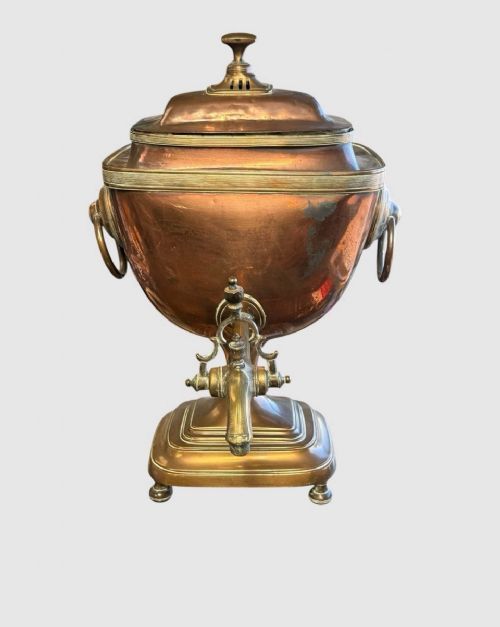


19th Century Samovar
These 19th century samovar examples are hot water vessels designed for social pouring, bringing warmth and presence to any historic interior.
19th Century Samovar
A 19th century samovar serves as a monumental tea or coffee urn designed to heat and dispense water for social gatherings. These vessels appear most frequently in copper and brass, often taking the form of large tea urns or decorative water dispensers.
The selections span the Victorian and Regency periods, alongside Dutch Regency and Meiji period examples. Buyers commonly encounter English and continental copper tea urns featuring traditional spigots and handles.
Variations include silver plated tea urns and Japanese cloisonne enamel temple water dispensers. Each object reflects the heavy social reliance on heated beverage vessels during the nineteenth century.
How they were made
Makers constructed these vessels primarily from sheet copper and brass, frequently combining them with wooden handles, bone fittings, and tinplate linings. Metalsmiths hammered, spun, and joined these materials to withstand boiling water.
Surface decoration involved applied paint, gold leaf, and intricate cloisonne enamel work on select Japanese water dispensers. Silver plating also appears on continental tea urns produced by specialised Parisian makers.
What varies in quality
Quality rests in the weight of the metal, the crispness of the chased or engraved detail, and the integrity of the internal heating elements or spigots. Substantial copper thickness and balanced proportions separate utilitarian vessels from showpieces.
The refinement of auxiliary materials, such as turned bone handles and secure wooden mounts, distinguishes superior workshop production. Signed examples by notable makers demonstrate higher levels of finishing in handles and mounts.
Risler and Carré Paris
The 19th Century Samovar Glossary
- Samovar
- A heated metal urn traditionally used to boil and dispense water for tea. These vessels typically feature an internal heating pipe and a spigot near the base.
- Toleware
- Metalware painted and japanned in decorative finishes, originating from Dutch and English workshops. This technique created durable, colourful surfaces on household urns.
- Cloisonne
- An enamelwork technique where thin wire partitions hold coloured glass pastes before firing. Japanese makers applied this method to large temple water dispensers.
- Spigot
- A tap or faucet fitted near the base of the urn to control the flow of water. These components often feature decorative turnkeys cast in brass.
- Regency
- An English design period characterised by classical restraint and bronze patination. Vessels from this era often display clean architectural lines.
19th Century Samovar: Frequently Asked Questions
How did a 19th century samovar work?
These vessels heated water using an internal metal tube or cylinder that held hot charcoal or a heated iron core. A tap near the base allowed users to draw off boiling water into teapots as needed.
Over the course of the century, many domestic models transitioned into decorative water urns heated externally or simply filled with already boiling water for immediate service.
What is the difference between a tea urn and a samovar?
While both vessels served hot water for social beverages, the samovar typically incorporates a central internal heating chimney. Tea urns often relied on external heat sources or simply retained the heat of pre-boiled water.
In marketplace listings, makers and merchants frequently used both terms interchangeably to describe large lidded beverage dispensers.
Where were these metal urns displayed?
Owners placed these vessels on sideboards or dedicated tea tables within dining rooms and drawing rooms. Their impressive scale made them focal points during formal afternoon tea service.
In larger domestic settings, servants managed the operation of the urn before bringing it into the main entertaining spaces.
How do I care for antique copper and brass?
Copper and brass require gentle dusting and occasional cleaning with appropriate non-abrasive metal cleaners to prevent active corrosion. Many collectors prefer to preserve a deep, aged patination rather than polish the metal to a bright shine.
Keeping the interior dry and clean protects the historic tinplate linings from moisture damage over time.