
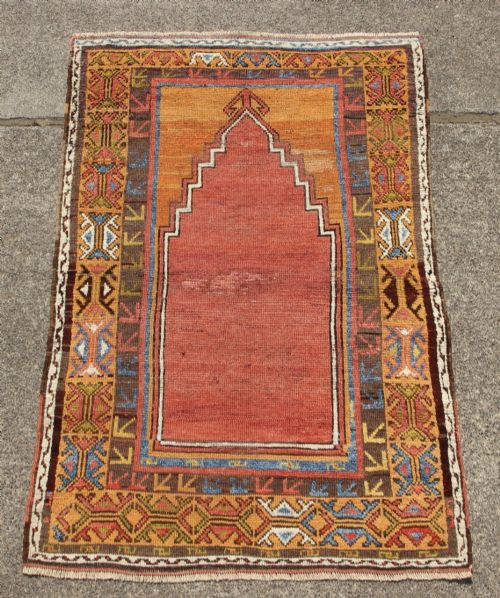


19th Century Prayer Rug
These woven pieces span village and tribal workshops across Anatolia, the Caucasus, and Persia, offering distinct mihrab designs for the collector.
19th Century Prayer Rug
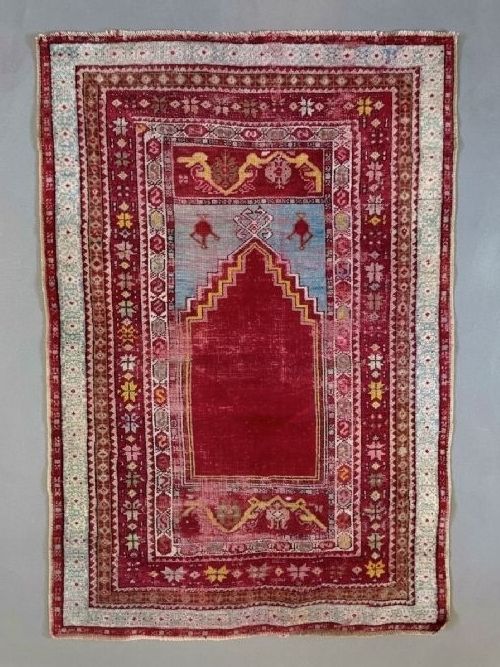
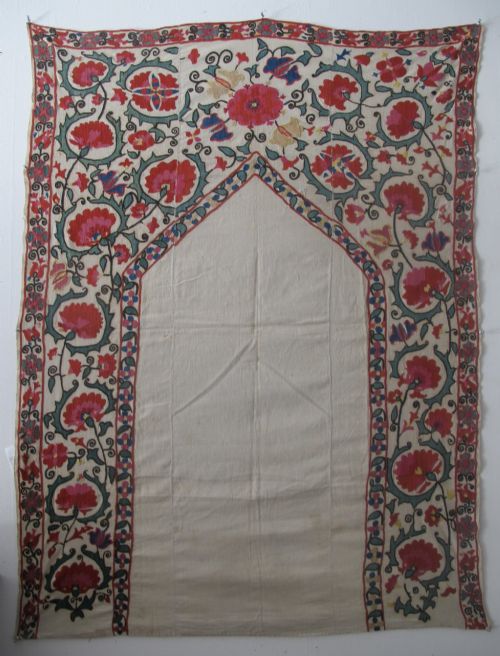
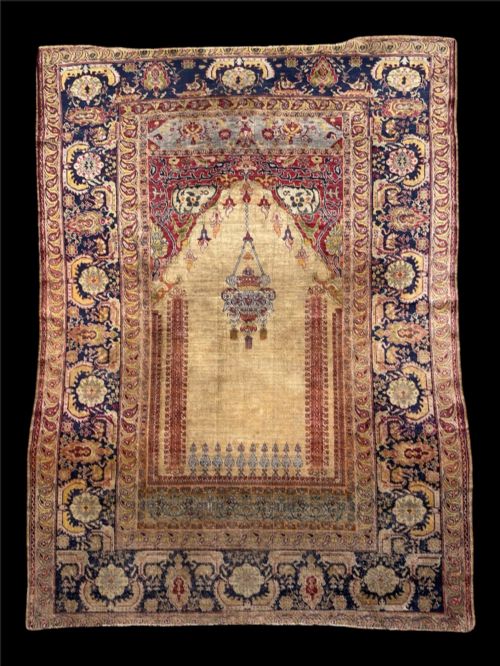
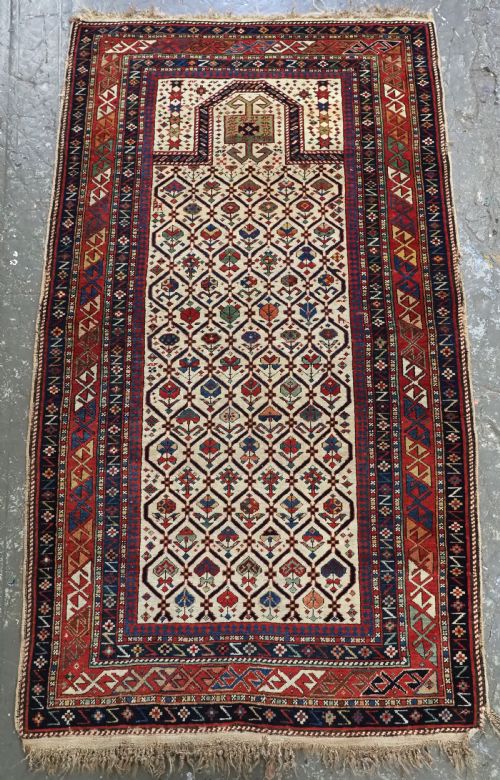
When you search for a 19th century prayer rug, you are looking at portable floor textiles defined by a characteristic arch or mihrab motif designed for daily devotion. These pieces originate from regional weaving traditions, most frequently appearing from Anatolian villages, Caucasian tribal groups, and Baluch or Turkmen makers.
The format typically presents a central niche directing the viewer toward Mecca, often accompanied by geometric borders, floral lattices, or trees of life. Examples on this page range from early nineteenth-century village formats to later regional variations produced across the Near East and Central Asia.
How They Were Made
Weavers constructed these textiles using hand-spun wool, cotton foundations, and occasionally silk or camel hair, tied in dense knots to secure the pile. Natural dyes supplied the deep blues, yellows, reds, and ivory grounds recorded across the surviving examples.
Village and tribal workshops relied on upright looms, utilising goat hair for sturdy selvedges and incorporating kilim ends to protect the foundational structure from fraying.
19th Century Prayer Rug Retail Price Guide 2026
Typical asking prices for 19th century prayer rug among the pieces listed under this phrase on Sellingantiques today, from the lower quarter to the upper quarter. They describe what is for sale here now, not the wider market.
Listings feature wool, cotton, silk, and camel hair materials spanning the nineteenth century.
What Varies In Quality
The standard of an individual piece rests upon the crispness of its drawing, the saturation and harmony of its natural dye palette, and the integrity of the weave. Finer knots per square inch and supple handle distinguish accomplished village or tribal work from more commercial output.
Preservation of original borders, kilim ends, and structural pile without extensive reweaving determines the historical intactness of the piece.
Haji Jalili
The 19th Century Prayer Rug Glossary
- Mihrab
- The arched architectural niche depicted on the field of the textile, oriented toward Mecca during prayer.
- Knit or Knot
- The individual loop of yarn tied around the warp threads that forms the dense pile of the rug.
- Warp
- The stationary longitudinal threads stretched on the loom that carry the structural weight and fringe of the textile.
- Weft
- The horizontal threads passed across the warp threads between rows of knots to bind the structure firmly together.
- Suzani
- An embroidered decorative textile panel, often worked in silk on a cotton ground in Central Asia.
19th Century Prayer Rug: Frequently Asked Questions
How do I identify a prayer rug?
A prayer rug is immediately distinguished by its architectural mihrab, or arch, which dominates the upper field of the textile.
This single-ended niche design was traditionally used to kneel upon during daily Islamic prayers.
Where were these rugs made?
These pieces originate primarily from villages and nomadic camps across Anatolia, the Caucasus, Persia, and Central Asia.
Each region developed distinct palettes, geometric motifs, and border arrangements that signal its specific origin.
Can I walk on an antique rug?
Many of these textiles were constructed for functional domestic use, utilising resilient wool and sturdy structural foundations.
Placing them in low-traffic areas or utilising appropriate underlays preserves the pile and historical integrity.
What materials are used?
The pile is predominantly hand-spun wool, though certain fine examples incorporate silk or camel hair.
Foundations generally consist of wool or cotton, fastened with natural dyes sourced from regional plants and minerals.