
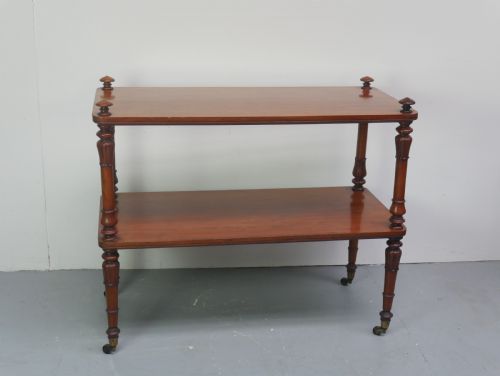
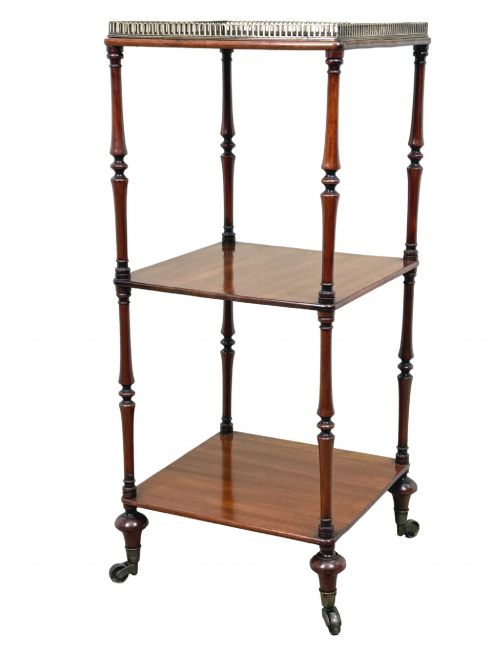


19th Century Mahogany Whatnot
A 19th century mahogany whatnot provides tiered open shelving for displaying books, china and ornaments in a drawing room.
19th Century Mahogany Whatnot
When you search for a 19th century mahogany whatnot, you encounter open tiered furniture designed primarily for holding small objects and books. These pieces span Georgian, Regency, Victorian and William IV periods, crossing object types such as étagères, music stands, dumb waiters and bedside tables.
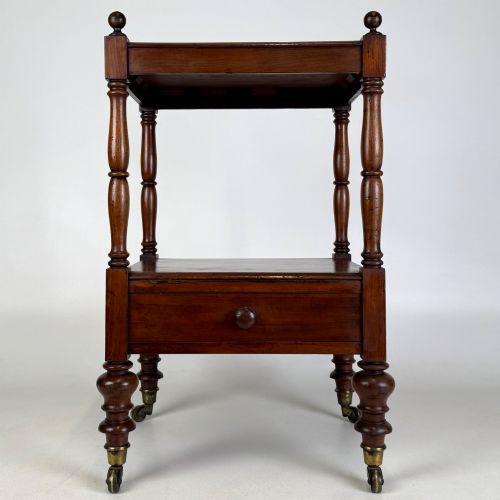
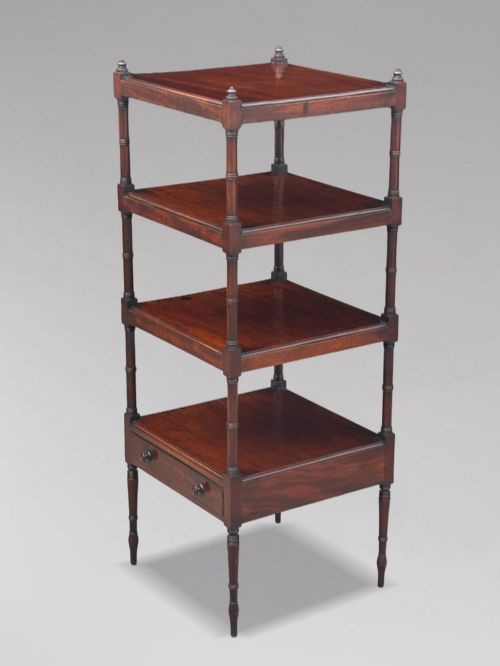
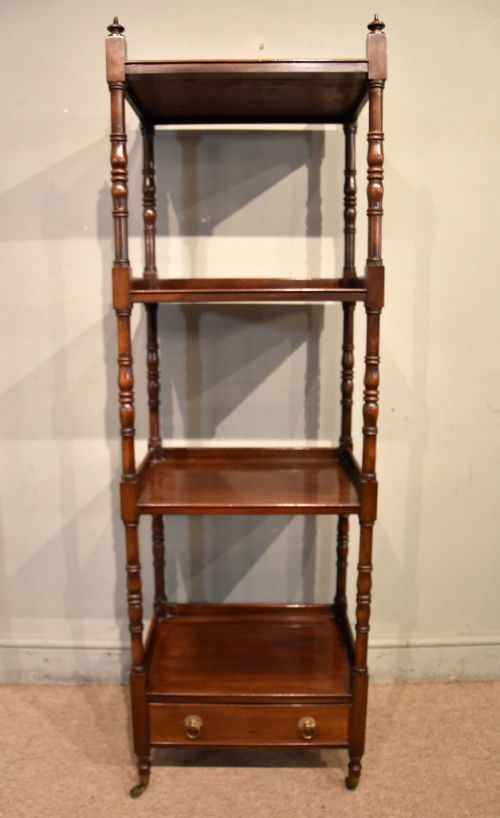
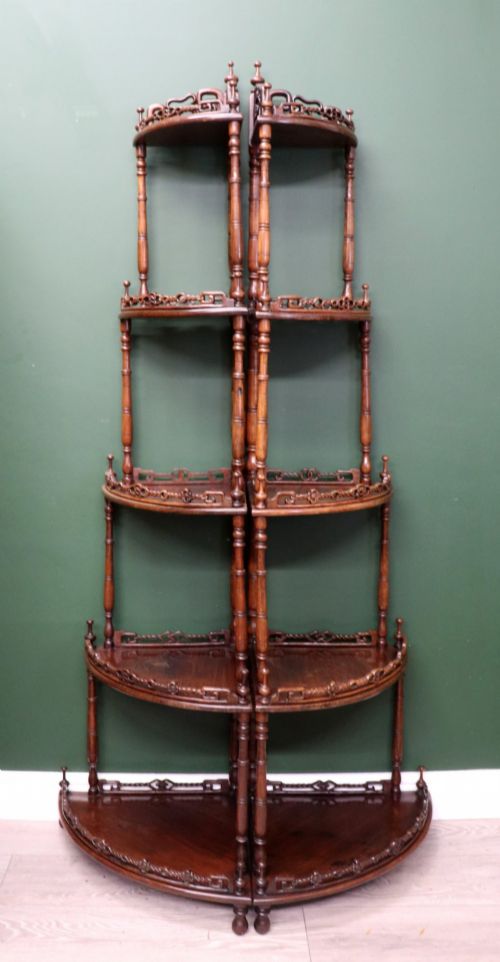
The version you are most likely to meet on this page is a three-tier or four-tier mahogany stand with turned supports. Examples range from compact corner units and small end tables to larger serving buffets and display stands fitted with drawers or cellarettes.
Materials and construction
Cabinet makers utilised solid mahogany and mahogany veneers for the upright supports, shelves and trays of these pieces. Brass castors frequently finish the feet, and occasional examples incorporate glass panels or marquetry inlay in walnut and mahogany.
Construction relies on straightforward tiered platforms held by slender columns or spindles. Drawer boxes employ traditional dovetail joints, while music stands and dumb waiters incorporate adjustable or rotating mechanisms.
Victorian cabinet makers ensured that even tea-drinking households had a dedicated multi-tiered stage for their smallest china cups.
Judging quality
Quality rests upon the selection of timber grain, the crispness of the turned columns and the structural stability of the stacked tiers. Finer pieces demonstrate careful attention to proportion, particularly in compact or small-scale examples.
Gillows
The 19th Century Mahogany Whatnot Glossary
- Whatnot
- An open set of shelves used for displaying ornaments and books. It originated in the eighteenth century and remained popular throughout the Victorian era.
- Étagère
- A French term for a piece of furniture with a series of shelves for display. These are functionally identical to many English whatnots.
- Cellarette
- A fitted compartment or drawer designed to hold bottles securely. They occasionally appear integrated into the lower section of a sideboard or whatnot.
- Dumb waiter
- A tiered stand or revolving table used for serving food or holding dishes without a servant present. Some Regency examples combine this form with the whatnot.
- Marquetry inlay
- Decorative patterns formed by fitting contrasting pieces of wood veneer into a prepared surface. Walnut and mahogany provide contrasting tones on select Victorian pieces.
19th Century Mahogany Whatnot: Frequently Asked Questions
What is a 19th century mahogany whatnot used for?
These pieces served primarily to display porcelain, small books, silver and decorative ornaments in principal rooms. Their tiered structure allowed owners to exhibit collections without crowding mantelpieces or side tables.
In modern rooms, they function well as corner displays, bedside tables or bookcase alternatives for modest spaces.
How many tiers do these whatnots have?
Most examples featured in the records have three or four tiers, though five-tier versions also exist. Corner units and compact end tables generally stick to two or three shelves.
Taller pieces provide substantial vertical display space while occupying a minimal floor footprint.
What is the difference between a whatnot and an etagere?
The terms are largely interchangeable for nineteenth-century English furniture. Both describe multi-tiered shelving units intended for display.
Etageres sometimes lean towards lighter, more decorative French-influenced designs, while whatnots often follow sturdier domestic English patterns.
Did all whatnots have shelves?
While open shelves dominate the category, several variations included drawers, cabinets, cellarettes or serving surfaces. Some pieces doubled as music stands or dumb waiters.
These hybrid forms offered multi-functional utility alongside standard display space.
How do I date a mahogany whatnot?
Dating relies on stylistic shifts from Georgian restraint through Regency elegance to ornate Victorian carving. Tighter proportions and simpler turned supports typically point to earlier Regency and Georgian eras.
Heavier mouldings, mirrored backs and marquetry inlay generally indicate later Victorian production towards the end of the century.