
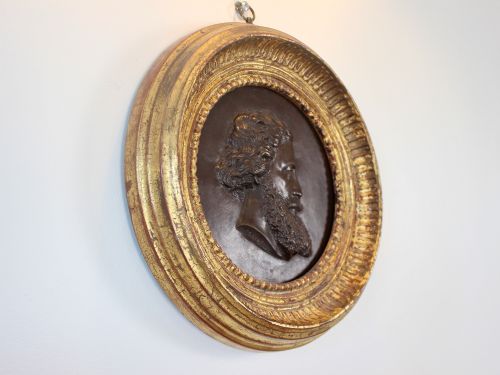


19th Century Gentleman Bust
These 19th century gentleman bust examples bring serious character to a room, offering carved marble, bronze, and plaster portraits of notable figures.
19th Century Gentleman Bust
A 19th century gentleman bust captures the likeness of notable or unknown figures from the era in three dimensions. Collectors find these pieces in solid bronze, carved marble, and plaster forms across this page.
The selection ranges from classical studies to specific portraits of clergymen, medical doctors, and naval figures. Most examples originate from the Victorian period and the wider nineteenth century.
Beyond standalone sculptures, the selection includes wall plaques and miniature busts alongside related portrait paintings on canvas and board. These objects reflect the Victorian appetite for commemorating notable men.
Materials and construction methods
Sculptors utilised white and veined marble alongside limestone for carved stone pieces. Bronze was cast for detailed studies, while plaster provided a versatile medium for simulated stone finishes.
Painters worked with oils and watercolours on canvas, board, and paper to create companion portrait paintings. Giltwood frames frequently accompanied these flat works to complete the presentation.
Several gentlemen sport exceptionally detailed Victorian beards rendered in cast bronze and carved marble.
Distinctions in quality
Quality rests upon the precision of the carving in marble pieces and the crispness of the casting in bronze works. Finer sculptures display nuanced rendering of facial hair, expression, and drapery.
Signed works and those attributed to recorded sculptors hold greater distinction than anonymous studio pieces. The choice of material also dictates quality, with fine veined marble and heavy bronze standing above simpler plaster.
John Wenlock Rollins·Sir Thomas Brock
The 19th Century Gentleman Bust Glossary
- Bronze
- A copper alloy utilised for cast metal sculptures. It allows for fine detail and patination.
- Marble
- A metamorphic rock prized for sculptural carving. White and veined varieties appear frequently.
- Plaster
- A building material used for cast busts. Simulated stone finishes imitate heavier materials.
- Plaque
- A flat ornamental tablet for wall hanging. These often feature portrait profiles in relief.
19th Century Gentleman Bust: Frequently Asked Questions
How do I display a bust?
Place a solid bronze or marble bust on a sturdy pedestal or a heavy sideboard where its weight is supported safely.
Ensure the piece sits away from direct heat sources to protect stone and patinated metal surfaces from damage.
What materials are common?
Bronze and carved marble represent the most durable and traditional sculptural materials found in these nineteenth-century works.
Plaster and limestone also appear, alongside painted canvas and board for flat portrait representations.
Are all subjects identified?
Many portrait busts and paintings depict unknown sitters whose names were lost over the decades.
Signed works or those with accompanying inscriptions often name specific historical figures, clergymen, or medical professionals.
How do I clean marble?
Dust carved marble gently with a soft, dry cloth to prevent dirt accumulation within the recessed details.
Avoid using water or chemical cleaners on porous stone surfaces unless advised by a professional conservator.