


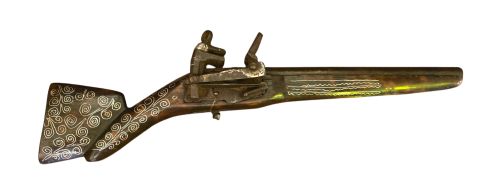


19th Century Flintlock
These pieces of 19th century flintlock metalwork and wood bring tangible history to a collection, offering working mechanisms and period craftsmanship.
19th Century Flintlock
A 19th century flintlock search uncovers functional firearms, military accoutrements, and regional variants spanning the Georgian, Regency, and Victorian eras. The selection ranges from British service pistols and duelling arms to ornate Ottoman long guns and holster pistols.
Collectors frequently encounter martial pieces alongside elaborately decorated North African and Balkan examples. Forms include pocket coats, blunderbuss variations, and snaphaunce long pistols alongside powder measures and period fine art.
Origins stretch across Britain, France, Russia, and the Ottoman Empire, reflecting diverse military requirements and domestic civil uses. Each piece documents the transitional mechanical period before percussion caps took over.
Materials and construction
Makers shaped stocks from dense hardwoods, primarily walnut, often embellishing the wood with intricate brass, silver, bone, or mother-of-pearl inlay. Barrels and locks rely on forged steel and iron, sometimes featuring brass bodies or flared blunderbuss bells.
Craftsmen utilised hand-engraving, wire inlay, and embossed metal cladding to decorate regional pieces from Turkey, Algeria, and Morocco. Gunsmiths balanced utilitarian martial durability with meticulous decorative detailing on grips and frizzen pans.
Recorded styles include Georgian, Regency, Victorian, Napoleonic Era, French Military, and various Ottoman regional designs.
Distinguishing quality and grade
Quality rests upon the crispness of the lock mechanism, the integrity of the timber stock, and the precision of any metal or shell inlay. Signed London makers and marked military regiments command closer attention for historical provenance.
Higher grade items retain original surface finishes, unpolished brass or steel components, and intact functional springs without replacement parts. Regional work displays superior craftsmanship through dense, symmetrical wire inlay and carved stocks.
A.W Spires·Benjamin Marshall·Wilson
The 19th Century Flintlock Glossary
- Flintlock
- An ignition mechanism that uses a piece of flint held in a cock to strike a steel frizzen, creating sparks to ignite the priming powder. This system dominated firearms technology before percussion caps emerged.
- Frizzen
- The vertical steel plate struck by the flint to create sparks and expose the priming pan. A grooved frizzen helps catch the flint effectively during the stroke.
- Snaphaunce
- An early type of flintlock mechanism where the pan cover opens automatically when the trigger is pulled. It represents an intermediate step in firearm evolution.
- Blunderbuss
- A muzzle-loading firearm with a flared barrel designed to scatter shot at close range. These were widely carried by coaches and naval personnel.
- Jezail
- A traditional long gun used across the Middle East and North Africa, typically distinguished by a long wooden stock and distinctive curved butt. They often feature extensive bone or mother-of-pearl inlay.
19th Century Flintlock: Frequently Asked Questions
How do I clean a flintlock?
Maintenance requires gentle removal of surface dust and application of light oil to protect steel and iron components from active oxidation.
Harsh abrasives ruin historic patinas on wood and metal, so conservation relies strictly on soft cloths and specialised preservative waxes.
Are these old pistols still operational?
Many surviving examples retain working lock mechanisms with functional springs and moving parts capable of half and full cock.
Firing antique gunpowder arms requires professional inspection by a qualified gunsmith to ensure structural safety before any use.
What is a holster pistol?
Holster pistols were large, heavy firearms designed to be carried in saddle holsters by cavalry troopers and officers on campaign.
Their substantial size provided greater stopping power compared to smaller pocket or coat pistols intended for personal defence.
How do I date a flintlock?
Dating relies on maker signatures, proof marks stamped into the metal barrels, stylistic changes in stock design, and military contract records.
Georgian and Regency eras display specific trigger guard shapes, barrel profiles, and lockplate engravings that narrow down the manufacturing window.