




19th Century Cat Painting
A 19th century cat painting captures domestic felines with Victorian charm, offering buyers a delightful glimpse into historical animal portraiture.
19th Century Cat Painting
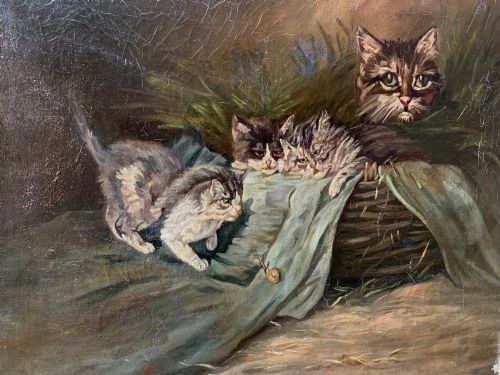
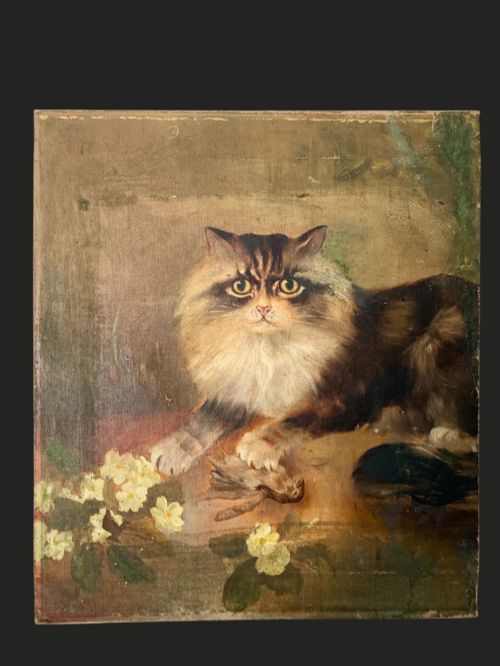
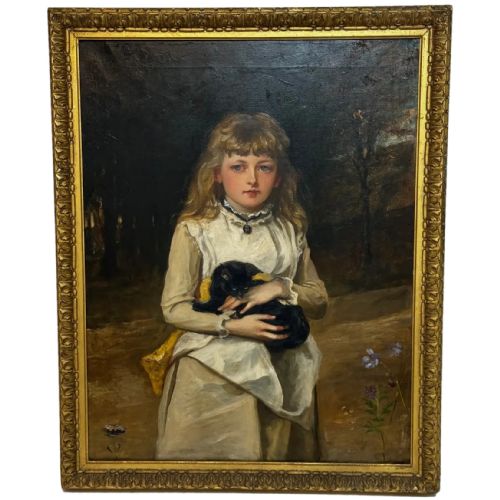
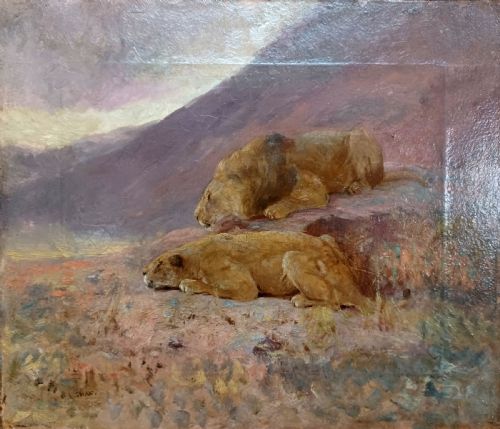
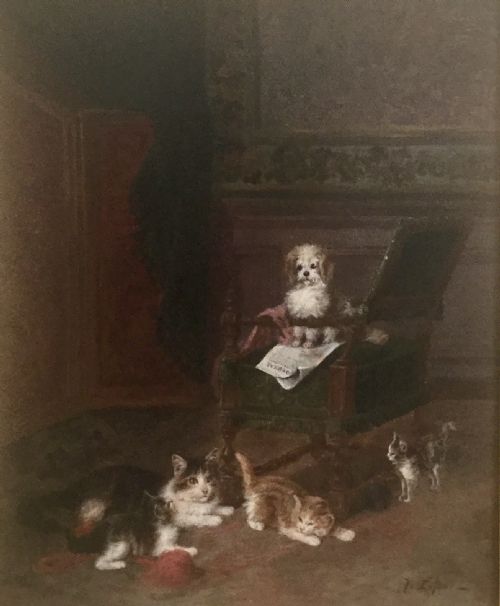
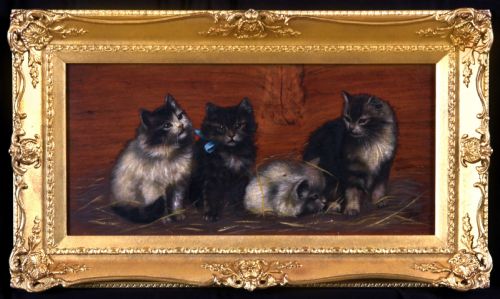
When you search for a 19th century cat painting, you enter a world of fine art dominated by oil on canvas, oil on board, and milk glass panels. These works capture domestic pets, playful kittens, and occasionally larger felines through the lens of Victorian animalier traditions.
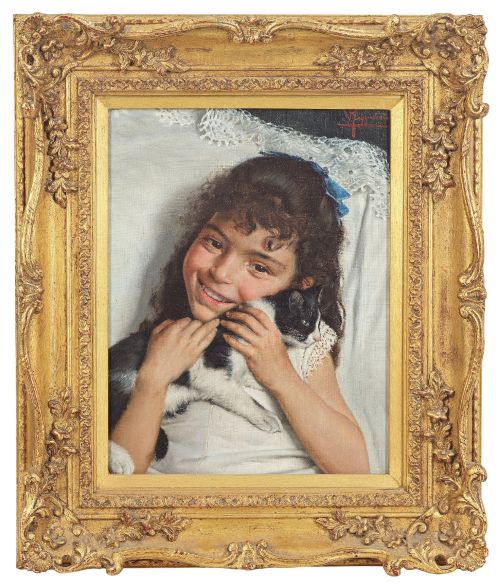
You are most likely to meet pieces originating from British and French schools, alongside naive representations and works by named artists. The subjects range from solitary feline portraits to complex genre scenes featuring children or fish alongside the animals.
The category spans the Victorian era through to the early twentieth century, reflecting shifting tastes in animal portraiture. Whether executed as delicate oil paintings or naive studies, these artworks preserve the character of domestic cats from generations past.
How They Were Made
Artists of this period primarily utilised oil paint applied to canvas, wood panels, or board, building rich textures and deep tones. Some works also appear on milk glass or tin panels, demonstrating the diverse supports favoured by nineteenth-century painters.
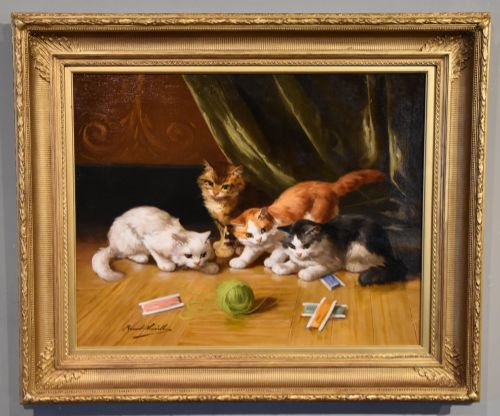
Many of these paintings survive within their original gesso and giltwood or carved gilded frames, which complement the traditional oil technique. The application of oil on canvas allowed artists to render the softness of feline fur and the play of light with notable precision.
Several Victorian artists discovered that getting kittens to sit still for a portrait required endless patience and a steady supply of fish.
What Varies in Quality
The distinction between standard works and exceptional pieces lies in the anatomical accuracy and the liveliness of the brushwork. Master painters capture the texture of fur and the individual expression of the cat with striking immediacy.
Compositional complexity also marks the superior pieces, such as genre scenes involving multiple kittens or human figures interacting with the animals. Furthermore, the presence of original period gilt frames influences the overall integrity and presentation of the artwork.
Vittorio Reggianini·Alfred Arthur Brunel de Neuville·Charles Burton Barber·Agnes Augusta Talboys·Henry Weigall·Cuthbert Edmund Swan·Horatio Henry Couldery·Francisco Jose Domingo y Marques·Geza Vastagh·Jules Le Roy·Bessie Bamber
The 19th Century Cat Painting Glossary
- Animalier
- Art depicting the realistic portrayal of animals, which gained immense popularity during the nineteenth century. Painters in this style focused closely on the natural behaviour and anatomy of their subjects.
- Gesso
- A plaster-like mixture applied to wooden frames or panels to prepare a smooth surface for gilding or painting. In nineteenth-century framing, it provided the base for intricate moulded decoration.
- Giltwood
- Wood that has been treated with a thin layer of gold leaf or gold paint. Frames finished in this manner were standard for showcasing fine oil paintings of the period.
- Genre Painting
- The pictorial representation of scenes from everyday life, often featuring people and their domestic animals. These works offer a narrative window into historical domestic settings.
- Naive School
- Art produced by self-taught painters who often bypassed formal perspective rules in favour of flat planes and direct expression. Pieces from this tradition possess a distinct charm and simplicity.
19th Century Cat Painting: Frequently Asked Questions
What subjects appear in these paintings?
The artworks predominantly feature domestic cats and playful kittens, frequently shown in interior settings or interacting with objects like fish. Some compositions also include children or larger feline species.
Artists of the period captured these animals with varying degrees of formality, ranging from intimate single portraits to lively genre scenes.
How do I identify the period?
Dating relies on stylistic markers typical of the nineteenth century, alongside artist signatures and framing materials. Victorian animalier and naive school conventions provide strong chronological clues.
Examination of the canvas, board, or underlying support panel also helps confirm the era of production.
Are these works original?
The selection includes original signed oil paintings, period watercolours, and authenticated works attributed to notable nineteenth-century artists. Each piece reflects the hand of the painter rather than modern reproduction.
Many retain their historical frames, adding to their authenticity as period antiques.
How should I display them?
These paintings suit traditional interiors, especially when housed within their original giltwood frames. Hang them away from direct sunlight to protect the oil pigments and canvas.
Pairing them with other nineteenth-century fine art enhances their historical context within a room.