
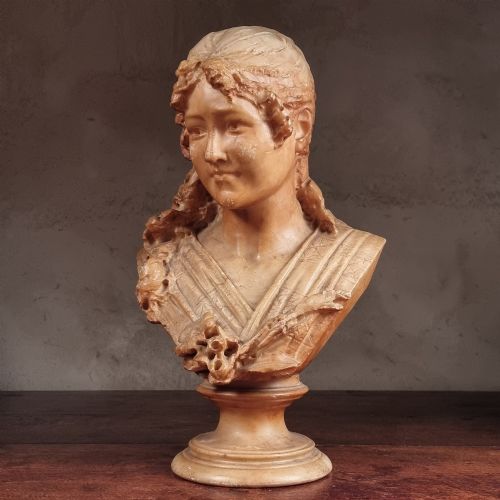


19th Century Alabaster Statue
A 19th century alabaster statue brings carved classical figures, mythological deities and animals into the home.
19th Century Alabaster Statue
When you search for a 19th century alabaster statue, you encounter sculptural works spanning busts, full figures and pairs of bookends. The most frequent versions on this page are carved representations of women, classical deities such as Hestia and Diana, and animal figures including dogs and tigers.
The objects originate from European workshops, with Italian and French pieces appearing prominently alongside English examples in Derbyshire alabaster and Indian imports. Forms range from intimate cabinet statuary to large decorative busts standing nearly a metre tall.
Makers and studios active in the period, including Guglielmo Pugi, P. Emilio Fiaschi, Mieczyslaw Leon Zawiejski and Bright And Sons, sign or attribute many of the finest figural pieces. Subjects draw heavily from Neoclassical, Art Nouveau and Orientalist aesthetics.
How they were made
Sculptors carved these pieces from solid blocks of alabaster, marble, veined Carrara marble and stone using chisels, rasps and abrasive powders to achieve smooth skin tones and detailed drapery. Certain figures combine two-tone alabaster or pair the stone with cast spelter and bronze elements.
Makers polished the soft gypsum-based stone to varying degrees of matte or glossy finish, sometimes accentuating the natural translucent qualities of the material. Derbyshire alabaster and Italian varieties provided the fine-grained texture necessary for intricate facial expressions and carved hair.
Listings feature 19th century alabaster statues alongside carved marble busts, spelter figures, and Derbyshire alabaster animal carvings.
What varies in quality
The choice of raw material also separates standard workshop output from exceptional examples. Uniformity of tone, freedom from heavy mineral inclusions, and effective use of two-tone veining distinguish superior sculptures.
Bright And Sons·Mieczyslaw Leon Zawiejski·Antonio Frilli·Gugielmo Pugi·P. Emilio Fiaschi·A. Cipriani
The 19th Century Alabaster Statue Glossary
- Alabaster
- A soft, fine-grained gypsum stone prized for its translucence and suitability for detailed carving. It takes a smooth polish but scratches easily compared to harder marbles.
- Carrara marble
- A white or blue-grey marble quarried in the city of Carrara in Tuscany, Italy. Sculptors utilised this dense stone for classical figures and architectural busts.
- Spelter
- An alloy of zinc and other metals cast into decorative figures and statues. It often received a bronze-like coating to imitate more expensive metalwork.
- Grand Tour
- A traditional trip of Europe undertaken by upper-class young men in the 19th century. Travellers frequently purchased small marble and alabaster sculptures as mementos of their journey.
- Neoclassical
- An artistic style drawing inspiration from the classical art and culture of ancient Greece and Rome. Statues in this style feature balanced compositions and mythological subjects.
19th Century Alabaster Statue: Frequently Asked Questions
How do I clean an alabaster statue?
Dust the surface gently with a soft, dry brush or a microfiber cloth to prevent dirt settling into the porous stone. Avoid water and liquid cleaning products entirely, as moisture damages unsealed alabaster.
Keep the statue away from direct sunlight and damp environments to preserve the polished finish and prevent discolouration over time.
What is the difference between alabaster and marble?
Alabaster is a softer stone composed of gypsum, possessing a warm translucence that allows light to penetrate slightly beneath the surface. Marble is a harder metamorphic rock derived from limestone with distinct crystalline structures.
You can often tell them apart by hardness tests, as alabaster scratches easily with a metal blade whereas marble resists marking.
Where were these statues displayed originally?
In the 19th century, owners placed these sculptures on mantelpieces, pedestals, and library tables within formal drawing rooms and studies. Larger busts and standing figures occupied entrance halls and galleries.
Pairs often served as decorative bookends or balanced ornaments on opposite ends of a sideboard.
Why are some figures signed while others are unsigned?
Signed pieces usually bear the surname of the master sculptor or the stamp of a known studio, indicating production by a recognised Italian or French workshop. Unsigned statues originated from anonymous workshops and commercial art houses that produced decorative pieces in quantity.
Attributions for unsigned works rely on stylistic comparisons with documented pieces from the same period.