


1960s Gold Necklace
A 1960s gold necklace brings mid-century design to the neckline, offering everything from pearl strands with gem-set clasps to structural gold fringe.
1960s Gold Necklace
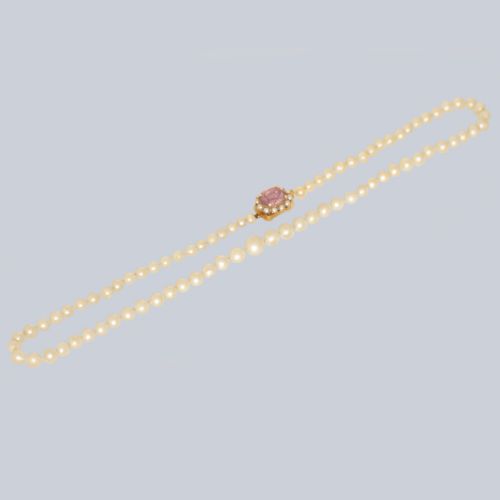
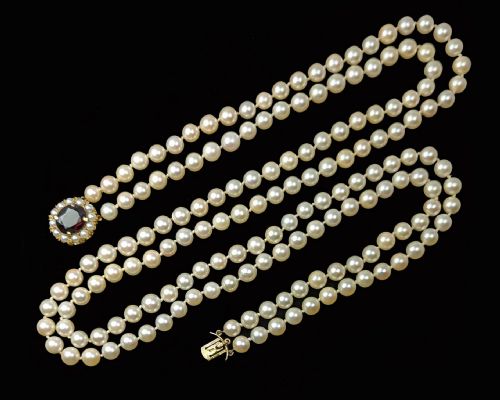
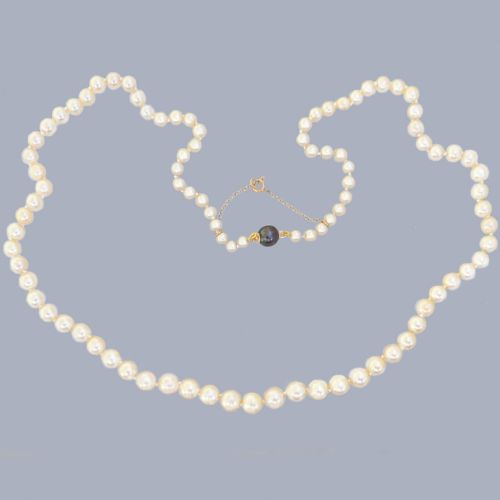
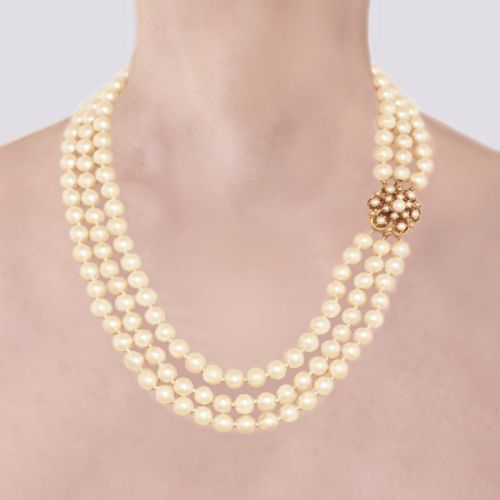
A 1960s gold necklace typically takes the form of a cultured pearl strand secured by an ornate gold clasp, or a solid gold pendant and chain. The pearls appear in single, double, triple, and long sautoir configurations, often paired with floral or cluster clasps set with garnet, sapphire, or diamond.
Beyond pearls, the selection includes geometric pendants and link chains shaped during the mid-century period. Buyers encounter stamped hallmarks from London and Birmingham alongside Italian workshop pieces featuring textured gold work and gemstone drops.
How they were made
Makers utilised 9ct and 18ct yellow and white gold, shaping metal into delicate wirework, cast floral clusters, and heavy fringed bibs. Silk thread was threaded and hand-knotted between cultured pearls to secure each bead individually.
Gemstones including diamonds, sapphires, garnets, aquamarines, and emeralds were bezel or prong-set into clasps and pendant mounts. Jewellers also employed textured finishes and abstract castings typical of mid-century modern metalwork.
The listings feature 9ct and 18ct gold alongside cultured pearls, diamonds, sapphires, garnets, and aquamarines in mid-century styles.
What varies in quality
Quality rests in the uniformity and lustre of the cultured pearls, alongside the weight and complexity of the gold mountings. Pieces featuring substantial gold grammage, certified gemstones, and integrated clasps demonstrate superior workshop execution.
The precision of the hand-knotting on pearl strands and the clarity of British assay office hallmarks or maker marks distinguish standard production from finer designer output.
Cropp and Farr·Unoaerre Italy·Yves Saint Laurent·Lapponia
The 1960s Gold Necklace Glossary
- Cultured pearl
- An oyster-produced pearl grown by human intervention with a inserted bead nucleus. These form the primary body of many mid-century strand necklaces.
- Sautoir
- A long, slender necklace often featuring a tassel or pendant drop. In this era, these pieces were designed to be worn long or doubled.
- Hallmark
- An official stamp indicating the metal purity and origin. British items feature assay office marks, such as leopard heads for London or anchors for Birmingham.
- Clasp
- The fastening mechanism which, in mid-century jewellery, was frequently designed as an ornamental focal point set with precious stones rather than a hidden utility.
1960s Gold Necklace: Frequently Asked Questions
How do I wear a multi-strand pearl necklace?
Multi-strand pearls sit high on the collarbone as chokers or rest lower depending on the strand length. They pair well with evening wear and open necklines.
Clasps set with garnets or diamonds are traditionally worn at the back, but many mid-century designs are decorative enough to display on the shoulder.
Are these necklaces hallmarked?
Many British pieces carry official hallmarks indicating the gold purity, sponsor mark, and year of assay. These stamps provide a reliable guide to the exact decade of manufacture.
Items lacking a full hallmark often rely on style, construction methods, and material testing to confirm their mid-century origins.
How should I store my vintage gold necklace?
Store pearl necklaces flat in a lined box to prevent the silk thread from stretching over time. Keep gold chains separated to avoid tangling and scratching.
Avoid exposing pearls to perfumes, hairsprays, or cosmetics, which can dull their natural lustre.
What is mid-century modern jewellery design?
Mid-century modern design embraces abstract forms, textured surfaces, and clean geometric lines. In gold necklaces, this translates to organic castings and asymmetric settings.
This aesthetic moved away from traditional floral realism towards bold, sculptural expressions of metal and gemstone.