
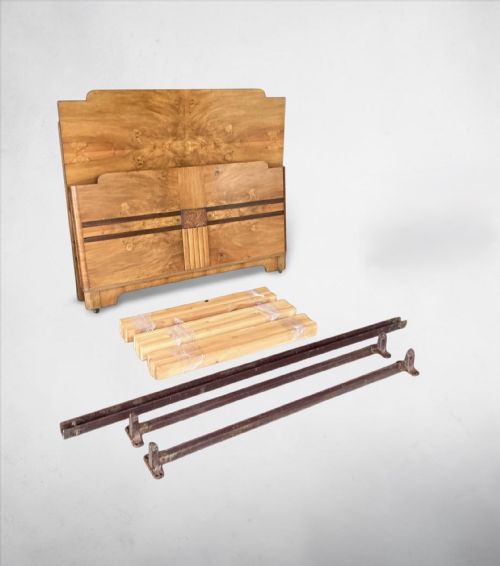


1930s Walnut Double Bed
A 1930s walnut double bed anchors a bedroom with sweeping veneers and architectural curves, bringing the bold optimism of the interwar period straight to the sleeping space.
1930s Walnut Double Bed
A 1930s walnut double bed is a statement sleeping platform defined by the geometric rigour and curvilinear drama of the Art Deco style. These pieces emerge predominantly from the 1930 period, with occasional examples tracing back into the 1920s.
Buyers encountering this selection will find frames designed with architectural presence, frequently incorporating headboards that scale outward or upward in fan shapes, sunray patterns, or semicircular contours. Some ambitious variants incorporate integral cabinets into the overarching frame structure.
Originating domestically as well as from continental workshops such as France, these beds rely on the visual weight of walnut to assert their presence without requiring excessive carved ornamentation.
Evaluating grain and design
Quality rests heavily on the selection and matching of the veneer. Highly figured burr walnut and book-matched grain arrangements command greater appreciation than plain timber surfaces.
The complexity of the silhouette distinguishes exceptional examples from standard production. Frames featuring fan shapes, sunray layouts, or built-in cabinetry demonstrate higher ambition in design than flat rectangular boards.
Some headboards feature built-in cabinets, ensuring your midnight glass of water stays within arm's reach of the cinema-inspired curves.
The 1930s Walnut Double Bed Glossary
- Burr walnut
- A prized timber harvested from the wart-like growths on walnut trees, yielding intricate swirling grain patterns. It provides a rich, textured surface across large headboards.
- Figured walnut
- Timber exhibiting distinctive natural grain variations that catch the light from different angles. Cabinetmakers deliberately position these boards to create decorative symmetry.
- Veneer
- Thin slices of superior wood applied over a stable secondary timber core. This technique allows makers to display striking grain patterns without exhausting scarce resources.
- Art Deco
- The dominant design movement of the interwar period, characterised by sleek lines, geometric shapes, and streamlined modernism. It governs the visual language of these frames.
- Sunray
- A specific decorative arrangement of veneer slices radiating outward from a central point. The pattern mimics the beams of the sun and defines the headboards of particular pieces.
1930s Walnut Double Bed: Frequently Asked Questions
How do I fit a modern mattress?
Many historical frames were built for dimensions slightly different from standard modern mattress sizes. Careful measurement of the internal wooden rails ensures a proper fit before acquiring bedding.
Adapting modern slats or concealed metal supports inside the original timber frame often provides the necessary adjustment for contemporary comfort.
Are these beds dismantlable?
Most examples separate into distinct components consisting of the headboard, footboard, and side rails. This modular construction facilitates transport through tight doorways and up staircases.
Bolts and iron brackets secure the heavy walnut sections together, requiring straightforward hand tools for assembly and disassembly.
How do I care for walnut veneer?
Maintaining the timber requires protection from direct sunlight and excessive humidity to prevent the thin veneer from drying or lifting. Regular dusting with a soft, dry cloth preserves the polished finish.
Occasional application of appropriate wax feeding helps nourish the wood without building up heavy chemical residues on the surface.
How do I identify an Odeon design?
Odeon-style frames draw inspiration from the streamlined architecture of 1930s cinemas, featuring stepped curves and cascading vertical tiers. These elements pull the eye upward along the central axis of the headboard.
Such pieces frequently integrate matching bedside cabinets directly into the architectural sweep of the bed structure itself.