


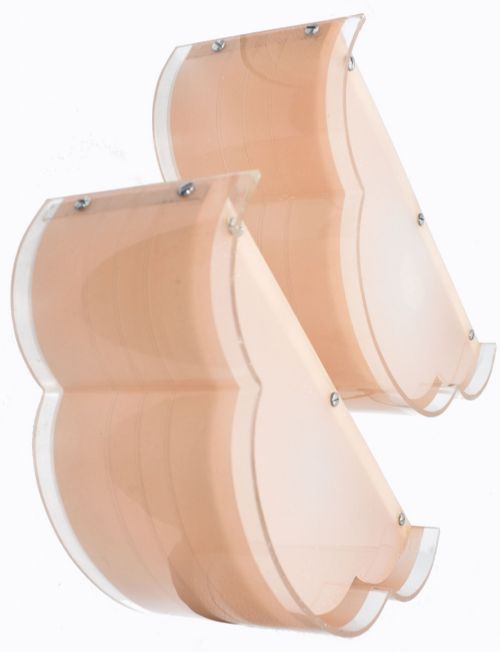
1930s Glass Wall Sconces
These 1930s glass wall sconces deliver direct interior illumination and distinct period design through moulded glass paired with metal mountings.
1930s Glass Wall Sconces
When you search for 1930s glass wall sconces, you encounter wall lights, lighting, wall sconces and girandoles designed in Art Deco and French Art Deco styles. These pieces mount directly to vertical surfaces to provide functional illumination and decorative presence in a room.
You meet pairs, suites and individual fixtures originating predominantly from the 1930 period, alongside examples dated to the 1920s and Edwardian eras. Common forms span trumpet, clam shell, cloud, skyscraper, flame and tubular profiles that utilise prominent glass elements.
The materials combine structural metalwork with substantial glass shades. You find chrome, chrome plating, brass, bronze, metal, resin, Lucite, Bakelite and catalin paired with frosted, pink mirror and clear glass components.
How they were made
The construction relies on combining formed glass shades with rigid metal armatures or backplates. Makers utilised chrome plating, brass, bronze and silvered wood to build the supporting frames that secure the glass elements.
Glass production involved moulding and frosting techniques to shape the characteristic cloud, clam shell, flame, skyscraper and trumpet forms. Materials such as Bakelite, catalin and Lucite also appear in mountings and structural details alongside traditional glass and metal.
The inventory records pieces from the Edwardian era through the 1920s and 1930s.
What varies in quality
Quality rests upon the weight and sculptural depth of the moulded glass shades and the finish of the metal mountings. Pieces featuring heavy frosted glass and refined chrome plating or cast bronze display greater substance.
Design execution distinguishes standard production from notable works associated with specific makers. Cohesion in matched pairs and suites indicates careful original pairing of the glass shades and metal backplates.
Baccarat·Lalique
The 1930s Glass Wall Sconces Glossary
- Sconce
- A wall-mounted light fixture designed to hold bulbs or candles and direct illumination outward into a space. These pieces attach directly to wall surfaces via a backplate.
- Girandole
- An ornamental bracket wall light featuring multiple branches, often incorporating mirrors to reflect and amplify the illumination. They frequently combine carved frames with glass components.
- Art Deco
- A design style spanning the 1920s and 1930s characterised by stylised motifs, geometric symmetry and streamlined forms. It dominates the architecture of these lighting fixtures.
- Bakelite
- An early form of synthetic plastic used for electrical components and decorative mounts during the period. It provides a durable, smooth finish in structural elements.
- Frosted glass
- Glass treated by acid-etching or sandblasting to create a textured, translucent surface that diffuses light softly. It remains a primary medium for the shades in these wall lights.
1930s Glass Wall Sconces: Frequently Asked Questions
What styles define 1930s lighting?
Art Deco and French Art Deco dominate the aesthetic, featuring geometric lines, symmetrical forms and stylised motifs. Designers embraced modern industrial materials alongside traditional glass and bronze.
Profiles range from stepped skyscraper designs to organic cloud and flame shapes. This variety reflects the era's transition toward streamlined modernity.
Are these fixtures sold in pairs?
Many listings comprise matched pairs or larger sets intended for coordinated installation across a room. Single fixtures also appear alongside multi-branch girandoles and larger suites.
Checking the specific listing details confirms whether the pieces comprise matching sets or individual wall lights.
What materials are used in the frames?
Metal mountings predominantly utilise chrome plating, brass, bronze and standard metal alloys. Synthetic materials such as Bakelite, catalin, Lucite and resin also support the glass shades.
Carved silvered wood appears on specific decorative wall fixtures like girandoles. These diverse materials provide structural stability and distinct period character.