




1930s Glass Dressing Bottle
These 1930s glass dressing bottles bring geometric Art Deco style and vibrant colour to a vanity table.
1930s Glass Dressing Bottle
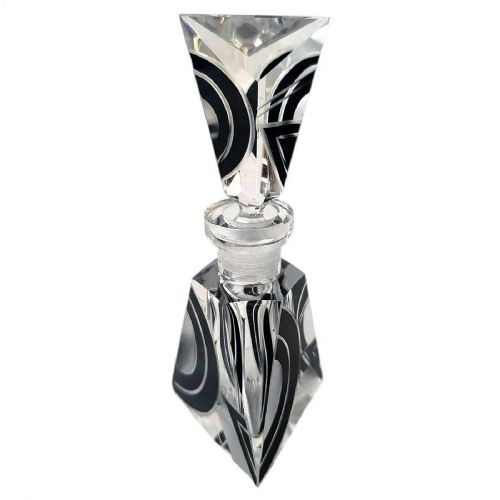
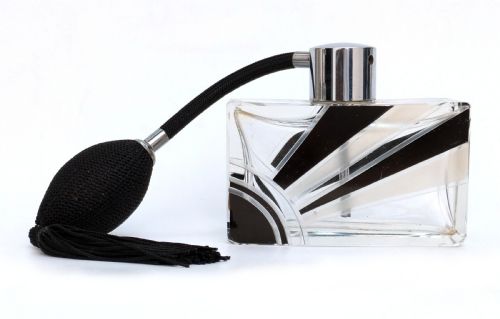
A 1930s glass dressing bottle serves as a decorative container for scent, perfume, or cosmetic preparations. Most examples found here take the form of perfume bottles, scent bottles, and perfume atomisers shaped in the Art Deco style.
The objects originate primarily from the 1930 and 1920 periods, often hailing from makers and workshops in the Czech Republic and London. Buyers frequently encounter variants featuring geometric cuts, globe shapes, and matching powder boxes.
Vessels designed for the dressing table range from tall lidded jars to large crystal atomisers on stands. Coloured glass in shades of blue and green appears alongside clear crystal and cut glass.
Materials and construction
Manufacturers combined glass and crystal with sterling silver mounts, enamel, and chrome to create these vanity items. Cut glass and crystal bodies received geometric surface patterns that reflected the light.
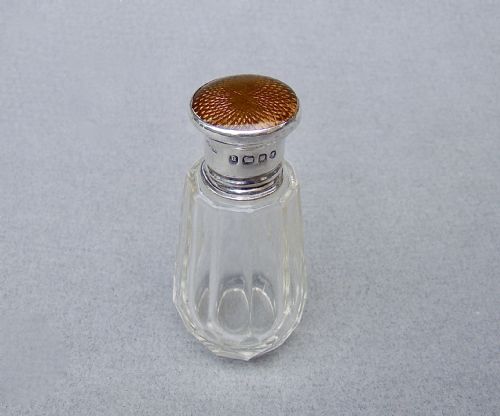
Silver components were frequently worked with guilloche enamel, adding coloured bands and decorative panels to the shoulders and stoppers. Some pieces incorporate fabric elements and gold leaf details to enhance the decorative finish.
Many of these bottles survived decades of vanity table service, likely having witnessed countless applications of vintage face powder and evening scent.
Factors of quality
Quality separates standard production wares from masterworks through the precision of the glass cutting and the complexity of the enamel work. Deep geometric facets and heavy crystal bodies indicate superior production standards.
Attribution to known designers and silversmiths elevates the status of a piece, particularly when combined with intact guilloche enamel panels and solid silver collars. The integration of complex atomiser mechanisms on stands also distinguishes finer examples.
Henry Perkins·Karl Palda·Rudolf Hlousek·Hermanova·Goldsmith's and Silversmith's Co.
The 1930s Glass Dressing Bottle Glossary
- Atomiser
- A spray mechanism fitted to a perfume bottle for dispersing scent in a fine mist. These often feature rubber bulbs and metal hardware mounted directly onto the glass body.
- Guilloche enamel
- A decorative technique where an underlying metal surface is machined with repetitive patterns and coated with translucent enamel. This finish frequently appears on the silver caps of dressing bottles.
- Vanity jar
- A lidded container used on a dressing table for holding creams, powders, or small trinkets. They share the cut glass and silver-topped construction style of scent bottles.
- Crystal
- A type of glass containing lead oxide that increases weight, brilliance, and clarity. It allows for deeper and sharper geometric cutting.
- Sterling silver
- An alloy of silver containing ninety-two point five percent pure silver and seven point five percent other metals. It is the primary metal used for the bottle collars and lids.
1930s Glass Dressing Bottle: Frequently Asked Questions
How do I identify an Art Deco scent bottle?
Art Deco scent bottles are distinguished by their geometric shapes, clean lines, and symmetrical patterns cut into the glass. They frequently utilise contrasting materials such as silver, enamel, and chrome alongside coloured glass.
Porter marks, maker signatures, and hallmarks on the silver mounts often help confirm the period of manufacture.
How were perfume atomisers used?
Perfume atomisers were used to spray liquid fragrance evenly over the skin or clothing by pressing a flexible bulb attached to a metal tube. The internal mechanism draws the liquid up from the glass reservoir and converts it into a fine mist.
They formed an essential part of the modern dressing table set during the early twentieth century.
Where were Czech glass bottles made?
Czech glass bottles from this era were produced in the Bohemia region, known for its long tradition of glassmaking. Local glassworks and designers created innovative pressed, cut, and coloured glass pieces for export.
Works by prominent Czech designers often feature distinctive geometric profiling and vibrant glass colours.