
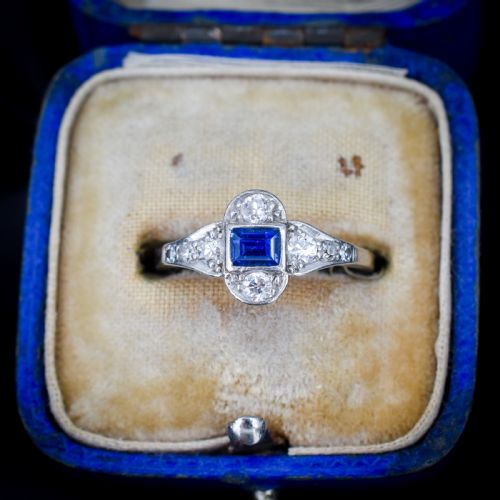


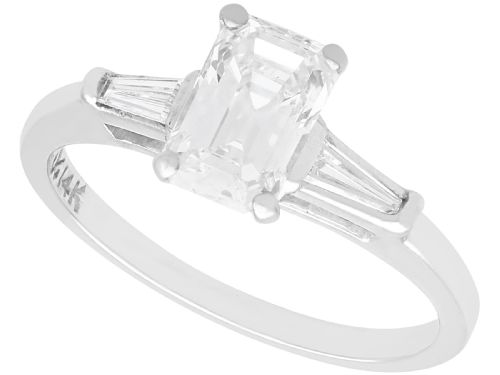


1930s Emerald Engagement Ring
A 1930s emerald engagement ring brings genuine Art Deco geometry and rich green colour to the finger.
1930s Emerald Engagement Ring
A 1930s emerald engagement ring sits firmly in the Art Deco period, defined by clean architectural lines and sharp geometric stone settings. These pieces showcase deep green emeralds flanked by brilliant diamonds in cluster, dress, solitaire and trilogy formations.
The selections available here span the 1920s and 1930s, capturing French and international jewellery design from the height of the Art Deco movement. Most examples pair emerald centre stones with platinum mounts, though occasional white gold and yellow gold variants appear.
How they were made
Platinum serves as the primary metal framework for these rings, valued for its strength in holding intricate gemstone arrangements without bulky prongs. Goldsmiths utilised this robust white metal alongside 14ct white gold and 18ct gold to create low-profile settings.
Master cutters shaped emeralds into distinct emerald cuts alongside traditional facets to maximise light play within tight geometric borders. Diamonds surround these central greens in careful cluster formations, secured by fine millegrain edges characteristic of the decade.
What varies in quality
The calibre of a 1930s emerald engagement ring depends heavily on the origin and treatment profile of the central green beryl, with Colombian stones holding particular renown. Stone weight, clarity grades and the presence of minor oil enhancements distinguish standard dress pieces from exceptional collector items.
Execution of the platinum metalwork dictates overall refinement, separating mass production from bespoke artisan craft. The balance between diamond carat weight and the central emerald determines visual harmony across solitaire, trilogy and cluster configurations.
The 1930s Emerald Engagement Ring Glossary
- Art Deco
- A design style from the 1920s and 1930s characterised by symmetry, geometric motifs and stylised linear forms. It replaced the flowing curves of Edwardian and Art Nouveau jewellery.
- Millegrain
- A decorative technique featuring a row of tiny raised metal beads along the edges of a setting. This subtle detail softens sharp platinum boundaries and frames the gemstones.
- Trilogue
- A ring style featuring three principal stones, typically a central emerald flanked by two matching diamonds. This formation symbolises past, present and future.
- Solitaire
- A ring featuring a single prominent gemstone set alone on the band. In these listings, emerald or diamond solitaires showcase individual stone quality without distraction.
- Cluster ring
- A setting style where smaller accent stones encircle a larger central gem. This arrangement maximises overall sparkle and presence on the hand.
1930s Emerald Engagement Ring: Frequently Asked Questions
Are these rings suitable for daily wear?
Platinum and gold mountings from this era provide robust daily support, though emeralds require thoughtful care due to their natural inclusions.
Removing the ring during manual tasks protects both the central green beryl and the surrounding diamond melee from sharp impacts.
How do I identify a 1930s ring?
Look for distinct geometric motifs, platinum construction and specific gemstone cuts that typify the Art Deco aesthetic.
Hand-finished millegrain details and low-profile cluster or trilogy arrangements further distinguish pieces from this specific decade.
What stone origins matter most?
Colombian origins command significant attention among collectors due to their deep saturation and historical prestige.
Zambian and other certified origins also appear, each bringing distinct hues and clarity characteristics to the finger.
Can these rings be resized?
Most platinum and gold bands allow for careful adjustment by a specialist jeweller familiar with antique mountings.
Intricate side gallery work or millegrain edges require expert handling to preserve the original geometry during sizing.