


1930s Dress Clips
These 1930s dress clips offer the geometric flair and versatility collectors seek, spanning clever convertible brooches and sleek modernist forms.
1930s Dress Clips
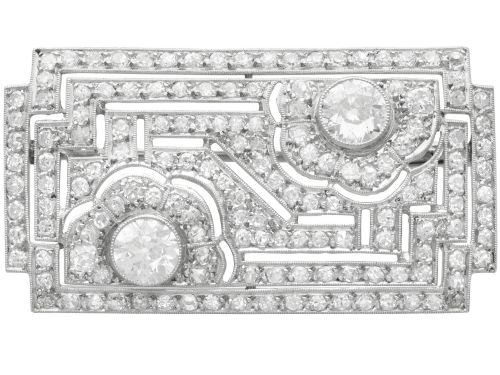
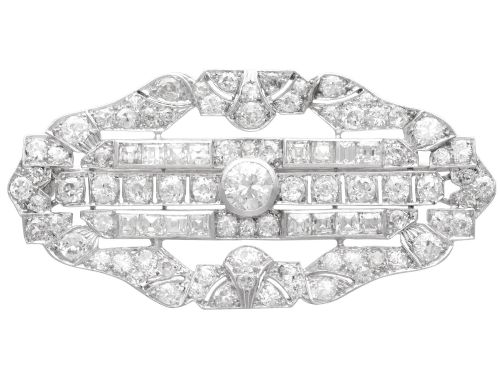
When you search for 1930s dress clips, you encounter versatile ornaments designed to adorn necklines, lapels, and hat bands, often separating into twin fur clips or matching brooches. The selections here include brilliant platinum diamond mountings, silver filigree pieces, and colourful Galalith or celluloid novelties.
Art Deco styling dominates these objects, bringing sharp symmetry and French or Swedish provenance to the surface. You will also find Chinese export examples featuring enamel butterflies alongside European paste and marcasite designs.
How they were made
Maker workshops utilised platinum and silver as foundations for fine gemstone settings, mounting diamonds, sapphires, and yellow sapphires into intricate geometric frames. Other pieces rely on base metal, silver plating, and glass paste to achieve high-contrast glamour without precious stones.
Modernist production introduced alternative materials like Galalith and celluloid, shaped into striking geometric blocks characteristic of the period. Filigree techniques and enamel work also feature in the metal-based items seen across the inventory.
A cheerful enamel butterfly brooch flutters into the selection directly from Chinese export workshops.
What varies in quality
Quality rests on the integrity of the mechanical clips and the precision of the metalwork, whether executed in platinum, silver, or plated base metal. Signed French workshops and documented modernist designers command attention through superior stone grading and structural engineering.
The choice of materials dictates the tier of the piece, moving from moulded celluloid and Galalith novelties up to multi-carat diamond and sapphire platinum mountings. The crispness of the Art Deco geometry and the security of the clasp mechanisms ultimately separate standard production from exceptional examples.
Jakob Bengel·Paillette
The 1930s Dress Clips Glossary
- Dress clip
- An ornamental clip with a serrated double-prong mechanism on the reverse designed to grip thick fabrics without pinning. They often attach to a separate frame to function as a solid brooch.
- Duette
- A patented double-clip frame holding two matching dress clips that lock together to form a single brooch. This ingenious mechanism defined 1930s convertible jewellery.
- Galalith
- A semi-synthetic plastic derived from casein and formaldehyde, widely utilised in the 1930s for colourful Modernist dress clips and bangles. It takes a high polish and rich hues.
- Marcasite
- Small faceted crystals of iron pyrite set tightly into silver mounts to provide a dark, metallic sparkle resembling diamond chips. It served as a popular affordable accent in Art Deco pieces.
- Paste
- Hand-cut and polished lead glass used to imitate diamonds and coloured gemstones in period jewellery. High-quality paste displays sharp facets and brilliant light reflection.
1930s Dress Clips: Frequently Asked Questions
How do dress clips attach to clothing?
Dress clips employ a hinged double-prong mechanism on the reverse that snaps firmly shut over a folded edge of fabric. This grips heavy wools or silks securely without piercing delicate threads.
Collectors often wear them on lapels, necklines, or the brims of hats, splitting a double clip set into two symmetric accents.
What is a Duette brooch?
A Duette is a patented frame that holds two matching dress clips side by side to form a unified brooch. When removed from the frame, the clips function independently.
This clever engineering allowed 1930s wearers to transform a single central lapel ornament into a pair of matching dress or fur clips.
How can I identify Art Deco style?
Art Deco pieces rely on clean geometric lines, symmetry, and stylised motifs rather than flowing organic curves. You will spot chevrons, steps, fans, and sharp rectangular gemstone cuts.
In 1930s jewellery, this aesthetic pairs white metals like platinum and silver with high-contrast black enamel or bright gemstones.
Are Galalith clips fragile?
Galalith is a stable casein-based plastic from the early twentieth century, but it can swell or crack if exposed to prolonged moisture or harsh chemicals. You should keep these pieces away from water and perfume.
Gentle dry cleaning with a soft cloth preserves the smooth finish and vibrant colour of modernist plastic items.