






1920s Woven Kilim
These 1920s woven kilim pieces bring tactile history and bold geometric patterns straight to the floor.
1920s Woven Kilim
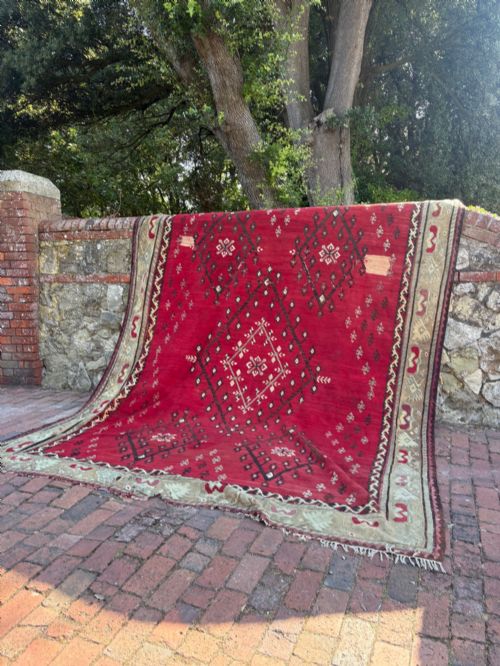
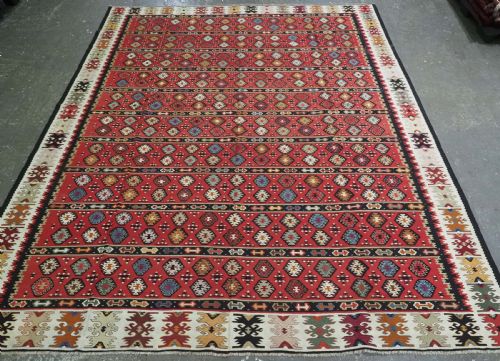
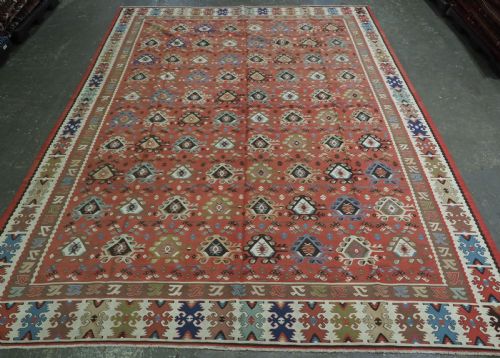
When searching for a 1920s woven kilim, a buyer encounters flatwoven textiles originating from various tribal and regional traditions. The selection spans distinct styles such as Pirot, Sarkoy, Baluch, Anatolian, and Senneh work.
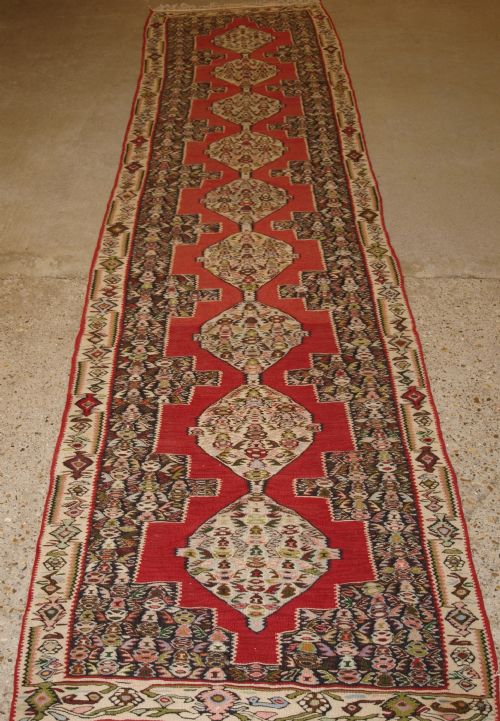
You are most likely to meet large room-size examples alongside smaller formats and runner rugs. These pieces showcase banded, chevron, lattice, flowering tree, and repeat medallion designs.
Originating from Turkish, Persian, and Balkan traditions, these flatweaves serve as versatile floor coverings that bring authentic period character into modern interiors.
Materials and construction
These textiles rely on wool and cotton as primary structural materials, interlocked and woven by hand without a knotted pile. This flatweave technique produces a lightweight, reversible fabric with crisp graphic boundaries.
Certain large formats are constructed by weaving the textile in two separate parts and joining them together down the centre. This method allowed makers to achieve generous room dimensions on standard looms.
Some weavers cleverly hid tiny geometric signatures within rows of chevrons, leaving silent messages beneath your feet.
What separates the best examples
Quality rests in the precision of the flatweave structure and the condition of the material over time. Examples that retain strong structural integrity and clean pattern alignment stand apart.
Colour depth and palette harmony also dictate distinction, with soft pastels and warm tones adding visual weight. The complexity of traditional motifs, from detailed lattices to flowering trees, reflects the weaver's skill.
The 1920s Woven Kilim Glossary
- Kilim
- A flatwoven carpet or rug produced without a pile by tightly interweaving warp and weft strands. This technique creates a smooth surface with patterns visible on both sides.
- Flatweave
- A textile constructed by interlacing horizontal and vertical threads rather than knotting yarn to a foundation. It results in a thin, flexible rug well suited for layering.
- Pirot
- A traditional style of kilim associated with a specific Balkan weaving centre renowned for geometric precision. These pieces often feature intricate repeat and floral motifs.
- Sarkoy
- A regional designation for flatweaves originating from the European territories of the Ottoman Empire. They frequently display large-scale repeat designs and distinctive colour palettes.
- Chevron
- A V-shaped pattern repeated in horizontal bands across the body of the textile. This geometric arrangement is typical of tribal and nomadic weaving traditions.
1920s Woven Kilim: Frequently Asked Questions
How do I clean a kilim?
Regular gentle vacuuming without a beater bar removes surface dust and grit from the flatweave structure.
Professional specialist cleaning is recommended for deep refreshing to protect the wool fibres.
Can I use a kilim as a runner?
Certain specific examples are woven in long, narrow formats explicitly suited for hallways and corridors.
A quality underlay keeps the flat textile secure and prevents sliding on smooth floors.
Where were these rugs made?
The pieces originate from diverse weaving regions including Anatolia, Persia, and the Balkan traditional areas.
Each geographic origin imparts distinct design motifs, colour combinations, and structural habits.
Why are some kilims in two parts?
Large room-size textiles were sometimes woven in two separate longitudinal strips and joined together.
This traditional practice enabled weavers to produce wide floor coverings on narrower village looms.